49 works in this view — arrow keys or swipe to move between them.
Dance in Art
Shiva and Parvati
Brahma, Dhirendranath
- Collection:
- Painting
- Source:
- Victoria and Albert Museum
- Rights:
- Rights vary by item — check the source record before reusing this image. Source record ↗
- Recorded as:
- V&A — check rights per item
The work documents a crucial moment in South Asian modernism when artists deliberately recovered and reinterpreted classical and sacred dance narratives. For dance historians, it shows how Shiva and Parvati—figures central to classical South Asian dance theory and practice—continued to inspire artistic reflection long after those classical traditions had been suppressed or marginalized by colonial authority. The expressionist technique signals that the dance itself is understood as an inner, spiritual reality rather than an external spectacle.
What you are looking at
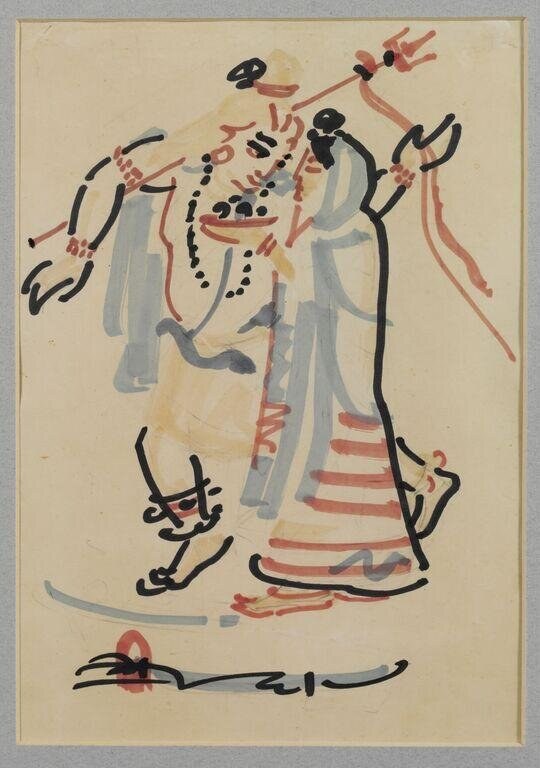
A dynamic composition rendered in bold black line and washes of blue-grey and red-ochre, depicting two figures in what appears to be a moment of ecstatic movement or divine play. The central figure wears a long skirt with horizontal red stripes and a pale upper garment, arms raised and gestures expansive. A second figure, similarly dressed, moves in counterpoint. Above them float two smaller heads rendered in black outline, possibly indicating celestial or spiritual presences. The setting is ambiguous—not a stage or courtyard but a kind of spiritual or imaginative space. The technique is economical and expressionistic: the artist has used minimal line to suggest the turn of torsos, the lift of limbs, and the rhythmic energy of the bodies in motion. Red ribbons or scarves seem to stream from the figures, adding to the sense of swirl and elevation.
The dancing
Two adult figures dominate, both with bodies rendered in loose, gestural outline. The figure on the left leans forward with arms raised and curved, suggesting a moment of surrender or invocation. The figure on the right mirrors this in reverse, weight shifted, arms extended. Both wear draped garments falling from the waist. The positioning suggests a synchronized or responsive duet rather than individual solos—each figure answers the other. Two schematic heads float above, outlined in black, possibly representing onlookers, celestial witnesses, or the spiritual dimension of the dance itself.
The dance depicted
The title identifies the subject as Shiva and Parvati, the Hindu god and goddess, whose divine play (lila) and cosmic dance are foundational to Hindu philosophy and devotional practice. The image suggests Shiva Tandava (the cosmic dance) or Lasya (the gentle, feminine counterpart), both central metaphors in South Asian sacred dance traditions including Kathak, Bharatanatyam, and Odissi. The composition reads as a moment of mutual invocation or ecstatic union, rendered not as literal classical dance vocabulary but as spiritual energy made visible. The artist has chosen to emphasize the inward, transcendent quality of the moment rather than technical precision.
How it was made
Watercolor or gouache on paper, rendered in economical line and color wash. The black contour lines are drawn with quick, assured strokes; the color—blue-grey for the draped garments, red for the striped skirt and the ribbon-like forms—is applied as flat or semi-transparent washes, never carefully modeled. This technique is characteristic of modernist South Asian art of the 1940s–50s, influenced by both European avant-garde practices and a deliberate turn toward indigenous spiritual and aesthetic vocabularies. The style privileges expressive gesture and symbolic clarity over illusionistic representation.
About this work
This is a modernist interpretation of a sacred Hindu dyad, painted in 1950 by an Indian artist working in a style that synthesizes European expressionism with South Asian iconographic and spiritual content. The work treats the dance of Shiva and Parvati not as a narrative or illustrative moment but as a vehicle for representing divine play and cosmic balance. It belongs to a mid-twentieth-century movement in South Asian art that drew on classical and devotional themes as a means of asserting cultural continuity and spiritual value in the face of colonialism and rapid social change. The painting demonstrates how classical dance narratives persisted in visual culture not as antiquarian references but as living symbols of transcendence and union.
How to look at it
Notice how the artist has abandoned realistic proportion and anatomical detail in favor of expressive line and symbolic gesture. The raised arms and turned torsos of the two figures are not naturalistic—they suggest movement and energy rather than depicting actual bodily positions. The floating heads above read as an addition to the spiritual or imaginative register of the scene, not as literal pictorial space. The red ribbons or scarves that stream upward have no clear physical source but serve a symbolic or emotional function, suggesting the ecstatic or transcendent quality of the moment. This is modernist spiritual art, using the language of the avant-garde to represent states of consciousness rather than observable action.
The artist
Dhirendranath Brahma (1888–1950) was a pioneering modernist painter associated with the Bengal School and later developments in Indian art. He worked at a time when Indian artists were actively reasserting indigenous aesthetic values and subject matter against colonial cultural hierarchies. His practice combined Cubist and Expressionist formal innovations with Hindu and Buddhist iconography, creating a visual language suited to post-independence Indian identity. His death in 1950, the year this work was painted, marks the end of a generational effort to forge a modern Indian art rooted in classical and spiritual traditions.
The period
This work was created in 1950, the year India adopted its Constitution and began the project of building a secular, pluralist nation-state. In the arts, this was a moment of intense negotiation between modernism (abstraction, expressionism, formal innovation) and cultural nationalism (the recovery of classical and folk traditions as sources of authentic Indian identity). In dance, the period saw the revitalization of Bharatanatyam and other classical forms, which had been suppressed during the colonial era but were now reclaimed as national cultural heritage. Paintings like this one participated in that larger cultural reassertion by treating classical narratives and deities as living sources of meaning rather than historical relics.
Where it lives
The work is held in a collection identified in the catalogue record only as 'va' (possibly an archive or museum code not fully expanded in the available metadata). It is catalogued as a painting, though the medium is not formally recorded; the visual evidence suggests watercolor or gouache on paper.
Dance in this work
Questions about this work
Who are Shiva and Parvati?
In Hindu philosophy and mythology, Shiva is the god of asceticism, yoga, and cosmic destruction-and-renewal; Parvati is his consort, goddess of fertility and devotion. Their relationship and their dance together are foundational metaphors in classical Indian dance, philosophy, and poetry. The dance of Shiva, known as Tandava, represents the cosmos itself in motion. Lasya, the gentle dance, is associated with Parvati and represents love, grace, and the feminine principle.
What is the connection between this painting and classical Indian dance?
The figure of Shiva as the cosmic dancer is central to Bharatanatyam, Odissi, Kathak, and other South Asian classical dance traditions. The dancer embodies Shiva's energy and spiritual realization. This painting does not depict actual dance movement or technique, but uses the archetypal image of Shiva and Parvati in motion as a symbol of transcendence and divine play. The artist treats classical dance not as a subject for illustration but as a source of spiritual meaning.
Why does the painting use such simplified, expressive style?
This is characteristic of early-to-mid twentieth-century modernist art in Asia, which often synthesized European avant-garde techniques (expressionism, abstraction) with non-Western spiritual and cultural content. The simplified forms and bold colors allow the artist to convey inner states and symbolic meaning rather than surface appearance. For a sacred subject, this directness and spiritual intensity was seen as more appropriate than naturalistic representation.
What does the date 1950 tell us about the work?
1950 was India's first year as an independent nation and marks a major cultural turning point. Artists like Brahma were engaged in recovering and modernizing classical Indian artistic traditions as part of building a post-colonial national culture. This work participates in that project: it treats a classical Hindu narrative as a living spiritual resource for contemporary art.
More dance artwork





