49 works in this view — arrow keys or swipe to move between them.
Dance in Art
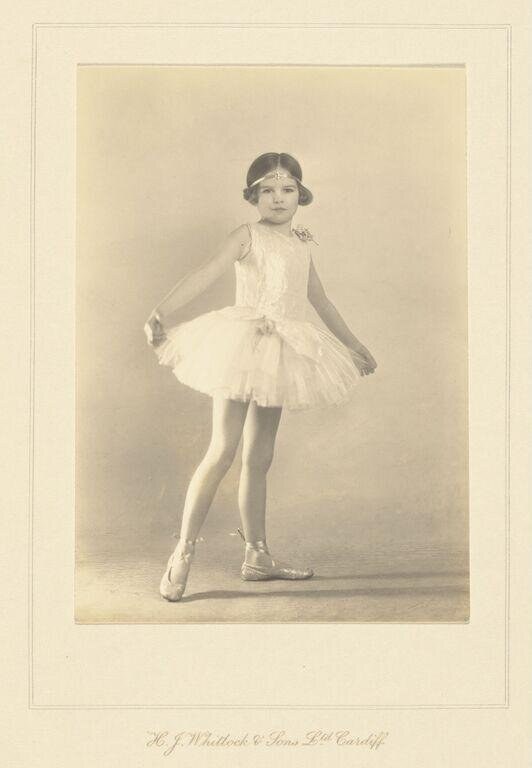
Portrait of a Child Ballerina
H.J. Whitlock & Sons, Ltd.
- Collection:
- Photograph
- Source:
- Victoria and Albert Museum
- Rights:
- Rights vary by item — check the source record before reusing this image. Source record ↗
- Recorded as:
- V&A — check rights per item
This photograph offers evidence of how ballet training and performance extended beyond London and the major theaters to provincial cities in Wales in the early twentieth century. It shows the professionalization of dance in Britain through the lens of commercial photography, and the role of studio portraiture in documenting and promoting young performers.
What you are looking at
A young girl in ballet dress stands alone against a plain, pale background in a formal studio portrait. She wears a white sleeveless tunic with a modest neckline and a short, pleated skirt of classical ballet cut, with white tights and ballet pointe shoes. Her dark hair is styled in a close-fitting cap or headband typical of early twentieth-century fashion. She stands in a composed, modest pose with one arm extended and the other at her side, her weight distributed evenly on both feet. The lighting is even and shadowless, characteristic of studio photography of the period, and the composition places her slightly off-center in the frame, a convention of portraiture that emphasizes the sitter's poise and professionalism.
The dancing
The child stands in a neutral, upright posture rather than a dynamic arabesque or extension. Her arms are relaxed and relatively low; the extended arm suggests a gentle port de bras but not the high, ethereal port de bras of Romantic ballet. Her feet appear to be in a modest closed position rather than a pronounced turnout or extended leg line. The overall impression is of a young student or performer at rest, posed for the camera rather than captured mid-movement. There is no dramatic extension, no lifted chest, no suggestion of flight or strain.
The dance depicted
This is a portrait of a child ballerina, likely dating to the early twentieth century based on the dress, hairstyle, and photographic technique. The tutu and pointe shoes identify her as trained in ballet, but the modest costume and restrained pose suggest she may have been a student or very young performer rather than a principal dancer. The absence of any dynamic movement or extended line is notable—this is documentation of a performer's professional identity rather than an attempt to capture the drama or physicality of ballet itself. The photograph serves as a studio portrait or promotional image, possibly part of a dance academy's documentation or a performer's publicity.
How it was made
This is a gelatin silver or albumen print photograph, as indicated by the tonal range and the printing technique characteristic of early twentieth-century commercial portraiture. The image has been mounted on a card with a printed credit line at the base reading 'H.J Whitlock & Sons Ltd Cardiff', identifying it as the work of a professional photographic studio. The even lighting, neutral background, and careful composition reflect the conventions and technical capabilities of studio portraiture of the period. Such mounted photographic prints were standard promotional and documentary tools for dancers and were distributed to theaters, academies, and patrons.
About this work
This is a studio portrait photograph of a young child in classical ballet costume, professionally produced by H.J. Whitlock & Sons in Cardiff, likely in the early twentieth century. It documents a moment in the history of ballet training and promotion when photography became the standard medium for recording and publicizing performers. The modest, composed pose and careful studio framing tell us as much about photographic conventions and the social role of the child performer as they do about ballet technique itself. The work sits at the intersection of dance documentation, commercial portraiture, and the emergence of ballet as a popular and accessible form of entertainment in the British provinces.
How to look at it
Notice the restraint in the pose: the child is not extended, not leaping, not captured in the moment of a dramatic movement. This reflects the conventions of early twentieth-century portrait photography, which favored composed, dignified stillness over dynamic movement. The pointe shoes and tutu are the markers of identity; the pose itself is about presenting the child as a trained professional. The plain background and even lighting keep all attention on the figure, a technique that emphasizes the costume and the sitter's bearing rather than any spatial or narrative context.
The artist
H.J. Whitlock & Sons, Ltd. was a professional photography studio based in Cardiff, Wales. The studio specialized in commercial portraiture and was one of many such operations that served the theatrical, musical, and dance professions in Britain during the late nineteenth and early twentieth centuries. Studios of this kind were essential to the promotion and documentation of performers and maintained archives of performers' portraits for distribution to theaters, newspapers, and the public.
The period
This photograph dates to an era when ballet was undergoing a significant transformation in Britain. The Russian Imperial Ballet's tours in the early 1900s had energized British interest in ballet, leading to increased training and performance activity outside London. At the same time, photography had become both cheaper and more widely accessible, making it the standard medium for documenting and promoting performers. Child dancers were a common sight in both music halls and in the growing network of private dance schools, and their photographs served both as training documentation and as tools for attracting audiences and students.
Where it lives
This photograph is held in a collection marked 'va', likely indicating a British regional archive or museum collection. It is a mounted gelatin silver or albumen print with the photographer's credit line printed at the base, a standard format for professional studio portraiture of the period.
Dance in this work
Questions about this work
Is this a famous ballet dancer?
The catalogue record does not identify the child by name. The photograph is a professional studio portrait by H.J. Whitlock & Sons Ltd of Cardiff, but without additional documentation, we cannot determine whether this was a celebrated performer, a student, or a local child dancer. The formal, professional framing suggests she had some status or accomplishment worth documenting.
When was this photograph taken?
The catalogue record does not give a date, but the style of the child's hair, the cut of the tutu, the photographic technique, and the printing method all suggest the early twentieth century, roughly 1900–1920. The Art Nouveau or early Edwardian aesthetic is consistent with this period.
What school or company was she with?
The photograph does not indicate a school or company affiliation. It is a commercial studio portrait, and such images were often produced independently for promotional use, for academies, or for personal keeping. Without additional archival context, her training and performance history cannot be established from the image alone.
Why is she not in a dramatic pose?
Early twentieth-century portrait photography valued composed, dignified stillness, especially for children. Dynamic movement was difficult to photograph clearly, and a restrained pose was seen as more respectable and professional. The tutu and pointe shoes are sufficient to identify her as a ballet dancer; the pose itself communicates formality and training rather than the drama of performance.
More dance artwork





