49 works in this view — arrow keys or swipe to move between them.
Dance in Art
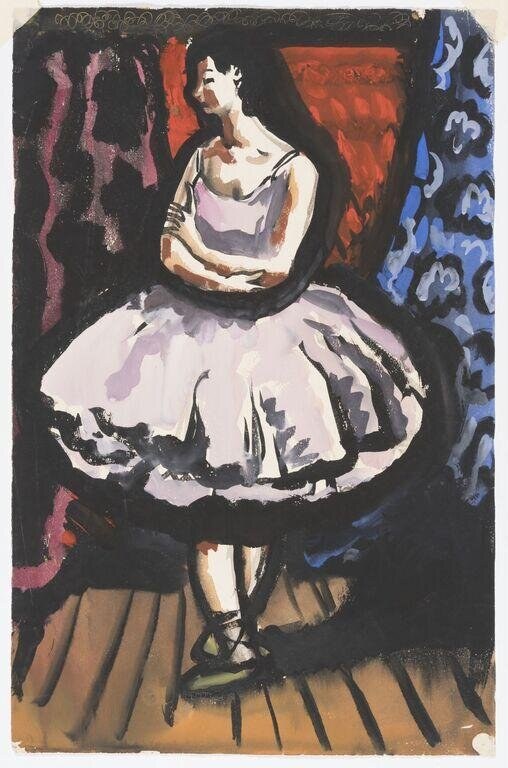
Figure study of a ballerina
Peake, Mervyn Laurence
- Collection:
- Watercolour
- Source:
- Victoria and Albert Museum
- Rights:
- Rights vary by item — check the source record before reusing this image. Source record ↗
- Recorded as:
- V&A — check rights per item
For dance historians and performers, this work is valuable as evidence of how theatrical dancers of the 1930s were seen and understood by visual artists outside the dance world. It shows the ballet dancer not as an icon of beauty or technique but as a working person—focused, gathered, and introspective. The artist's choice to depict stillness rather than movement offers a counterpoint to more conventional dance imagery.
What you are looking at
A solitary ballerina occupies the center of this composition, posed in a moment of stillness or preparation rather than active movement. She wears a pale lavender tutu with a fitted bodice and pale tights, set against a dramatically dark background of blacks, purples, and deep blues. The figure is rendered in soft watercolor washes, with the tutu's volume defined by delicate shading and darker accents along the folds. Warm ochre and tan tones suggest a wooden stage floor beneath her feet. The composition is intimate and introspective—the dancer is seen at roughly three-quarter length, her gaze lowered and her posture gathered rather than extended. Splashes of color—red, blue, and purple marks—surround her in the background, creating a sense of energy or atmospheric turbulence that contrasts with the dancer's composed, inward demeanor. The work has the quality of a preliminary study or rehearsal moment captured in passing.
The dancing
The dancer stands with her weight evenly distributed, her arms held close to her body in a collected position rather than in an extended line. Her torso is upright but not rigid; the shoulders are relaxed and drawn slightly forward. The tutu falls naturally around her hips and thighs, suggesting she is standing still rather than executing a specific step. Her head is bowed slightly, with an expression of concentration or quietude. There is a single figure present, and the artist's focus is entirely on capturing the dancer's physical presence and inner state rather than the dynamics of movement.
The dance depicted
This is a study of a classical ballet dancer, almost certainly trained in the Romantic or early twentieth-century tradition given the tutu style and academic bearing. The pose itself—neither a fully extended position nor an active step—suggests a moment between movements, perhaps during class or in the wings before entrance. The artist has chosen to depict the dancer in a state of preparation or introspection rather than in virtuosic display, which was a deliberate choice. The work captures something of the dancer's physical reality: the modest, gathered quality of the body at rest, the weight and presence of the tutu, and the mental focus required even in stillness.
How it was made
This is a watercolor on paper, a medium evident from the translucency of the washes, the way color blooms and mingles, and the visible white paper left as highlights on the face and tutu. Watercolor allowed the artist to work quickly and capture the figure with economy and freshness—the soft gradations of the tutu, the gestural marks in the background. The dark wet background was likely laid down first, allowing the paler figure to emerge by reserve (leaving paper unpainted) and by the application of opaque or semi-opaque pigment. This technique of dramatic tonal contrast and loose gestural marks in the background is characteristic of early twentieth-century figure study practice, when watercolor was widely used for theatrical and dance subjects.
About this work
This is a figure study of a ballerina by Mervyn Peake, dated 1938. It belongs to a tradition of theatrical and backstage observation—the artist documenting the dancer not in performance but in a private moment of preparation or pause. Peake was a visual artist and writer with a keen interest in the physical life of the theatre; this work exemplifies his approach to capturing character and presence through economical, expressive means. The watercolor is neither a formal portrait nor a record of a specific performance; it is a study of the body, the costume, and the psychological state of a dancer at work.
How to look at it
Look first at the ballerina's face and the position of her gaze—the downward look gives the figure a quality of introspection or concentration that is unusual in dance imagery, which often emphasizes spectacle. Notice the way the tutu is rendered: not as an ideal or ethereal form, but as an actual garment with weight, fold, and volume. The surrounding marks and colors in the background are not incidental decoration but create a sense of the heated, intense atmosphere of rehearsal or performance—the contrast between the dancer's stillness and the energy around her. The watercolor technique itself, with its soft transitions and areas of pooled color, suggests spontaneity and immediacy, as if this were a rapid notation made in the moment rather than a polished formal portrait.
The artist
Mervyn Laurence Peake (1911–1968) was a British writer, illustrator, and painter best known for his novels, especially the Gormenghast trilogy. He was trained as an artist and worked extensively in theatre, designing sets and costumes and creating drawings of theatrical subjects. His visual practice was characterized by expressionist tendencies, vivid color, and a gift for capturing psychological states through physiognomy and gesture. Dance and theatre were lifelong interests; he moved in bohemian London circles where he encountered performers and theatrical life directly.
The period
In the 1930s, ballet in Britain was entering a period of renewal and nationalism. The Sadler's Wells Ballet (later the Royal Ballet) was forming, and there was growing interest in ballet as a living British art form rather than a foreign import. At the same time, modernist artists were increasingly attending dance performances and creating works inspired by dancers and movement. Watercolor figure studies of theatrical subjects were a popular form among British artists of this period, reflecting both the accessibility of the medium and a genuine appetite for capturing the ephemeral world of theatre and performance. Peake's work sits within this context of artistic engagement with dance as a subject worthy of serious visual study.
Where it lives
This work is held in the Victoria and Albert Museum's collection, a major UK repository of theatrical art and design. It came to the museum as part of their acquisitions of twentieth-century theatre and dance-related material.
Dance in this work
Questions about this work
Is this a painting or a drawing?
It is a watercolor, a medium that combines properties of both. The artist used pigment suspended in water applied to paper, creating transparent and semi-transparent washes. Watercolor was a favored medium for quick figure studies and theatrical subjects in the early twentieth century because it allowed for both spontaneity and refinement.
What is the dancer doing?
She is standing still, likely between movements or during a pause in rehearsal or class. The artist was not interested in capturing a leap or a turn, but rather a moment of stillness and gathering—the physical and mental state of a dancer preparing herself.
Why is the background so dark and chaotic?
The dark, energetic marks create contrast and mood. They suggest the intensity of the theatrical or rehearsal space, and by surrounding the figure with visual turbulence, the artist emphasizes the dancer's composed, centered state. It is a way of expressing the internal focus required in dance.
Who was Mervyn Peake?
A major twentieth-century British author and artist, best known for his fantasy novels. He was also a gifted visual artist and spent time in theatre, designing sets and costumes and drawing performers. This work is one of his many explorations of theatrical subjects.
More dance artwork





