49 works in this view — arrow keys or swipe to move between them.
Dance in Art
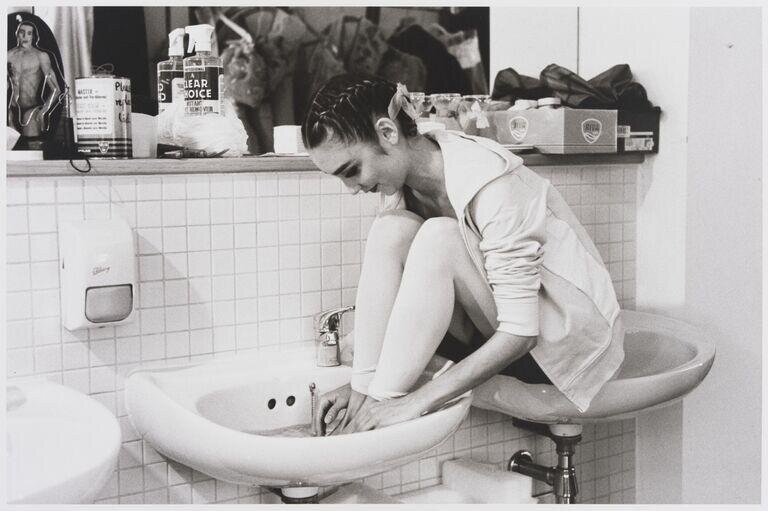
Ballerina in Sink
Mary McCartney
- Collection:
- Photograph
- Source:
- Victoria and Albert Museum
- Rights:
- Rights vary by item — check the source record before reusing this image. Source record ↗
- Recorded as:
- V&A — check rights per item
The work exemplifies late-20th-century artistic practice that rejected the stage and the studio as the only legitimate sites for the dancing body. By placing a body trained in or associated with ballet into a bathroom sink, the photograph asks what dance is, where it can happen, and whether beauty and grace are the point. It is a record of a conceptual and performative gesture that challenges the visual and spatial assumptions of the dance world itself.
What you are looking at
A young woman in a white sleeveless shift crouches over a white porcelain sink in a modest tiled bathroom, her body folded into the basin itself. The photograph is in black and white, shot from the side. Behind her, a shelf holds grooming products, towels, and what appears to be a small framed photograph or poster. To the left, the edge of a toilet is visible. The tiles covering the wall are small and uniform, characteristic of mid-20th-century bathrooms. The lighting is even and documentary; this is a stark domestic interior. The woman's posture is contorted—her legs drawn up, her torso compressed—in a way that treats the sink not as a functional object but as a sculptural volume her body must inhabit and conform to.
The dancing
A single figure, female, occupying the frame from approximately mid-thigh upward. Her weight is distributed across the sink basin; her legs are drawn up sharply, knees high, feet tucked. Her upper body is bent forward over her own thighs in profound flexion. The arms appear to be engaged in manipulating or steadying herself within the sink. The head is lowered. This is a position of extreme bodily compression and introspection—not a balletic or upright frame, but one of contortion and intimate spatial negotiation.
The dance depicted
This is not a depiction of recognizable theatrical dance. Rather, it is a performance artwork or conceptual photograph that uses bodily flexibility and spatial constraint as its subject. The work appears to explore themes of the body as a sculptural object, domestic space as a performance venue, and the limits of human flexibility. The sink—an ordinary functional fixture—becomes an unexpected stage. If this engages with dance at all, it is through a contemporary dance or performance art lens that rejects traditional vocabularies of movement, beauty, and presentation in favor of the quotidian and the awkward.
How it was made
A black-and-white photograph, likely from slide or negative film stock. The documentary clarity and the even, non-dramatic lighting suggest this was shot in daylight or with available bathroom light, without theatrical or studio apparatus. The photograph's matter-of-fact aesthetic—its refusal of sentiment—is itself part of the work's meaning. Photography's capacity to record and verify the actual body in the actual world was crucial to mid-to-late 20th-century performance art and conceptual practice.
About this work
This photograph documents a performance or sculptural moment in which a dancer's body is positioned within and conforms to the geometry of a domestic fixture. Titled *Ballerina in Sink*, it proposes an ironic or provocative dialogue between classical dance (suggested by the title's reference to ballet) and the mundane materiality of the home. The work sits at the intersection of performance art, conceptual photography, and dance practice—a moment when artists began using the body not to transcend or beautify space, but to interrogate it, and to use domestic and industrial objects as unlikely partners in bodily investigation.
How to look at it
Attend to the precise geometry of the body within the sink: how the woman's form has had to adjust, compress, and conform to the object. Notice the absence of grace or extension—the classical balletic virtues. Look at the title and feel the tension between what it promises (a ballerina, poise, beauty) and what the image delivers (constraint, compression, awkwardness, domesticity). The photograph is matter-of-fact; it does not romanticize the moment. That documentary flatness is crucial to the work's meaning.
The artist
Mary McCartney is a British photographer known for documentary work, portraiture, and photography that engages with the human form and everyday life. Her practice has often foregrounded the body, domestic space, and the intersection of the personal and the artistic. This work appears consistent with broader conceptual and performance-art practices of the early 2000s, when the boundaries between dance, visual art, and documentation were actively contested.
The period
In 2004, contemporary dance and performance art had long moved beyond the proscenium stage and the classical body. Artists and choreographers were exploring movement in non-traditional spaces—streets, galleries, kitchens, bodies of water. The photograph also arrives at a moment of intense photographic documentation of performance and the body. Simultaneously, conceptual art's interrogation of everyday objects and spaces (a lineage reaching back to Duchamp and Fluxus) continued to influence visual and performative practice. The image sits comfortably within both documentary photography and a performance-art tradition that uses the body and the ordinary to ask philosophical and aesthetic questions.
Where it lives
The work is held in the VA (Victoria and Albert Museum) collection and is catalogued as a photograph. The catalogue record provides minimal information beyond title, artist, and date, which is not unusual for performance documentation and conceptual works acquired during this period.
Dance in this work
Questions about this work
Is this a ballet photograph?
No. While the title references ballet, the photograph does not depict classical ballet technique or a stage performance. It is a conceptual artwork that uses the title ironically—setting up a tension between the idea of the ballerina and the reality of a body compressed into a sink.
What is the artist trying to say?
The work invites multiple readings: an interrogation of where dance and the body are allowed to appear; a commentary on the gap between romantic ideals of ballet and material bodily reality; an investigation of domestic space as a site of performative possibility; or a statement about bodily control, flexibility, and the limits of human conformity to objects. The photograph does not enforce a single interpretation.
Is this dance?
It depends on what you mean by dance. It is not a performance of a choreographed piece or established dance vocabulary. But it is a deliberate, performative use of the body in space, likely documented as a artistic gesture. Many artists and choreographers in the contemporary field would recognize it as dance or as a work engaged with dance's questions and possibilities.
More dance artwork





