49 works in this view — arrow keys or swipe to move between them.
Dance in Art
Ballerina
Frances Grant
- Collection:
- Puppet
- Source:
- Victoria and Albert Museum
- Rights:
- Rights vary by item — check the source record before reusing this image. Source record ↗
- Recorded as:
- V&A — check rights per item
This puppet documents ballet's reach into amateur and folk theatrical practice, and the way ballet vocabulary and costume became a recognisable language of femininity and movement even at the scale of puppet play. It is evidence of who engaged with ballet, how, and what materials and imagination were brought to bear—matters often absent from histories that focus only on professional companies and the concert stage.
What you are looking at
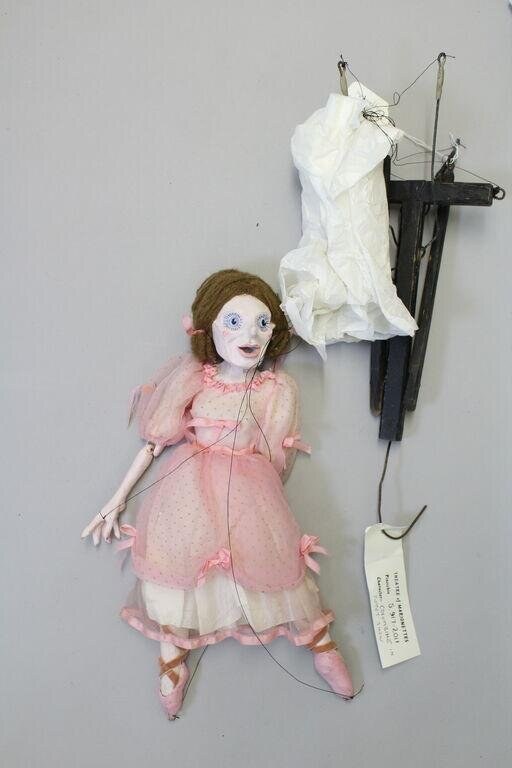
A puppet ballerina in a pink tutu and matching pink bodice stands against a white wall, her posture upright and formal. The figure has a painted papier-mâché or similar sculpted head with brown hair, pale complexion, and blue eyes rendered in a naive or folk-art style. Her legs are thin and jointed, clad in pink tights and pink pointe shoes. Above and to the right of the puppet, a black wooden control frame or rod apparatus is mounted on the wall, from which white fabric drapery hangs—the mechanism by which the puppet was animated. A museum label is visible at lower right. The whole composition suggests a marionette or string puppet designed to perform ballet movements, likely displayed here as a three-dimensional folk or theatrical artifact rather than in performance.
The dancing
The ballerina figure is posed in a standing position with arms at rest; from this angle, her arm articulation is not fully visible, but her posture is upright and her legs are extended in a neutral standing position rather than any active ballet posture. The proportions are doll-like and stylized rather than anatomically naturalistic. The control apparatus above indicates this was a jointed puppet capable of movement, with strings or rods connecting the puppet to the overhead frame. A single standing figure, not a group or partnered dance.
The dance depicted
This is a ballet puppet or marionette, a theatrical prop designed to perform classical ballet. The pink tutu, pointe shoes, and upright carriage all reference the vocabulary of theatrical ballet—specifically the aesthetic of mid-to-late 20th-century recreational or folk puppet theatre rather than professional dance company traditions. The naive or expressionistic rendering of the face and the construction technique suggest this is a folk or amateur creation, possibly a child's toy or a puppet made for small-scale performance or display.
How it was made
This is a three-dimensional puppet constructed from papier-mâché or similar molded material for the head and likely wood or stuffed fabric for the body and limbs. The jointed limbs and control frame indicate articulation achieved through stringing or rod control. The pink fabric of the tutu and bodice has been sewn onto a cloth or wire frame body. This is not a drawing, painting, or print, but a theatrical artifact—an object made to be animated and moved, now displayed statically. The technique places it closer to folk craftsmanship or amateur theatrical practice than to professional puppet-making.
About this work
This is a ballet puppet made by Frances Grant in 1981—a three-dimensional folk or amateur theatrical object rather than a two-dimensional artwork. The puppet depicts a ballerina in classical costume (pink tutu and pointe shoes) and includes the overhead control apparatus that would have allowed it to move. It represents the intersection of domestic craftsmanship, children's theatre, ballet as a popular image, and folk art practice. Displayed as a museum piece, it speaks to how ballet was circulated through popular culture and amateur performance in late-20th-century Britain, and to the persistence of ballet as a form recognisable and deployable even outside professional dance contexts.
How to look at it
Look at the control frame and the relationship of the strings to the puppet's joints—this tells you how movement was achieved and what range of action the maker anticipated. Note the care taken in costume detail (the tutu, the pointe shoes, the pink palette) despite the rough execution of the face, which suggests the maker prioritised ballet recognisability over naturalism. The painted expression is earnest and vacant in a way that was conventional in folk puppetry and which became acceptable again in late 20th-century amateur and children's craftsmanship.
The artist
Frances Grant is not widely documented in standard dance or art historical records. The work carries the modest signature of a maker working in folk or amateur theatrical traditions, likely producing objects for local performance, teaching, or exhibition. No further biographical information is available from the catalogue record.
The period
In 1981, ballet in Britain was established as both professional (Royal Ballet, regional companies) and popular culture. Ballet remained the default aesthetic for 'proper' femininity in dance education and children's entertainment. Amateur puppet-making and string puppet theatre had deep roots in British folk tradition and continued as a live craft practice, particularly in educational and recreational contexts. This puppet belongs to that vernacular tradition.
Where it lives
The work is held as part of a puppet collection or collection of theatrical artifacts (the record lists the source as 'va', likely a UK collection). It is catalogued as a puppet rather than as a work of fine art, reflecting its status as a three-dimensional theatrical object and folk craft.
Dance in this work
Questions about this work
Was this puppet actually used to perform ballet?
The control apparatus and jointed construction suggest it was designed to be animated. Whether it was performed with, kept as a display piece, or both, cannot be determined from the image alone. It is now displayed statically as a museum object.
Why would someone make a ballet puppet?
Ballet was deeply embedded in British cultural education and entertainment in the late 20th century. A homemade puppet could serve as a toy, a teaching tool, a prop for amateur theatre or puppet shows, or a craft project. The ballet aesthetic signalled culture, femininity, and aspiration.
Is this considered art, or is it just a toy?
In museum practice, the distinction matters less than the context and intent. This puppet is preserved as a cultural artifact—evidence of how ordinary people engaged with dance and made meaning through craft. Its presence in a collection makes it a subject of historical and ethnographic interest, regardless of whether it was called 'art' when made.
More dance artwork





