49 works in this view — arrow keys or swipe to move between them.
Dance in Art
Ballerina
Sitzendorf Porcelain Manufactory
- Collection:
- Figurine
- Source:
- Victoria and Albert Museum
- Rights:
- Rights vary by item — check the source record before reusing this image. Source record ↗
- Recorded as:
- V&A — check rights per item
This figurine is evidence of how ballet circulated as a cultural symbol in early 20th-century Europe beyond live performance. It shows what the dance meant to the people who bought and displayed such objects—not technical virtuosity, but an image of refined, controlled, feminine grace. For historians of dance and material culture, it reveals the gap between what dancers actually did on stage and what the public understood or desired ballet to be.
What you are looking at
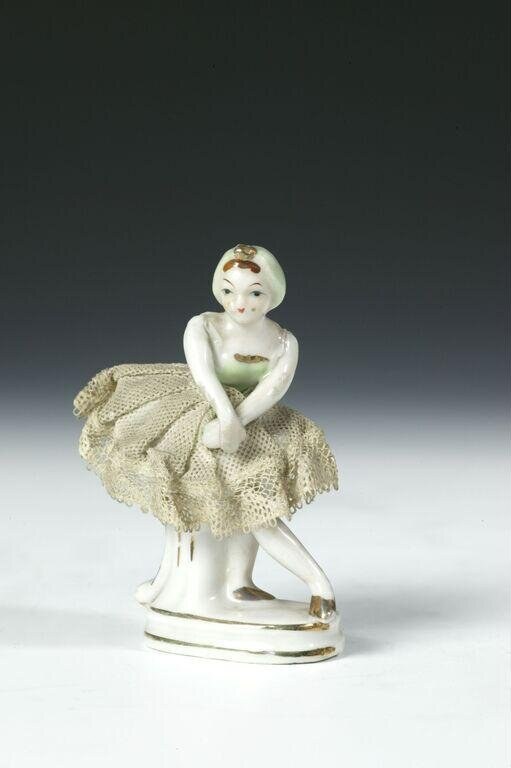
A porcelain figurine of a single female dancer in a posed, graceful stance. She wears a white porcelain bodice and has painted facial features with dark hair styled in a 1920s bob. Her lower body is swathed in an elaborate cream-colored lace skirt or overskirt that falls in soft, textured folds to her ankles. The skirt appears to be a separate textile element—actual lace fabric—sewn or attached to the porcelain form, creating a striking contrast between the smooth glazed upper figure and the delicate, three-dimensional fabric. She stands with her weight balanced, one leg slightly extended, in a pose suggesting mid-movement or a held classical position. The figurine rests on a simple white porcelain base with a narrow gold or gilt band at the edge.
The dancing
The dancer's body is upright and composed, with her upper torso held gracefully and her arms positioned with one bent near her body. The extended leg, visible beneath the lace, suggests a controlled, balletic pose rather than vigorous movement. Her weight appears centered and controlled. The figurine captures a moment of stillness and elegance rather than dynamic action—the pose is classical and formal, with no indication of rapid footwork or dramatic extension.
The dance depicted
This represents a stylized, idealized image of ballet as understood in early 20th-century decorative arts. The pose, the classical upright carriage, and the ethereal treatment of the skirt all reference the aesthetic of romantic and classical ballet. However, this is not documentation of specific choreography but rather a symbol of ballet refinement marketed through domestic ornament. The work belongs to a tradition of ballet-inspired porcelain figurines that emerged in the late 19th and early 20th centuries, reflecting ballet's status as a fashionable cultural reference for middle-class interiors.
How it was made
This is a porcelain figurine with hand-painted details and an integral white glazed base. The upper body and head are fully modeled and glazed porcelain; the lower portion features an applied textile element—genuine cream-colored lace fabric—that has been sewn or otherwise fixed to the ceramic form. This hybrid technique (porcelain with textile overlay) was employed by some manufacturers to create visual richness and three-dimensional texture that glazed fabric simulation alone could not achieve. The Sitzendorf manufactory, based in Thuringia, Germany, was known for such hybrid figurines and for detailed hand decoration aimed at the middle- and upper-middle-class consumer market.
About this work
This is a decorative porcelain figurine of a ballerina, manufactured by the Sitzendorf Porcelain Manufactory (one of Germany's significant porcelain producers in the 19th and 20th centuries) around 1920. It represents the commercialization of ballet as a symbol of elegance and refinement in domestic interiors during the interwar period. The work blends industrial manufacture—molded porcelain—with craft detail (hand painting, applied lace) to create a luxury object intended for display in middle-class homes. The figurine does not depict a specific performance or dancer but rather embodies contemporary attitudes toward ballet as graceful, feminine, and aspirational.
In the context of dance history, such figurines document how ballet was understood and represented outside the theater during the early 20th century. They show the dance as an aesthetic ideal rather than as lived practice, filtered through the decorative arts market and the commercial interests of porcelain manufacturers. The work is a artifact of material culture and taste as much as it is a representation of dance.
How to look at it
Observe the contrast between the smooth, precisely modeled porcelain of the upper body and head, with hand-painted features, and the three-dimensional lace skirt, which introduces actual textile texture into a ceramic object. This hybrid technique is the work's most distinctive feature. The pose itself is classical and closed—weight centered, no dramatic extension—which suggests the artist's understanding of ballet as composed and graceful rather than athletic or kinetic. The 1920s facial features (the bob hairstyle, the painted eyebrows) date the work more precisely than the costume alone might, and they underscore that this is an image of contemporary fashion intersecting with classical dance.
The artist
The Sitzendorf Porcelain Manufactory (Sitzendorfer Porzellanmanufaktur) was founded in Thuringia, Germany, in 1850 and became known for figurative porcelain, particularly domestic ornaments depicting dancers, coquettes, and mythological subjects. The factory employed skilled modelers and painters to create pieces for export and domestic sale. By the early 20th century, Sitzendorf figurines were a recognizable commodity in European and American drawing rooms, marketed as affordable luxury through retail networks. The factory's work exemplified the aesthetic of early 20th-century German decorative porcelain: detailed hand painting, attention to fabric and surface effects, and an embrace of applied textiles to enhance visual interest.
The period
In the 1920s, ballet occupied a complex position in European cultural life. The Ballets Russes had thrilled avant-garde audiences in Paris and London in the 1910s, but ballet as an institution remained associated with the Imperial Russian tradition and with a refined, aristocratic aesthetic. At the same time, ballet was being absorbed into mass culture and domestic commerce through figurines, prints, and theatrical photographs. The interwar period saw a growing market for decorative ballet imagery aimed at bourgeois homes. The applied-lace technique visible in this figurine reflects a broader trend in ceramic manufacturing toward hybrid, tactile surfaces that combined industrial efficiency with craft detail. The work belongs to a moment when ballet was simultaneously elite and domesticated, avant-garde and commercialized.
Where it lives
This figurine is held as a decorative object in a museum collection (the source record indicates 'va', likely the Victoria and Albert Museum in London, which holds significant collections of Sitzendorf porcelain). Such objects were originally manufactured for retail sale and domestic display, and museums have since acquired them as examples of early 20th-century decorative arts and as evidence of how dance was represented in material culture.
Dance in this work
Questions about this work
Is the lace real fabric or painted porcelain?
The skirt appears to be actual cream-colored lace textile applied to the porcelain body, not a glazed simulation. This hybrid technique was used by some porcelain manufacturers to achieve a more convincing and three-dimensional effect than painted fabric could provide. It was a labor-intensive and costly process, indicating this was a mid-to-high-end product.
What dance is this figurine showing?
The figurine does not depict a specific choreography or performance, but rather an idealized image of classical ballet as a symbol of elegance and refinement. The pose is generic and posed rather than action-based. It represents how ballet was understood and marketed in domestic decorative arts, not what dancers actually performed on stage.
Why does a dance archive include decorative porcelain?
Figurines, prints, and other domestic objects are primary sources for understanding how dance was understood, valued, and represented in society outside the theater. This piece documents the commercialization of ballet imagery and reveals the gap between professional dance practice and public perception during the early 20th century.
More dance artwork





