49 works in this view — arrow keys or swipe to move between them.
Dance in Art
Active Sindy
Pedigree Dolls & Toys
- Collection:
- Teenage doll
- Source:
- Victoria and Albert Museum
- Rights:
- Rights vary by item — check the source record before reusing this image. Source record ↗
- Recorded as:
- V&A — check rights per item
This object reveals how dance—and specifically ballet—was marketed to girls in the 1970s as an identity and aspiration, not just an activity. The doll's existence shows that ballet was seen as central enough to teenage femininity that a competitor to Barbie needed to offer it; the specific pose and costume tell us what manufacturers believed ballet should look like through a child's eyes.
What you are looking at
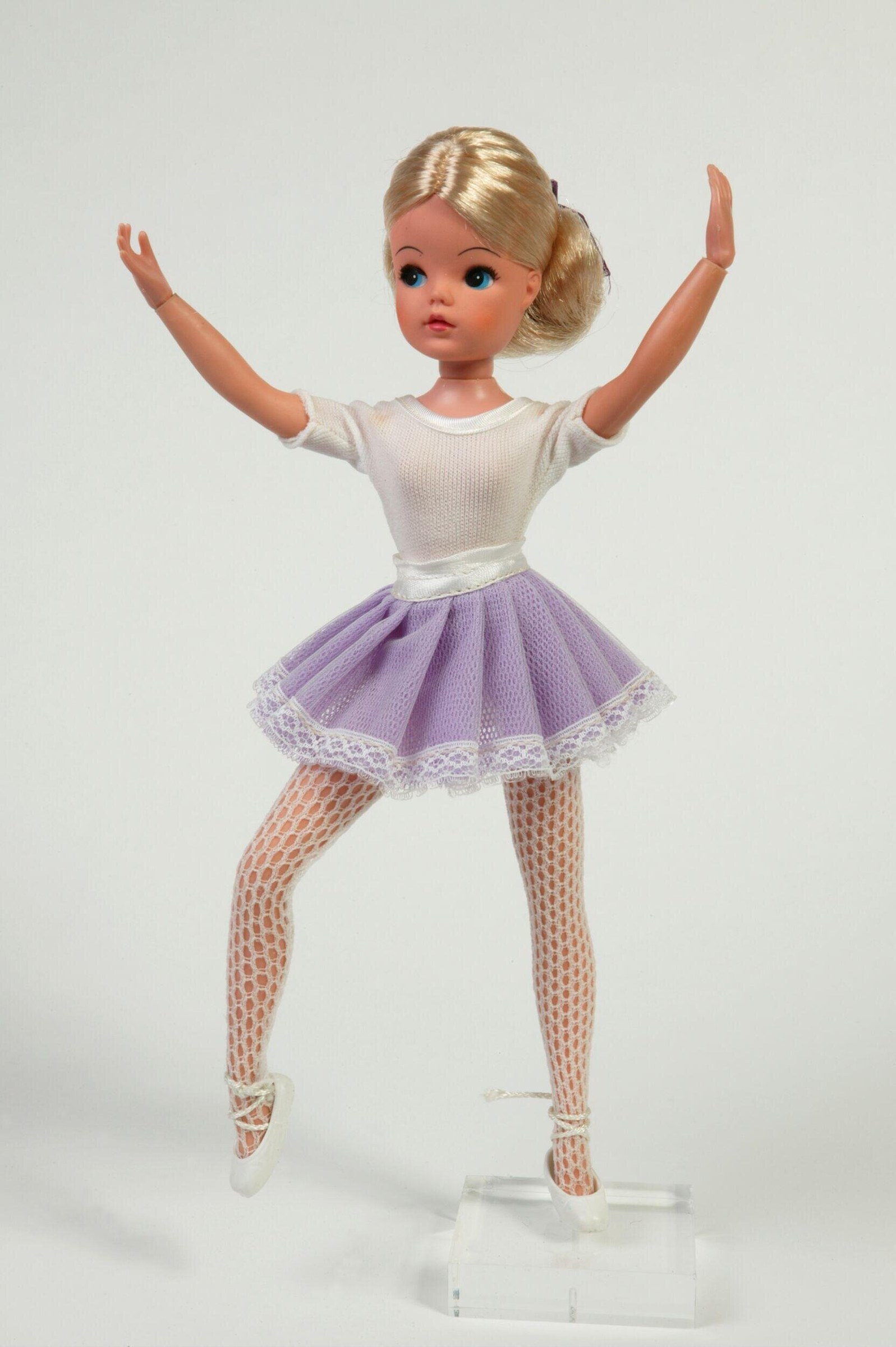
A small blonde doll in a ballet-inspired pose stands alone against a plain white background. She wears a white ribbed short-sleeved shirt tucked into a lavender tulle skirt trimmed with white lace at the hem. Her legs are covered in white mesh fishnet stockings, and she wears white ballet pointe shoes with ties. Her arms are raised to shoulder height with elbows slightly bent, a classical ballet port de bras position. Her posture is upright and the pose conveys active, joyful movement—she appears to be mid-leap or in a moment of exuberant extension. The doll's painted blue eyes look forward and her expression is animated. The lighting is bright and even, characteristic of product photography.
The dancing
The single figure demonstrates understanding of classical ballet port de bras: the arms are raised with soft, rounded elbows, not rigidly extended. The pose is light and energetic rather than heavy or grounded. The doll stands in what appears to be an approximation of fifth position or turnout, and the raised arms combined with the vertical orientation of the body suggest a moment of elevation or preparation for it. The pose conveys movement and joy rather than a static stance.
The dance depicted
This is a ballet doll, explicitly designed to represent a young ballet student or dancer. The pointe shoes, tutu, and port de bras all reference classical ballet tradition, likely the Cecchetti or RAD method as taught to children in mid-20th-century Britain and America. The pose suggests a moment of celebration or preparation rather than a specific canonical ballet position—it reads as generalized 'ballet happiness' rather than a precise choreographic moment. The doll is performing ballet for an audience of children who would purchase or receive it.
How it was made
This is a vinyl or plastic doll, mass-produced by injection molding—a technique that became standard for affordable toys in the 1970s. The blonde hair appears to be rooted synthetic fiber, the limbs are jointed at shoulders, hips, and knees to allow posing, and the face is painted. The white tutu and fishnet stockings are sewn fabric applied to the doll's body. This manufacturing technique allowed for inexpensive reproduction and wide distribution, making ballet accessible as a toy narrative to children of modest means.
About this work
Active Sindy is a teenage fashion doll by the British toy manufacturer Pedigree, designed in 1975 as a competitor to Barbie. This example shows Sindy in ballet attire, one of several outfit options available for the doll. The ballet costume and pose reflect the cultural prestige of ballet in 1970s Britain and the expectation that aspirational teenage girls would be introduced to dance as a sign of refinement and accomplishment. The doll's energetic raised-arm pose and pointe shoes encode a particular vision of what ballet should look like: graceful, joyful, and achievable for girls.
How to look at it
Notice the precision of the ballet reference: the pointe shoes are actually sculpted and painted, not just stickers or decals, and the tutu is made of real tulle, not plastic. The pose is not a generic 'dance' position but specifically references classical ballet—the turned-out legs, the port de bras, the upright spine. The artist (product designer) understood ballet well enough to convey it convincingly in miniature. The doll's expression—bright-eyed and smiling—reflects mid-century ideals about what girls should aspire to: a combination of technical achievement and uncomplicated joy.
The artist
Pedigree Dolls & Toys was a British toy manufacturer founded in 1919, based in Nottingham. By the 1970s it was one of Europe's leading doll makers and a serious rival to Mattel's Barbie. Sindy was Pedigree's flagship teenage fashion doll, launched in 1963, and was marketed as more fashion-forward and less overtly sexualized than Barbie—though still aspirational and trend-conscious. Pedigree produced many costume sets for Sindy, including dance wear, reflecting the cultural moment in which ballet and modern dance were seen as markers of style and sophistication.
The period
The 1970s saw a global expansion of ballet beyond the professional stage: ballet schools proliferated, ballet on television was popular, and participation in ballet was a normalized activity for middle-class girls in Britain and Europe. At the same time, fashion dolls like Barbie and Sindy had become standard toys, and manufacturers competed by offering an ever-widening range of outfits and narratives. The Sindy ballet outfit sits at the intersection of these two trends: ballet had become desirable as a consumer identity, not just as a rare professional pursuit. The doll's design also reflects the 1970s aesthetic of playfulness and flexibility in gender expression—unlike earlier dolls, Sindy could be a ballerina, a nurse, a office worker, or a fashion model.
Where it lives
This is a toy doll, part of the Sindy range produced by Pedigree Dolls & Toys in the 1970s. The catalogue record identifies it as part of a teenage doll collection held in a museum or archive. Pedigree marketed Sindy across Europe and the Commonwealth, so examples are relatively common in collections but still significant as documentary evidence of toy design and marketing.
Dance in this work
Questions about this work
Was Sindy a ballet dancer character?
Sindy was a fashion doll with multiple personas—she had many costume sets that allowed children to imagine her in different roles. The ballet outfit was one option among dozens. Unlike some dolls designed to represent a specific profession, Sindy's identity was flexible and aspirational rather than fixed.
How does Sindy compare to Barbie?
Sindy was marketed as Barbie's British rival and was designed to appeal to European sensibilities. Sindy was often promoted as more fashion-focused and less sexualized, though both dolls offered children a fantasy of grown-up femininity through clothing and lifestyle. Sindy outsold Barbie in some European markets during the 1970s and 1980s.
Is the ballet outfit historically accurate?
The outfit reflects a generalized idea of ballet rather than the costume of any specific ballet or method. The pink tutu, white pointe shoes, fishnet stockings, and simple top are all recognizable ballet signifiers, but the ensemble is a toy designer's interpretation rather than a replica of professional ballet costume.
What does this doll tell us about dance history?
Toys are documents of what cultures believe about themselves. The existence of a ballet doll shows that by the 1970s, ballet was no longer a rare or elite pursuit but part of mainstream teenage aspiration. The doll's design and marketing tell us that ballet was coded as feminine, refined, and accessible—at least as a fantasy for children playing with dolls.
More dance artwork





