49 works in this view — arrow keys or swipe to move between them.
Dance in Art
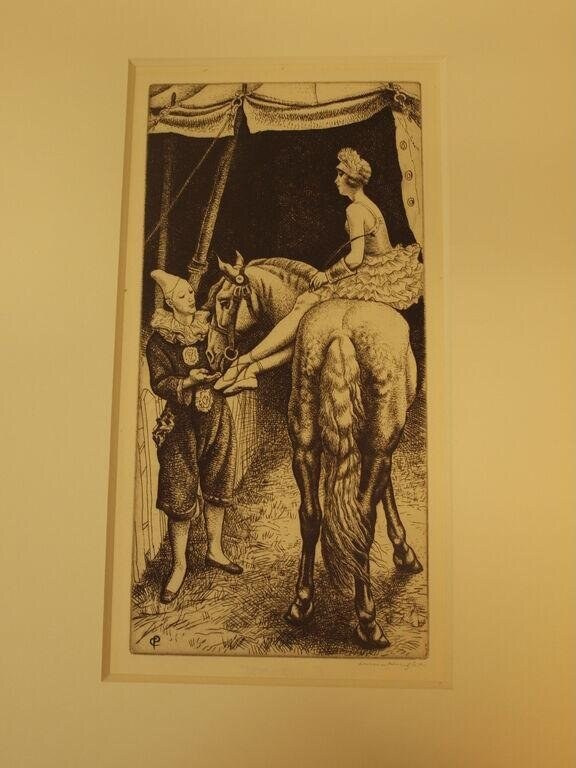
The Bareback Rider
Knight, Laura
- Collection:
- Source:
- Victoria and Albert Museum
- Rights:
- Rights vary by item — check the source record before reusing this image. Source record ↗
- Recorded as:
- V&A — check rights per item
Bareback riding represents a historical moment when circus performance was at the height of its cultural prestige, employing techniques and aesthetics that influenced theatrical dance. The image documents how women performers used their bodies and training to combine strength, balance, and theatrical grace in a context where gender performance was central to the spectacle. This engraving is evidence of a performance idiom—the feminized, balletic approach to equestrianism—that has largely disappeared, making it valuable for understanding the breadth of 19th-century movement culture.
What you are looking at
A circus or equestrian performance is captured in this engraving, centered on a bareback rider mounted on a horse within an enclosed ring. The horse, rendered in fine detail with clear musculature and movement, stands at the center of the composition. The rider, a young woman in a light-colored costume with puffed sleeves and what appears to be a fitted bodice, sits upright on the horse's back with one arm extended in a graceful gesture. She wears a decorative headpiece or headdress. To the left of the horse stands a male figure in darker clothing, possibly a ringmaster or attendant, gesturing toward the performer. The setting is clearly indoors—heavy draped curtains with swags frame the top of the scene, and the background is rendered in deep shadow, emphasizing the theatrical staging. The ground plane is sketched with minimal detail. The engraving technique creates strong contrasts of light and shadow, drawing the eye to the central figures while the architectural framing and costume detail suggest a professional circus or music-hall venue of the late 19th century.
The dancing
The bareback rider maintains an upright, balanced posture on the horse, demonstrating the core skill of circus equestrianism. Her extended arm and turned head suggest performative awareness—she addresses an imagined audience or acknowledges her attendant rather than concentrating purely on balance. The male figure's gesture is encouraging or directing, typical of circus performance direction. The rider's costume—fitted bodice, puffed sleeves, and headdress—is designed for visibility and elegance from a distance, not functionality in the modern sense. Her weight appears centered and secure, consistent with trained bareback technique.
The dance depicted
This depicts circus bareback riding, a performance art that combines horsemanship with acrobatic and balletic elements. Bareback riding became a popular circus act in the 19th century, particularly among female performers who could integrate graceful arm movements and poses into their balance work, creating a hybrid of equestrian skill and theatrical performance. The rider's extended arm and upright carriage suggest she is executing a pose or transition mid-performance rather than simply riding. While not dance in the formal sense, bareback riding shares with dance a concern for line, balance, elevation, and audience awareness; 19th-century performers often trained in both disciplines. The act was a standard feature of Victorian and Edwardian circus troupes.
How it was made
This is an engraving, likely wood engraving or steel engraving, executed with fine crosshatching and line work to create tonal depth and texture. The technique was ideal for reproduction in print and allowed for sharp detail in the costume, horse anatomy, and architectural elements. The quality of the line work—particularly in rendering the horse's musculature and the fabric of the curtains—suggests a skilled hand and a work created for commercial distribution, likely as a theatrical or circus print. Engravings of this type were sold individually or collected in albums, making them accessible to a broad middle-class audience interested in theatrical spectacle and fashionable entertainment.
About this work
This engraving documents a bareback circus performance, likely from the 1870s or 1880s, at a time when such acts were major theatrical attractions. The work captures not merely the acrobatic skill of the rider but the theatrical presentation—the costume, the staged setting, the attendant's presence—that made such performances compelling to contemporary audiences. Bareback riding sits at the intersection of equestrian performance, acrobatics, and dance, disciplines that converged in the circus ring. The careful attention to the rider's pose and the dramatic framing suggest this is a record of professional performance, possibly commissioned as a memento or promotional image. For dance historians, the work illustrates how 19th-century performers synthesized multiple physical disciplines and how the circus functioned as a laboratory for movement innovation and theatrical spectacle.
How to look at it
Focus on the moment of pause or balance rather than motion: the rider is not captured mid-gallop but in a posed, balletic moment of display. This freeze is characteristic of circus ringwork, where the skill lies in the ability to hold elegant positions while mounted. Notice the careful graduation of line and shadow to suggest the horse's musculature and the rider's security and poise. The male attendant's gesture and gaze direct the viewer to look at the rider, a compositional choice that emphasizes performance and audience awareness. The theatrical framing—the heavy curtains, the contained ring, the dramatic lighting—signals that this is not a naturalistic riding scene but a staged spectacle designed to astonish and please.
The artist
Laura Knight (1877–1970) was a British painter and printmaker known for her depictions of theatrical and circus life. She was particularly drawn to the lives of performers—acrobats, dancers, circus artists—and created numerous works documenting their training, performance, and offstage moments. Knight exhibited regularly with the Society of Women Artists and later became a Royal Academician. Her prints and drawings from circus and theatrical scenes are characterized by close observation of anatomy, costume, and the architecture of performance. She worked in multiple media including oil, watercolor, etching, and engraving, and her circus subjects were part of a broader interest in the physicality and drama of performance that extended across her long career.
The period
The 1870s and 1880s were the height of the Victorian and Edwardian circus era, when establishments like Astley's and later circus troupes drew huge audiences across Europe and America. Circus performance was culturally prestigious and artistically innovative; leading choreographers and performers often trained in circus techniques, and the circus ring was a space where acrobatics, dance, and equestrian skill converged. Simultaneously, the period saw intense interest in naturalistic representation and the documentary aspects of printmaking, particularly through wood and steel engraving. Laura Knight's choice to document circus and theatrical performance reflects both the cultural prominence of these entertainments and the artistic legitimacy printmakers and painters increasingly granted to popular performance.
Where it lives
The work is held as a print, catalogued as being from the Victoria and Albert Museum (indicated by the source code 'va'). The catalogue record provides minimal detail, but the object is part of the Museum's collection of theatrical and performance-related prints, a major strength of that institution's holdings.
Dance in this work
Questions about this work
Is bareback riding a form of dance?
Not technically, but it shares many of dance's concerns: balance, line, elevation, musicality, and the creation of meaning through the moving body in front of an audience. In the 19th-century circus, bareback riders often trained as dancers, and their performances incorporated balletic arm movements and poses. The boundary between acrobatics, circus performance, and dance was more fluid then than it is now.
Who were bareback riders and how did they train?
Bareback riders were circus performers, often women, who combined equestrian skill with acrobatic training. They trained from childhood in balance, flexibility, and strength, typically within circus families or troupes. The best performers could execute turns, poses, and transitions on a moving horse, often to music. It was a prestigious and dangerous profession, and leading performers were celebrities of their era.
What does Laura Knight's attention to this subject tell us?
Knight was fascinated by the physicality and discipline of performance, particularly the lives of performers themselves. Her repeated choice to document circus and theatrical subjects suggests she recognized these performers as serious artists deserving of artistic attention and commemoration. Her work was part of a broader early-20th-century interest in circus and popular performance as worthy subjects for fine art.
More dance artwork





