49 works in this view — arrow keys or swipe to move between them.
Dance in Art
Fan
Unknown
- Collection:
- Fan
- Source:
- Victoria and Albert Museum
- Rights:
- Rights vary by item — check the source record before reusing this image. Source record ↗
- Recorded as:
- V&A — check rights per item
The fan is the literal instrument of fan dance; studying its construction, weight, pleating, and balance directly illuminates how dancers controlled gesture, rhythm, and visual design. For researchers of buchaechum and related traditions, the physical object is a primary source that cannot be conveyed by written description alone.
What you are looking at
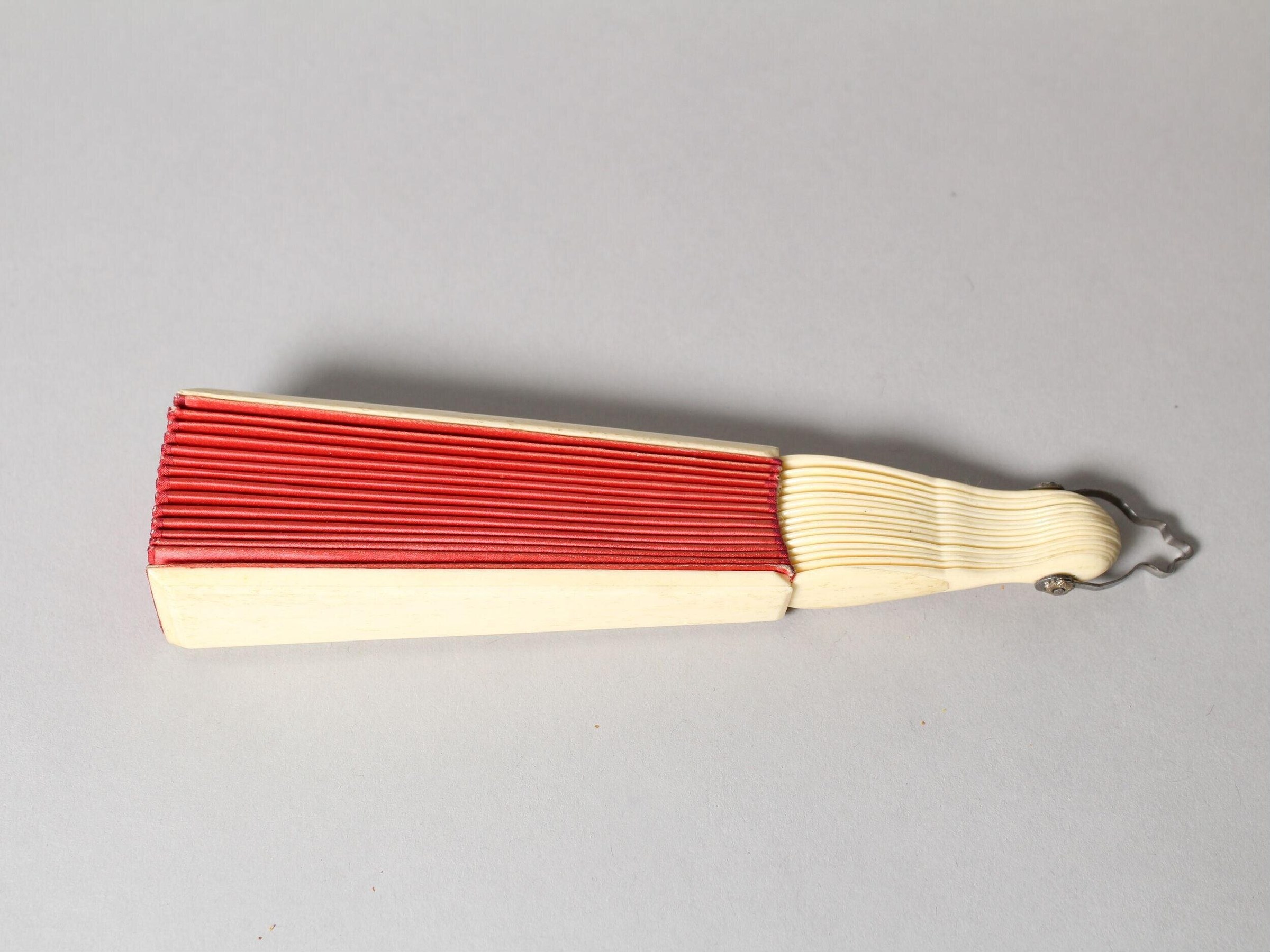
A single decorative fan laid flat against a neutral ground, photographed from above. The fan consists of a broad, pleated head in brilliant red silk or similar material, densely gathered into fine, even vertical pleats that create a ribbed texture across the entire surface. The handle is cream or ivory-coloured, rendered in what appears to be bone or similar material, with a turned or carved profile that tapers toward a small metal ferrule at the tip. The fan is shown fully open, displaying its complete span, and casts a distinct shadow on the ground plane, indicating overhead lighting. The object is pristine and appears to be a museum piece or archival photograph.
The dancing
There are no figures. This is a prop or costume accessory, not a depiction of dancers in motion.
The dance depicted
This is a fan of the type used in East Asian fan dance, most likely Korean buchaechum (부채춤, fan dance) or a related Chinese or Japanese tradition. The fan's construction—a broad, fully pleated silk or silk-like head on a bone or wooden handle—is consistent with fans used in classical and theatrical fan dance, where the fan becomes an extension of the dancer's arm and a primary vehicle for design and control of space. The dense, regular pleating allows the fan to open fully for broad, sweeping gestures and to collapse for rapid transitions. Without seeing the fan in use or in a dated context, the specific regional tradition cannot be determined with certainty.
How it was made
The object itself is a functional fan constructed from pleated fabric (likely silk) and bone or carved wood, not a drawing or artwork. The photograph is a straightforward documentary image, likely archival or collection documentation. The fine pleating and even construction suggest skilled handcraft, and the pristine condition indicates professional preservation. The overhead lighting and neutral background are typical of museum photography intended for catalogue or collection records.
About this work
This is a decorative fan of the type used in East Asian fan dance traditions, preserved as a museum or archival object. It is not a representation of dance in paint, print, or drawing, but rather a material artifact—the actual tool through which choreography is executed. For historians and dancers of buchaechum, fan dance, and related Asian theatrical traditions, the fan itself is primary evidence of technique, construction, and aesthetics. Its inclusion in a dance art collection reflects the expanded understanding of 'art of dance' to include the physical apparatus, costume, and props through which dance meanings are made.
How to look at it
Observe the density and regularity of the pleating—this determines responsiveness and the range of visual effects possible in performance. Note the balance and heft implied by the proportions of head to handle: a fan must be light enough for sustained arm work but substantial enough to carry visual weight across a stage. The bone handle suggests both utility and aesthetic refinement. Imagine the fan collapsing and opening, and how the pleated silhouette would read from the audience at distance.
The period
Fan dance traditions in East Asia have long, documented histories: buchaechum emerged as a theatrical form in Korea, drawing on earlier courtly and folk practices; Chinese fan dance is documented in classical performance; Japanese traditions similarly integrate fans into theatrical vocabulary. The object's construction and style are consistent with 20th-century theatrical or professional fan manufacture, though without dating information or maker's marks, a precise period cannot be assigned.
Where it lives
The catalogue record identifies the holding collection only as 'Fan' and the source as 'va', which is insufficient to establish current location or institutional context. The photograph appears to be archival documentation.
Dance in this work
Questions about this work
Is this a fan for cooling or for dance?
This is a fan designed for theatrical or ceremonial fan dance, not an everyday fan for cooling. The broad, heavily pleated head and formal handle construction are characteristic of dance fans used in Korean buchaechum, Chinese fan dance, and related traditions. Functional cooling fans are typically smaller and less ornate.
How would a dancer use this?
In fan dance, the performer holds the handle and executes broad, sweeping gestures that open and close the pleated head, creating dynamic visual patterns. The fan extends the arm's reach and creates a frame around the body. Rapid transitions between opened and closed positions, precise timing, and coordination with music are central to the form.
What is the fan made of?
The head appears to be pleated silk or a similar lustrous fabric in red; the handle is bone, wood, or a similar carved material. Fine pleating was achieved by hand or mechanical pressing, a skilled labour-intensive process that reflects the object's value and intended use.
More dance artwork





