49 works in this view — arrow keys or swipe to move between them.
Dance in Art
drawing
Suter, Elizabeth
- Collection:
- drawing
- Source:
- Victoria and Albert Museum
- Rights:
- Rights vary by item — check the source record before reusing this image. Source record ↗
- Recorded as:
- V&A — check rights per item
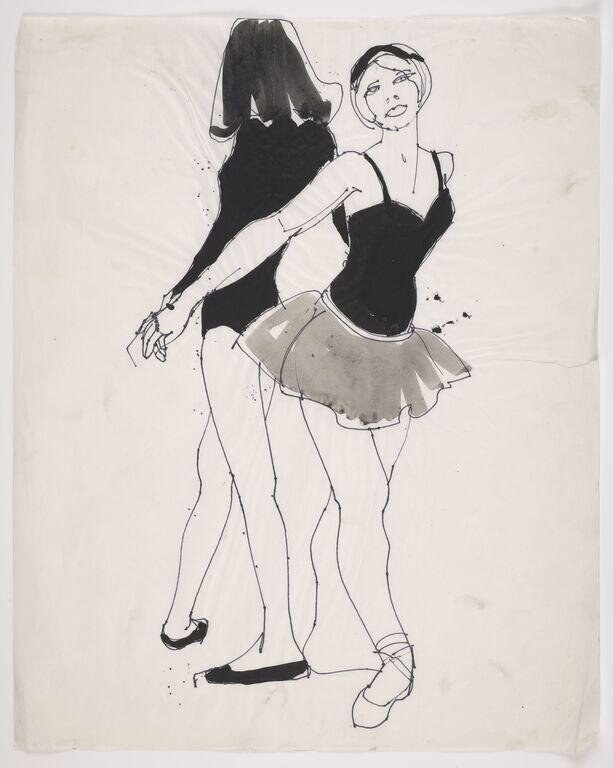
As a drawing by Elizabeth Suter dated 1960, this work documents the visual conventions and training methods of mid-twentieth-century ballet, particularly how the dancer's body and costume were abstracted and idealized in study form. The simultaneous front-and-back view is a pedagogical device—showing the complete spatial form of the trained ballet body—that reveals how dancers and choreographers understood and transmitted the classical line.
What you are looking at
A pen and ink drawing of a female dancer seen from two angles simultaneously—a frontal view and a rear view of the same figure. The dancer wears a black sleeveless leotard or corset top and a pale gray tutu skirt with soft, layered ruffles. Her legs are long and slender, rendered in simple line work, and she wears black pointe shoes. The drawing style is economical and gestural, with bold black ink for the torso and tutu contrasting against delicate linework for the limbs. The figure's head is small and simplified, with a simplified face looking slightly upward. The rear view shows the dancer's dark hair in a neat style, emphasizing the back of the costume and the arc of the body. The composition occupies most of the page, set against a plain, aged cream background. The overall effect is that of a quick study or sketch, capturing both the front and back silhouettes of a ballet dancer in standing position.
The dancing
A single dancer shown in frontal and rear elevation simultaneously. The posture is upright and elongated, with arms at rest or slightly raised, suggesting a posed studio position rather than active movement. The emphasis on the straight legs and pointed feet, combined with the pointe shoes, indicates classical ballet technique. The proportions—particularly the long, slender limbs and small head—follow the conventions of ballet figure drawing. There is no suggestion of a dynamic step or turn; the body is arranged for display of line and costume silhouette.
The dance depicted
This is a study of a ballet dancer, most likely from a rehearsal or costume design perspective. The work captures the essential silhouette and line of a classical ballet figure, emphasizing the elongated proportions and the costume elements—the leotard and tutu—that define theatrical ballet presentation. The simultaneous front and back view suggests this may be a design drawing or a teaching study meant to show the complete form of a ballet body and costume. The style and economy of line are consistent with early-to-mid twentieth-century dance documentation or training materials.
How it was made
Pen and ink drawing on paper, rendered with bold linear strokes and selective solid fills in black ink, with watercolor or wash applied to the tutu in gray. The technique is direct and economical—no preliminary graphite is visible—suggesting confidence and speed of execution. The combination of ink line with colored wash is typical of 1950s–1960s dance documentation and costume studies, allowing quick capture of both structure and color information. This approach was well-suited to theatrical or educational contexts where drawings needed to be produced quickly and reproduced.
About this work
This is a pen and ink study of a classical ballet dancer, dated 1960, showing a single figure in both frontal and rear views. The drawing emphasizes the essential silhouette and line of the ballet body—long legs, upright carriage, pointed feet—and the costume of black leotard and pale tutu. The technique is direct and economical, using bold ink line combined with gray wash, consistent with mid-twentieth-century dance documentation and training materials. The work belongs to a tradition of dance figure studies made by artists to capture and analyze the ballet form, either for design, teaching, or documentation purposes.
How to look at it
Observe how the artist has flattened and stylized the body to emphasize line and silhouette rather than anatomical detail. Notice the proportions—particularly the length of the legs relative to the torso—which reflect the ballet ideal of the period rather than actual human anatomy. Look at how the tutu is rendered: suggested rather than fully described, with gray wash indicating volume and transparency. The rear view adds information about the back line and hair styling, showing how the ballet costume was understood as a complete three-dimensional form. This is not a naturalistic drawing but a design study meant to communicate the essential visual idea of the ballet body.
The artist
Elizabeth Suter was an artist active in the mid-twentieth century who documented dance and the figure. Her practice included pen and ink studies of dancers, often employing economical line and quick notation to capture movement and pose. This drawing is consistent with a broader mid-century interest in dance documentation among visual artists, particularly the intersection of dance training, costume design, and figure study.
The period
In 1960, classical ballet was at a peak of institutional prestige in the United States and Europe, and the idealized, elongated ballet body had become a dominant visual ideal. Artists and designers regularly produced studies of the ballet figure for costume, pedagogical, and artistic purposes. The simultaneous front-and-back view drawing was a standard convention in fashion and costume design of the period, adapted here to the ballet figure. Mid-century modernism in graphic art also favored economical line and bold forms, which is reflected in Suter's technique.
Where it lives
This drawing is held in a collection designated 'va' in the catalogue record, suggesting it may be part of a visual arts or dance documentation collection. The sparse catalogue entry suggests it may be an accessioned work within a larger series of dance studies or costume sketches.
Dance in this work
Questions about this work
Why is the dancer shown twice on the same page?
The front and back views show the complete silhouette of the dancer and costume from opposite sides. This was a standard practice in costume design and dance documentation, allowing a single drawing to communicate the full three-dimensional form. It is both economical—two views on one sheet—and pedagogically useful for understanding how the costume and body line read from all angles.
What kind of ballet is this?
The costume and body line are consistent with classical ballet of the mid-twentieth century. The pointe shoes, tutu, and idealized proportions follow conventions established in Romantic and Classical ballet repertory. Without additional context, the drawing does not specify a particular ballet or role, but represents the generic ballet dancer of the period.
Is this a finished artwork or a study?
This appears to be a finished study drawing rather than a preliminary sketch. The pen line is confident and the composition is complete, but the economical technique and focused subject matter—capturing silhouette and costume line—suggest a functional purpose: costume design, teaching, or documentation. It is an artwork in its own right, not a working draft.
More dance artwork





