49 works in this view — arrow keys or swipe to move between them.
Dance in Art
Dance Bites
Crickmay, Anthony
- Collection:
- Poster
- Source:
- Victoria and Albert Museum
- Rights:
- Rights vary by item — check the source record before reusing this image. Source record ↗
- Recorded as:
- V&A — check rights per item
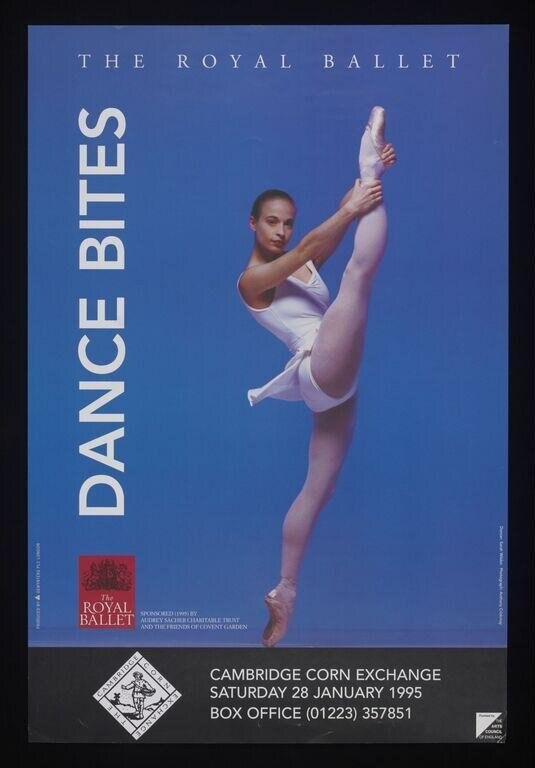
This poster documents a significant format shift in ballet in the 1990s: the move toward shorter, more accessible programming and the use of photography as the primary marketing image for classical dance. The image also captures the male dancer's body in classical ballet at a moment when male classical dancers were beginning to be foregrounded more prominently in British and European ballet marketing.
What you are looking at
A single male dancer in a white sleeveless leotard and pale pink pointe shoes is captured mid-arabesque against a rich blue background. His body is extended in a classical ballet line: his right leg lifted high behind him, nearly vertical, his left leg supporting his weight in turnout, his arms in fifth position en haut (overhead). His head is held in profile, tilted slightly back. The pose is held with precision and apparent ease, the musculature of his legs visible and taut. The composition is stark and intimate, filling almost the entire frame with the dancer's body. No other figures, no scenery, no props—only the dancer's form and the unmarked blue void. The lighting is even and frontal, with a subtle shadow beneath him suggesting a floor plane but no spatial context beyond that.
The dancing
A single male dancer in full turnout, weight held on a strongly pointed left foot, executing an arabesque with the right leg extended high and back. His arms frame his head in a classical position suggesting either a classical suite or a moment of composed lyricism. The body demonstrates the balletic vocabulary of épaulement (shoulder carriage) and the elongated line prized in academic ballet. His physique—lean and muscled—is that of a professional classical dancer, and the execution shows technical command.
The dance depicted
This is classical ballet, almost certainly. The arabesque is one of ballet's five fundamental positions, and the pointe work, turnout, and arm carriage are unambiguously part of the European academic tradition. The image captures the dancer mid-phrase, in a moment that might conclude a variation or bridge a dramatic transition. The costume and setting suggest this is professional classical ballet rather than contemporary work. The photograph was likely taken in a studio context—the blank background and controlled lighting are deliberate choices to isolate the dancer's form.
How it was made
This is a poster, printed in colour lithography (or similar offset process), designed for public display. The image itself appears to be a professional colour photograph, reproduced at scale on paper stock suitable for posting. The bright, almost luminous blue background and the clean separation of the dancer's pale form from it are typical of professional dance photography of the 1990s. The poster format suggests wide distribution—this was promotional material, likely for a touring ballet company or a season of performances.
About this work
This is a promotional poster for "Dance Bites," a Royal Ballet production, printed by Anthony Crickmay in 1995. It shows a male classical ballet dancer in arabesque against a blue ground. The image exemplifies late-twentieth-century dance photography's use of the isolated figure and controlled studio lighting to emphasize the dancer's body as an aesthetic object. Dance Bites was a short-form performance format—the title refers to brief, digestible ballet pieces—and the poster's bold simplicity, its focus on a single dancer in a canonical ballet pose, was designed to market the work as accessible, modern classicism: recognisably ballet, but presented with graphic clarity and contemporary photographic style.
How to look at it
Notice the geometry of the arabesque and its perfect symmetry within the rectangular frame. The photographer has aligned the dancer's body centrally and used the blue ground to create a sense of weightless suspension—the subtle shadow beneath him is the only spatial anchor. The choice to photograph the dancer en arabesque, rather than in motion or in a more dramatic mid-leap pose, emphasises stillness and control; it is a ballet position held, not a moment of passage. This reflects a late-twentieth-century aesthetic in which the dancer's body, when frozen photographically, becomes a sculptural object.
The artist
Anthony Crickmay was a prominent British dance photographer and graphic designer who documented ballet and contemporary dance from the mid-twentieth century onward. He was closely associated with The Royal Ballet and created much of its promotional and archival photography. Crickmay's style emphasised clarity, clean composition, and the isolation of the dancer's form—aesthetic choices that became standard in dance photography and helped shape how ballet was visually marketed to the public.
The period
In the 1990s, classical ballet companies were experimenting with shorter performance formats and more varied programming as a means of broadening their audience. The Royal Ballet introduced "Dance Bites"—short pieces, often extracted from full-length ballets or newly choreographed—to attract younger or less committed audiences. This coincided with a shift in dance photography away from narrative or scenic contexts toward abstracted, graphic approaches that emphasised the dancer's body as a sculptural form. The blue ground and the stark composition are characteristic of this aesthetic shift in dance promotional culture.
Where it lives
The poster is part of the Victoria and Albert Museum's collection (source: VA). It was printed for The Royal Ballet and distributed to promote a performance of "Dance Bites" at Cambridge Corn Exchange on Saturday, 28 January 1995. The box office contact and performance details are printed in small type at the bottom of the poster.
Dance in this work
Questions about this work
What is Dance Bites?
Dance Bites was a Royal Ballet programme format consisting of short ballet pieces, designed as an accessible entry point to classical ballet. It typically featured newly choreographed works or extracted segments from longer ballets, performed in a shorter evening that appealed to audiences who might find full-length classical ballets daunting. The format was part of a broader movement in the 1990s to make classical ballet more approachable to diverse audiences.
Who was the dancer in this photograph?
The poster does not identify the dancer, and the catalogue record does not provide this information. It was common for promotional posters of the period to feature dancers without attribution; the focus was on the company and the work, not on individual performers. To identify the dancer, one would need to consult the performance records of The Royal Ballet for the Cambridge performance of 28 January 1995.
Why is the background blue?
The blue ground is a deliberate artistic choice by the photographer. It isolates the dancer's body from any spatial context and creates a sense of weightlessness or suspension. In the 1990s, this kind of graphic, non-representational background became standard in dance photography and promotional design, marking a shift from earlier photographs that often included scenery, other dancers, or stage settings.
Was this a tour?
Yes. The poster indicates that the performance took place at Cambridge Corn Exchange, which suggests the Royal Ballet was on regional tour. Such tours were (and are) essential to bringing classical ballet to audiences outside London and major metropolitan centres.
More dance artwork





