49 works in this view — arrow keys or swipe to move between them.
Dance in Art
New London Ballet
Unknown
- Collection:
- Poster
- Source:
- Victoria and Albert Museum
- Rights:
- Rights vary by item — check the source record before reusing this image. Source record ↗
- Recorded as:
- V&A — check rights per item
This poster is a primary document of how ballet was presented to British audiences in the 1970s, showing the enduring influence of the Romantic and Classical tradition even as contemporary dance was gaining ground. For historians of theatrical design and dance promotion, it is evidence of the visual language used to market ballet during a period of significant change in dance aesthetics. The photograph itself is a record of a professional classical technique as it was practiced and valued at that moment.
What you are looking at
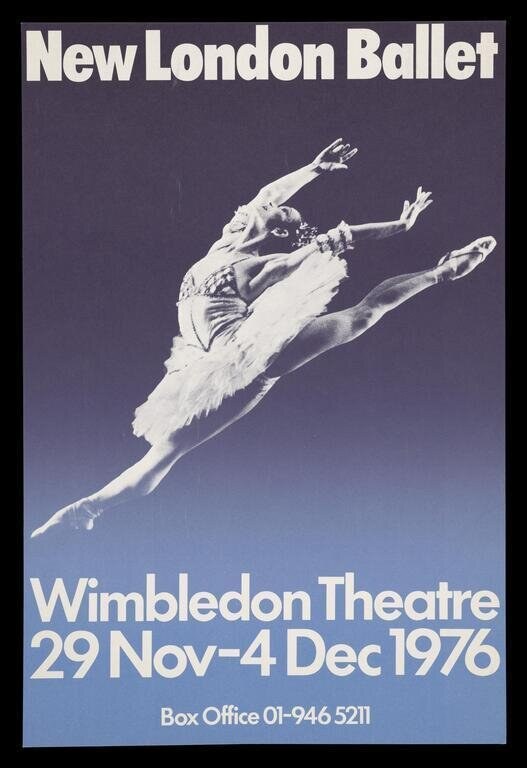
A single female dancer photographed mid-leap against a deep blue-to-purple gradient background, captured in the dynamic instant of a grand jeté. She wears a white classical tutu with a decorated bodice, her body suspended in the archetypal balletic pose: one leg extended straight ahead, the other bent behind, both arms reaching upward in an open frame. The photograph is shot from a low angle, emphasizing the height and weightlessness of the jump. The lighting is theatrical, with the dancer's pale costume and skin luminous against the dark background, creating sharp definition of her extended limbs and the tutu's volume. This is a professional studio photograph, likely taken for promotional purposes.
The dancing
The dancer's body demonstrates classical ballet technique: her supporting leg at takeoff shows the propulsive extension of a properly executed grand jeté, while her working leg is held in a crisp attitude derrière (bent behind). Her upper body maintains an open, lifted carriage with both arms extended upward in a graceful port de bras. The pose suggests training in the academic ballet tradition, with clear articulation of each limb and a sense of suspension that defies gravity. Her position is that of a solo virtuoso performer, not part of an ensemble.
The dance depicted
This is classical ballet, almost certainly the grand jeté or similar signature jumping step from the Romantic or Classical ballet repertory. The New London Ballet was a professional British ballet company active in the 1970s, and this image served as their promotional poster, suggesting this dancer performed lead roles in their productions. The photograph freezes a moment of technical virtuosity—the grand jeté is one of ballet's most visually striking and demanding steps, requiring explosive power from the supporting leg and precise control of the working leg and torso. The choice of this particular leap for a company poster reflects the aesthetic values of 1970s ballet: drama, technical brilliance, and the illusion of weightlessness.
How it was made
This is a color photograph, printed as an offset lithographic poster. The photographic image has been reproduced at large scale with bold sans-serif typography overlaid in white. The printing technique allowed for mass reproduction and wide distribution to theaters and the public, making this a document of how ballet companies marketed themselves in the mid-1970s. The high-contrast rendering of the photograph against the gradient background is characteristic of professional theatrical publicity design of that era, where clarity and visual impact were essential for posters displayed in streets and lobbies.
About this work
This is a promotional poster for the New London Ballet's season at the Wimbledon Theatre in late 1976. It exemplifies mid-twentieth-century ballet company marketing: a single image of a classically trained dancer executing a technically demanding and visually spectacular jump, set against a stylized background and paired with minimal text giving venue and dates. The work sits at the intersection of dance documentation, graphic design, and theatrical promotion—not a record of a specific performance, but a carefully constructed image designed to convey the company's professionalism and the drama of ballet itself to a potential audience. As such, it reveals what ballet companies of that period believed would attract viewers: technical virtuosity, feminine grace, and the sense of transcendence associated with the classical technique.
How to look at it
Observe the exact moment the photographer chose: the dancer is captured at the absolute apex of the jump, when both feet are furthest from the ground and the illusion of weightlessness is strongest. Notice how the photographer's low angle of view amplifies this sense of suspension, making the figure loom against the background. The composition is tightly framed on the dancer's body with no extraneous detail, directing all attention to the technical execution and the grace of the pose. The stark contrast between the white costume and dark background creates a theatrical effect that would read clearly from a distance, making it an effective poster design.
The artist
The photographer is unknown, as is typical for commercial theatrical photography of this era. The design and typography are uncredited as well. The work is a product of the professional publicity apparatus surrounding a mid-tier British ballet company—the designer and photographer would have been working to standard commercial conventions of the period rather than pursuing artistic innovation.
The period
The New London Ballet was founded in 1969 and operated through the 1970s as a British touring ballet company. This poster dates to 1976, a moment when classical ballet had entered mainstream popular culture in Britain following the success of films and television broadcasts of ballet, yet when the form was also being challenged by the rise of contemporary dance. The company's decision to market itself with a grand jeté—one of ballet's most classical and recognizable images—suggests they were positioning themselves in the traditional ballet lineage, appealing to audiences familiar with Romantic and Classical repertory. The photograph's style, with its dramatic lighting and high-contrast printing, is consistent with theatrical publicity design of the 1970s, when bold graphic statements and professional photography were standard.
Where it lives
This is a printed offset lithographic poster from the archives of the Victoria and Albert Museum. It functioned as a publicity object for the New London Ballet's 1976 season at the Wimbledon Theatre in London, distributed to advertise performances to the public.
Dance in this work
Questions about this work
Was this image taken during an actual performance?
Almost certainly not. This is a professional studio portrait taken specifically for promotional purposes. The controlled lighting, plain background, and perfect focus indicate a studio setting, not a stage during a live performance. The photographer would have asked the dancer to execute the leap repeatedly to capture this perfect moment.
What is the 'grand jeté' and why does it appear on so many ballet posters?
The grand jeté is one of classical ballet's most spectacular jumps: the dancer propels themselves forward and upward, extending one leg straight ahead while the other bends behind, creating a wide silhouette mid-air. It appears on posters because it is instantly recognizable as 'ballet,' visually striking, and requires visible technical skill. For audiences unfamiliar with dance, it communicates virtuosity in a single image.
What was the New London Ballet?
The New London Ballet was a professional British ballet company founded in 1969, based in London but touring nationally and internationally through the 1970s. The company specialized in classical and Romantic ballet, performing works by established choreographers. It was one of several regional ballet companies operating in Britain during this period, competing with the larger Royal Ballet.
Why does the poster use white text on the dark background?
White text provides maximum contrast and readability from a distance, essential for a street poster. The design follows the conventions of 1970s theatrical publicity, where bold, high-contrast graphics were standard. The color choice also echoes the dancer's white costume, unifying the design.
More dance artwork





