49 works in this view — arrow keys or swipe to move between them.
Dance in Art
Ruth French
Unknown artist
- Collection:
- Publicity Board
- Source:
- Victoria and Albert Museum
- Rights:
- Rights vary by item — check the source record before reusing this image. Source record ↗
- Recorded as:
- V&A — check rights per item
This work documents the professional practice of studio photography in dance promotion during the early 20th century, a moment when photography became central to how dancers marketed themselves and how dance was disseminated beyond the theater. Ruth French's near-invisibility in published dance history despite the evident professional investment in her image raises important questions about whose careers were recorded and remembered.
What you are looking at
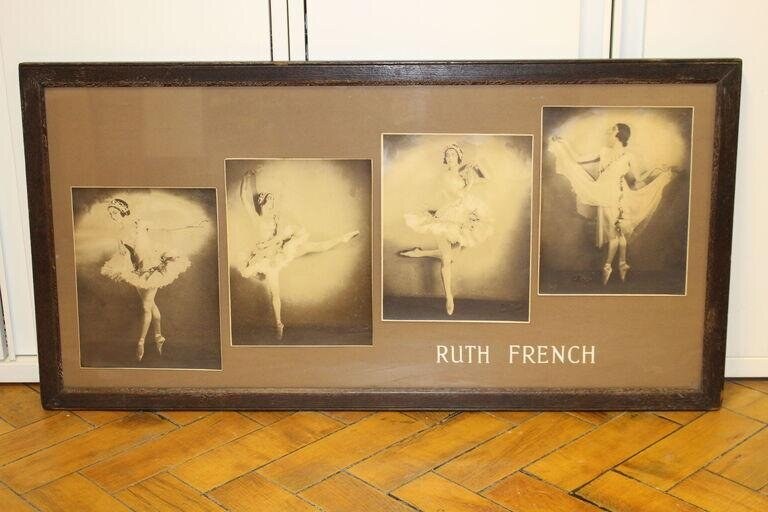
A framed publicity board displays four sepia-toned photographs arranged horizontally across a tan mount, each showing a solo female dancer in classical ballet positions. The photographs progress from left to right, each capturing a different moment or pose. The dancer wears a white tutu and pointe shoes in each image. The lighting in all four photographs is soft and diffused, creating a ethereal quality typical of early-to-mid 20th-century dance photography. The mount bears the name "RUTH FRENCH" in white capital letters at the lower right. The entire composition is set within a dark wooden frame, suggesting this was a promotional or archival display piece.
The dancing
Each photograph isolates a single female dancer in classical ballet positions. From left to right: the first shows a dancer en relevé with arms in a graceful upper position; the second depicts a standing pose with the body aligned vertically; the third captures an extended leg position, possibly an arabesque or attitude, with the torso articulated; the fourth shows the dancer in a similar extended position from a different angle. The dancer's port de bras (carriage of the arms) is fluid and controlled throughout, with the arms held at varying heights that suggest classical ballet training. The dancer's weight is consistently held upward and forward, the hallmark of ballet technique.
The dance depicted
These photographs document Ruth French, a ballet dancer, in a series of classical ballet positions. The poses—characterized by turned-out legs, raised relevé, and extended limbs—are consistent with the vocabulary of classical Romantic or early 20th-century ballet. The progression of images suggests this may have been a study of movement or a portfolio documenting a dancer's technical range and stage presence. The format of the publicity board indicates French was a working professional dancer whose image was distributed for promotional purposes, likely during the early-to-mid 20th century.
How it was made
This is a composite photograph-and-mount work: four original gelatin silver (or similar) photographic prints mounted on a single backing and framed. The photographs show the characteristics of professional studio portraiture—controlled lighting, neutral background, and careful posing. The sepia tone and soft focus are consistent with hand-tinted or chemically toned photographs from the 1920s–1940s era. The mounting on a commercial publicity board with printed text suggests this was a mass-produced or semi-mass-produced item intended for distribution to theaters, studios, or promotional agencies. The dark wooden frame adds to the archival or institutional appearance.
About this work
This is a publicity board displaying four studio photographs of ballet dancer Ruth French in classical positions. The four-image format was a standard promotional tool in early-to-mid 20th-century dance, allowing theaters and agencies to assess a dancer's technique and stage appeal at a glance. Ruth French is otherwise largely undocumented in surviving institutional records, making this board an important artifact of a working professional dancer whose career was substantial enough to warrant commercial photography and distribution, yet whose name has not been preserved in major dance histories.
How to look at it
Attend to the consistency of the dancer's technique across all four images: the turnout, the lifted carriage, the articulated port de bras. Notice how each photograph frames the body differently—some emphasize the verticality of the pose, others highlight extension of the limb. The soft, diffused lighting and neutral background are intentional; they remove distraction and keep focus on the body's line and shape. This is not a candid moment but a carefully choreographed photographic session designed to display the dancer's capabilities to a professional audience.
The artist
The photographer is not credited on the board. The professional quality and standardized format suggest work by a commercial studio specializing in dance photography, a flourishing specialty in major theater centers during the 1920s–1940s. Ruth French herself remains undocumented in major dance archives and histories; without additional records, her training, career trajectory, and repertoire cannot be established.
The period
In the 1920s–1940s, photography became the primary tool for dance promotion and documentation. Studio portraits of dancers in classical positions served as calling cards for booking agents and theater managers. This was the era of the great Russian Imperial Ballet companies' tours in the West and of a thriving professional ballet scene in major American and European cities. Ruth French's publicity board fits within this economy of professional dance labor, where a dancer's marketability depended partly on the quality and circulation of their photographic images.
Where it lives
The holding collection is identified as "Publicity Board" from source "va" (likely Virginia or a similar institutional abbreviation). This is a framed composite object that functioned as both promotional material and archival artifact, likely housed in a theater collection, studio, or dance archive.
Dance in this work
Questions about this work
Who was Ruth French?
Ruth French was a professional ballet dancer active in the early-to-mid 20th century, known well enough to warrant commercial studio photography and distribution on a professional publicity board. Beyond these photographs, little institutional record of her career survives.
What is a publicity board in dance?
Publicity boards were promotional materials featuring photographs of dancers, typically displaying multiple poses or full-length images. They were distributed to theaters, booking agents, and promotional agencies to help secure engagements and to establish a dancer's professional reputation.
What ballet positions is Ruth French demonstrating?
The four photographs show classical ballet positions including relevé work, standing poses, and extended leg positions (possibly arabesque or attitude). These are foundational positions in classical ballet technique and would have been used to demonstrate the dancer's technical proficiency to prospective employers.
When was this board made?
The photographic style, sepia tone, and mount design are consistent with the 1920s–1940s period, though the exact date is not documented in the catalogue record.
More dance artwork





