49 works in this view — arrow keys or swipe to move between them.
Dance in Art
Santina Zanuzzi
Cattaneo, Gerolamo
- Collection:
- Source:
- Victoria and Albert Museum
- Rights:
- Rights vary by item — check the source record before reusing this image. Source record ↗
- Recorded as:
- V&A — check rights per item
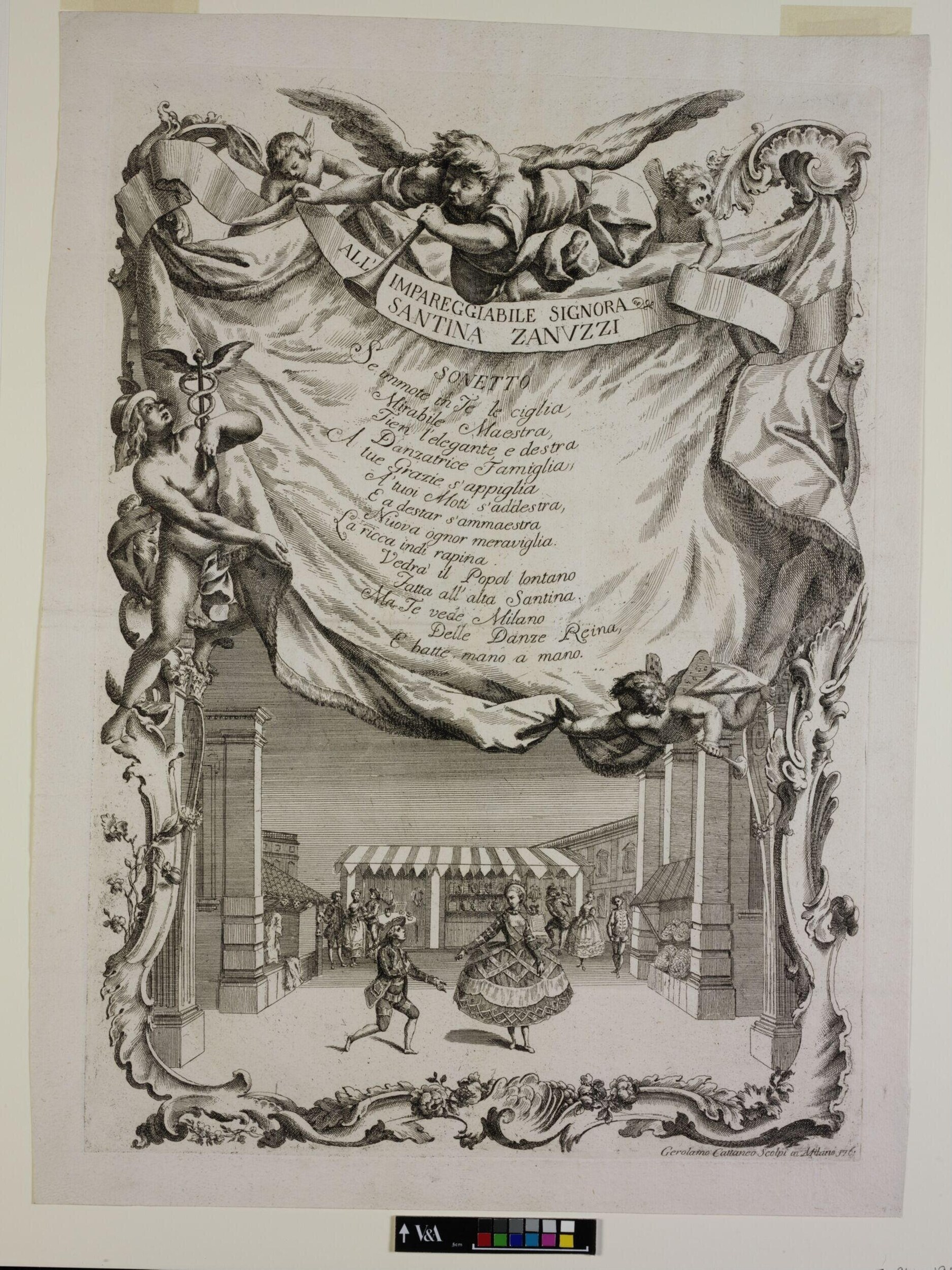
This engraving documents both a named female dancer of the 18th century and the conventions by which her fame was publicly celebrated and circulated. It shows how dance professionals—particularly women—were honored through publication and how the visual language of Rococo art was deployed to elevate the status of the performer and the entertainment. For historians of dance, gender, and print culture, it reveals the intersection of performance, aristocratic patronage, and image-making in the long 18th century.
What you are looking at
This is an engraved title page for a sonnet dedicated to the dancer Santina Zanuzzi, dated 1761. The composition is framed by an elaborate Rococo border of scrollwork, putti, and ornamental flourishes. At the top, two winged putti hold aloft a banner inscribed "AUT IMPAREGGIABILE SIGNORA SANTINA ZANIZZI" (the incomparable lady Santina Zanuzzi). The central field contains the sonnet text in italic script. Below the text, a theatrical scene unfolds in a colonnade: a woman in a full-skirted dress with panniers stands at center, her posture upright and formal; a male dancer in breeches and coat attends her; musicians and onlookers fill the loggia in the background. The architectural setting—with its tall columns, striped awning, and perspective depth—evokes a fashionable indoor entertainment space of the mid-18th century. The classical vocabulary of the frame (with its caduceus on the left margin) and the formal dress of the figures mark this as a work of courtly or aristocratic circulation.
The dancing
The female figure at center wears the full-skirted dress typical of mid-18th-century fashion, with a fitted bodice and panniers creating a broad silhouette. She stands with her weight centered, her posture dignified and composed—the bearing expected of a professional or celebrated dancer of the period. The male figure beside her adopts a complementary stance, suggesting a partnered moment in a formal dance. Both figures are upright and controlled rather than dynamic; the mood is ceremonial rather than acrobatic. A small putti dances or floats at the lower right of the frame, a common Rococo motif signifying the lightness and grace of the entertainment.
The dance depicted
This is a tribute to a celebrated female dancer of the mid-18th century, Santina Zanuzzi, likely Italian given the Italian sonnet and dedication. The scene depicted—a formally dressed couple in a columned interior with musicians—most closely resembles the conventions of theatrical or court dance of the period, possibly a minuet or other suite dance of the Baroque-to-Rococo transition. The woman's prominence in the dedication and central placement in the scene suggests she was known for skill and reputation rather than mere participation; the formal, controlled posture of both figures aligns with the aesthetic of noble or theatrical dance of this era. The identity of Zanuzzi and her specific repertory cannot be determined from the image alone, but the format—an engraved tribute with embedded theatrical scene—suggests she was celebrated enough to warrant publication.
How it was made
This is an engraving, likely executed by Gerolamo Cattaneo in 1761 (as credited in the lower margin: "Gerolamo Cattaneo Sculpt." with a date). Engraving allowed for fine linear detail and was the standard medium for circulating images of celebrated performers and courtly entertainments. The technique's precision enabled the artist to render both the decorative Rococo border and the theatrical scene below with comparable care, and the use of engraving—rather than painting or drawing—indicates this was intended for multiple impressions and distribution among patrons, collectors, and dance enthusiasts. The work combines text and image to create a composite tribute, typical of mid-18th-century practice.
About this work
This is an engraved title page commemorating the dancer Santina Zanuzzi, created in 1761 by the engraver Gerolamo Cattaneo. It frames a dedicatory sonnet with an elaborate Rococo border and an inset theatrical scene showing a formally dressed couple in a columned interior, surrounded by musicians and attendants. The work belongs to the tradition of engraved tributes to celebrated performers of the 18th century—objects intended for circulation among the educated and fashionable classes, combining literary praise, visual celebration of the dancer's presence, and idealized representation of theatrical or court entertainment. Zanuzzi appears to have been a notable figure in Italian dance during the mid-century, though little is now known of her repertory or career beyond this commemoration.
How to look at it
Observe the careful distinction between the ornamental border (addressed to the viewer's sense of luxury and refinement) and the theatrical scene below (documenting an actual moment or type of entertainment). The female dancer's upright, dignified posture is characteristic of the period's ideal of noble bearing; she is not shown in a moment of high motion or acrobatic display, but rather in the formal, composed state expected of a celebrated performer. Notice how the engraving technique allows fine detail in both the architectural perspective of the colonnade and the delicate linework of the Rococo scrollwork—a testament to the skill required to produce such a composite image. The presence of the sonnet text as the primary element, with the theatrical scene as secondary illustration, reminds us that this is fundamentally a literary tribute that happens to include a representation of dance.
The artist
Gerolamo Cattaneo was an Italian engraver active in the mid-18th century. The credit line and date at the lower margin ("Gerolamo Cattaneo Sculpt." with 1761) indicate he executed this print. Cattaneo worked in the context of Italian print culture and theatrical celebration; his engraving style—combining ornamental borders, narrative scenes, and textual matter—was conventional for tributes to performers and courtly entertainments of the period. Little detailed biographical information is available, but his practice situates him among the artisans producing images for educated patrons interested in theater, dance, and fashion.
The period
The engraving dates to 1761, a moment when dance was undergoing significant transformation in Europe. The mid-18th century saw the rise of professional dancers and the formalization of dance notation and technique; women dancers were increasingly prominent on both court and public stages. In Italy, dance remained closely tied to theater and aristocratic patronage, and the publication of engraved tributes to celebrated performers was a common way of honoring and publicizing their work. The Rococo aesthetic—evident in the ornamental frame, the lightness of the putti, and the overall decorative sensibility—was at its height in 1761. The formal dress, the architectural setting, and the overall tone of the work reflect the conventions of courtly or semi-public entertainment in mid-century Italy.
Where it lives
The work is held as a print in an unspecified collection (noted as 'va' in the source field). No further provenance details are recorded. The engraving was created in 1761 and appears to be an original publication from that period rather than a later reproduction.
Dance in this work
Questions about this work
Who was Santina Zanuzzi?
Santina Zanuzzi was an Italian dancer celebrated enough to merit an engraved dedicatory tribute in 1761. The sonnet and theatrical scene indicate she was a professional performer of some renown, likely working in Italian court or theatrical contexts. Beyond this engraving, detailed biographical information is scarce, and her specific roles, companies, or repertory are not documented in readily available sources.
What kind of dance is shown?
The scene depicts a formally dressed couple in a theatrical or court setting, consistent with the conventions of suite dances (such as minuets) or theatrical dances of the mid-18th century. The upright posture, formal dress, and architectural setting suggest a courtly or noble dance rather than a popular or acrobatic form. The specific dance type cannot be definitively identified from the image alone.
Why is this an engraving rather than a painting?
Engraving was the preferred medium for circulating images in the 18th century because it allowed multiple impressions to be made from a single plate, making it economical for distribution to patrons, collectors, and the educated public. This work combines text (a dedicatory sonnet) with image, making it a composite tribute intended to celebrate and commemorate the dancer among those who could afford or access such prints.
What does the Rococo border tell us?
The ornate scrollwork, putti, and classical motifs (including a caduceus) identify this as a work of refined artistic ambition and aristocratic or educated patronage. The Rococo aesthetic signals that the subject—a dance performance—was considered worthy of the same decorative and formal treatment as literary or courtly subjects. It also dates the work firmly to the mid-18th century, when this style was dominant in European print culture.
More dance artwork





