49 works in this view — arrow keys or swipe to move between them.
Dance in Art
Theatre costume
Unknown artist
- Collection:
- Theatre costume
- Source:
- Victoria and Albert Museum
- Rights:
- Rights vary by item — check the source record before reusing this image. Source record ↗
- Recorded as:
- V&A — check rights per item
This costume represents a strand of twentieth-century performance in which the body was deliberately obscured or transformed through architectural garments—a practice that influenced everything from constructivist theater to contemporary dance and fashion. Without knowing the production it served, we can still read the costume's ambition: to make the wearer into a formal sculpture, a moving shape rather than a recognizable human figure. This speaks to the radical experiments of early modernism in dance, when artists broke with ballet and social dance conventions.
What you are looking at
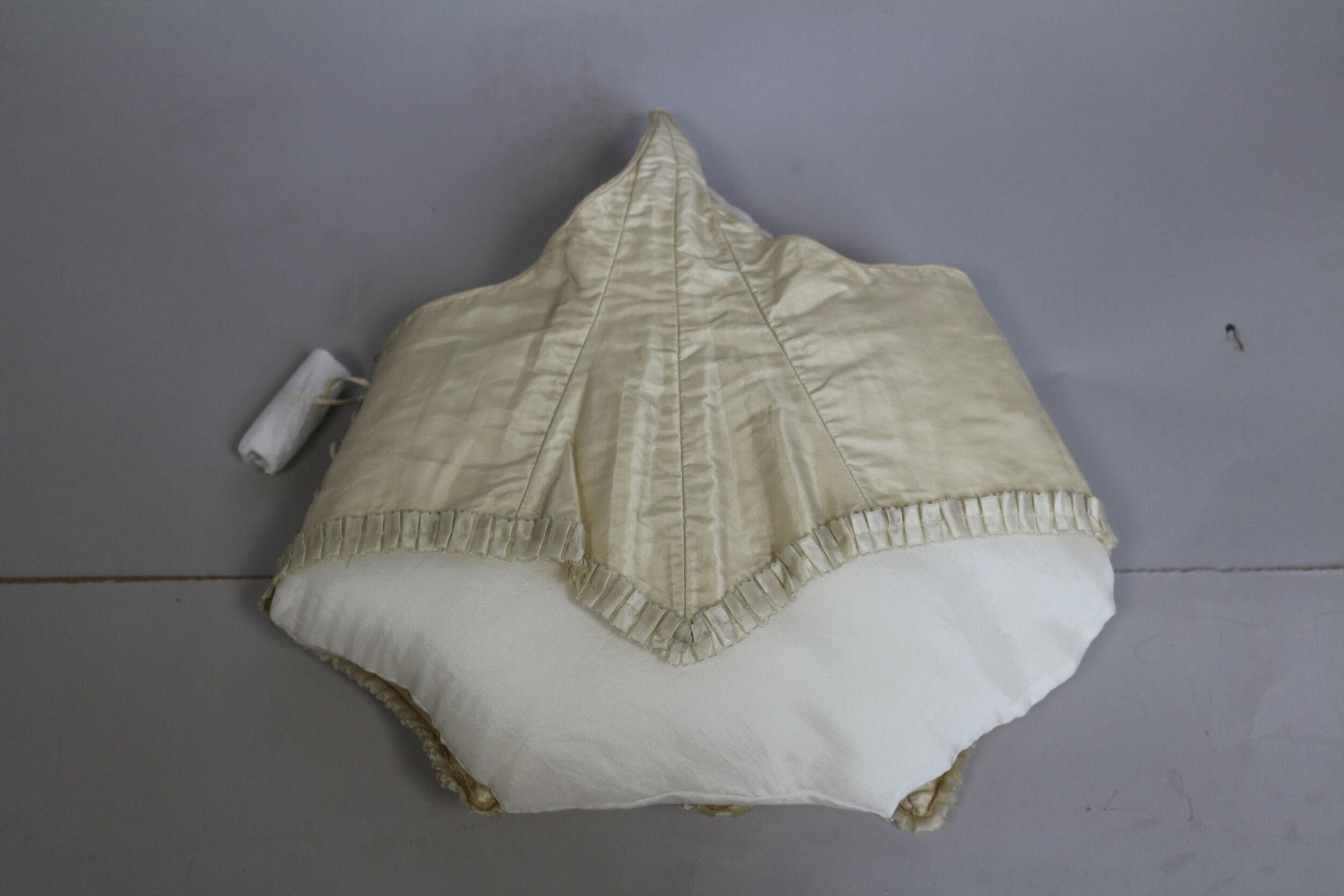
A cream-colored fabric garment is displayed flat against a neutral background, viewed from above. The piece consists of two distinct sections: an upper portion of structured, quilted or pleated linen-like material shaped into a pointed cone at the center, with radiating vertical seams creating a cartwheel or fan effect; and a lower section of soft, voluminous white cotton or linen forming a gathered pouf or bubble silhouette. The upper fabric is naturally off-white with visible seaming throughout, while the lower section is bright white and heavily gathered or ruched around the edges with what appears to be binding or trim. A small white paper label or tag is visible at the left side. The garment reads as a theater costume designed for a specific silhouette and movement—the structured top would hold its conical form on stage, while the gathered lower portion would create dramatic visual effect and allow freedom for gesture or motion.
The dancing
This is a costume piece rather than a figure in motion. The garment would create an exaggerated, architectural silhouette on a wearer: the cone at the top suggests a headpiece or shoulder extension, and the bubble of gathered fabric below implies a distorted torso or skirt volume. The radiating seams of the upper section suggest it was designed to project outward from a central point, creating a sculptural effect visible from multiple angles on stage. The construction implies the wearer's body would be largely obscured or abstracted.
The dance depicted
This is a theatrical costume, but the specific dance tradition cannot be identified with confidence from the garment alone. The architectural, non-naturalistic silhouette suggests early to mid-twentieth-century avant-garde theater or dance rather than classical ballet or ballroom dance. The structure—cone over gathered bubble—does not match the codified costumes of ballet, contemporary dance technique, or social dance forms. It may derive from experimental modernist dance of the 1910s–1930s, constructivist theater design, or abstract movement practice. Without documentation of the performer, choreographer, or production, the specific dance context remains unknown.
How it was made
This is a constructed textile object combining two different fabrics and construction techniques. The upper section appears to be quilted, pleated, or structured linen, sewn with visible seams radiating from a central point; the lower section is gathered white cotton or muslin, creating volume through ruching and bound at the hem. The piece was hand-sewn, suggesting professional costume construction from the early-to-mid twentieth century. The materials and techniques are those of stage costume: durable, lightweight, designed for visibility and silhouette rather than wearable comfort.
About this work
This is a theater costume of unknown provenance and date, constructed from cream linen and white cotton. The garment combines a structured cone of radiating pleats with a voluminous gathered skirt, creating a highly stylized, non-representational silhouette. It belongs to no single codified dance tradition but rather suggests avant-garde or experimental theatrical practice, possibly from the early twentieth century when artists including Oskar Schlemmer, the Ballets Russes, and modernist choreographers were reimagining the human body on stage through costume and abstraction.
The work is significant because it embodies a moment in dance history when costume became a vehicle for formal and conceptual experiment rather than decoration or narrative function. It raises questions about the relationship between garment and body, visibility and abstraction, that remain central to contemporary performance.
How to look at it
Stand back and consider the silhouette: how would this garment move? The gathered fabric at the bottom would create dynamic visual interest even in stillness, while the cone projects forward aggressively. A wearer could gesture with arms, but the costume itself would dominate the visual field. This is not a costume that disappears in favor of the dancer's body or expression; it is one that transforms the body into a geometric form. Notice the careful seaming of the upper section—each stitch line contributes to the radiating effect, suggesting this was made by someone who understood how construction creates visual form.
The period
The construction method and materials suggest this costume dates from the early-to-mid twentieth century, a period of radical formal experiment in dance and theater. The 1910s–1930s saw artists including the Ballets Russes (with designers like Léon Bakst), Oskar Schlemmer and the Bauhaus, and German Expressionist theater embracing costume as sculpture and abstraction. The idea that a costume could obscure the human body rather than adorn it, using geometric forms and non-naturalistic silhouettes, was revolutionary. This piece, with its cone and bubble construction, sits within that avant-garde genealogy—it is costume as formal experiment, not costume as representation.
Where it lives
The piece is held in a theater costume collection and carries a paper label suggesting it was catalogued as part of an institutional collection (likely a costume archive or theater museum). The collection label indicates it was preserved specifically as a costume artifact, not as textile art or fashion history.
Dance in this work
Questions about this work
What style of dance was this costume for?
The costume cannot be identified with certainty. Its highly stylized, non-naturalistic silhouette suggests early twentieth-century avant-garde or experimental dance rather than classical ballet, contemporary technique, or social dance. It may derive from constructivist theater, Dada performance, or the radical costume experiments of artists like Oskar Schlemmer. Without production documentation, the specific dance tradition remains unknown.
What is it made of?
The upper section is cream-colored structured linen or cotton, quilted or pleated with radiating vertical seams. The lower section is white cotton or muslin, heavily gathered and ruched to create volume. Both sections are hand-sewn, indicating professional stage costume construction. The materials are practical for theater: durable, visible under stage light, and suitable for movement.
How would a dancer move in this costume?
The costume would transform the wearer's silhouette dramatically. The cone at the top projects forward, creating a striking profile from the side and front. The gathered bubble below would move and shift with any motion, creating visual dynamism even in stillness. The upper structure would restrict vertical arm movement somewhat, but the loose lower portion would allow free leg movement. Overall, the costume would foreground the form and movement of the garment itself rather than the dancer's virtuosity.
More dance artwork





