49 works in this view — arrow keys or swipe to move between them.
Dance in Art
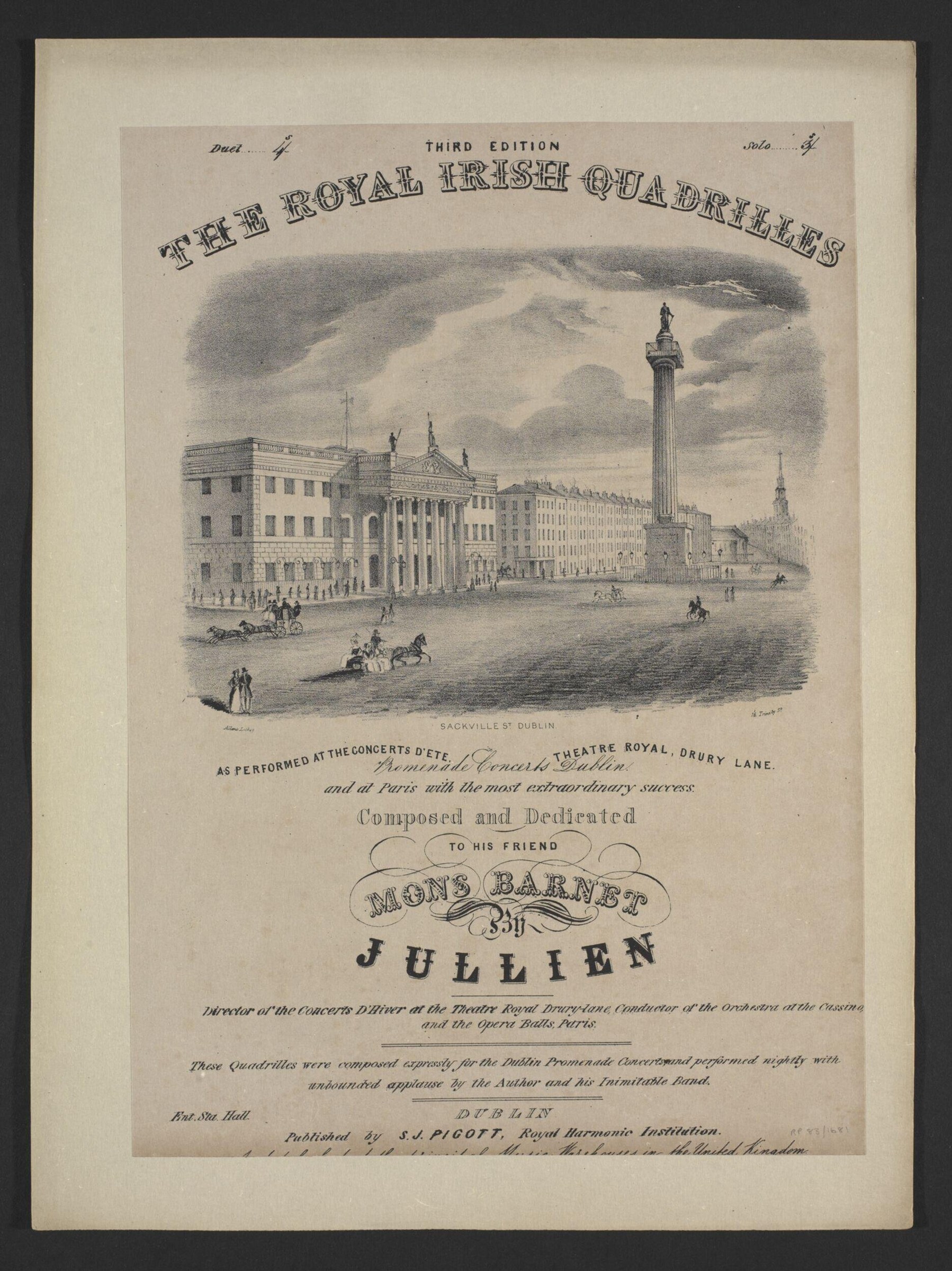
The Royal Irish Quadrilles
Jullien, Louis Antoine
- Collection:
- Sheet Music
- Source:
- Victoria and Albert Museum
- Rights:
- Rights vary by item — check the source record before reusing this image. Source record ↗
- Recorded as:
- V&A — check rights per item
The quadrille was the primary social dance of the 19th-century ballroom, and Jullien was one of its most prolific and celebrated composers. This title page shows how dance music was published, sold, and advertised—it names the venues, the dedication networks, and the geographic reach that made a work 'successful.' For historians of dance, ballroom culture, and 19th-century popular music, this is a document of the machinery that circulated choreography across continents.
What you are looking at
This is the title page of a published musical score, not a depiction of dancers in performance. The engraving shows a grand neoclassical building (identified in the caption as Sackville St Dublin, home to the Theatre Royal and Drury Lane), with a tall column monument at its right and substantial stone buildings lining the square. In the foreground, a few small figures on horseback and on foot move across an open plaza—they are incidental to the architectural focus, not engaged in choreographed dancing. The composition emphasizes civic grandeur and institutional prestige. The whole is set within an ornamental frame of scrollwork, and the text below identifies this as the third edition of *The Royal Irish Quadrilles*, a work composed by Louis Antoine Jullien and dedicated to Mons. Barnet, described as director of concerts at the Theatre Royal. The score was published by S. J. Picott of the Royal Harmonic Institution in Dublin, and the quadrilles were performed with great success at the Promenade Concerts at the Theatre Royal, Drury Lane, and later in Paris.
The dancing
The small figures scattered across the plaza are rendered at such a distance and in such detail that individual gesture cannot be discerned. None of them appear to be in the formal postures or partnered holds that would characterise quadrille dancers. They are architectural ornaments to the urban scene, not anatomically or choreographically the subject of the artist's attention.
The dance depicted
The *Royal Irish Quadrilles* are a set of quadrilles—a ballroom dance in square formation for four couples, typically divided into five figures (Pantalon, L'Été, Poule, Trénis, Galop or Finale). The piece is named for an Irish identity, though the quadrille itself was a French courtly dance that became the dominant ballroom form of the 19th century, from the 1830s onward. The title page tells us that Jullien composed the work and that it was performed at the Theatre Royal, Drury Lane in London (where Jullien was a celebrated bandleader and conductor) and subsequently in Paris with remarkable success. The quadrille, though executed in a ball or concert setting, was sometimes staged as a theatrical spectacle, which may explain the title's reference to 'Royal' performance venues. However, this image itself shows no dancers and reveals nothing about how the dance was performed.
How it was made
This is a lithographed or engraved title page, rendered in fine-line black-and-white technique with light tonal shading to create depth and shadow. The architectural detail suggests either steel engraving or lithography, both of which were standard for music title pages of the 1840s–1860s. The precision and repeatability of the medium meant that this page could be bound into multiple copies of the published score, making it an accessible advertisement for Jullien's work and the venues where it was performed. The ornamental border and formal typography announce the work as a commercial publication aimed at middle-class ballroom dancers and concert attendees.
About this work
This is a music title page, not a picture of dancers. It documents one of the most successful dance music compositions of the 19th century—Jullien's *Royal Irish Quadrilles*—and identifies the institutional and geographic networks through which it circulated: the Theatre Royal Drury Lane in London, Paris concert halls, and Dublin publishers. While it contains no choreographic information, it is a primary historical record of how quadrille music was packaged, marketed, and performed across the anglophone and continental concert and ballroom worlds of the mid-19th century. It stands as evidence of the quadrille's dominance as a social dance form and of Jullien's celebrity as a composer and conductor.
How to look at it
Attend to the architectural setting and the institutional names inscribed on the page. The choice to depict the Theatre Royal Drury Lane as the seat of this work's triumph is itself a claim about the quadrille's status: it was not merely a ballroom dance but a theatrical event, worthy of a grand civic building and professional performance. The small figures in the plaza are a convention of architectural engraving—they establish scale and suggest urban life—but they are incidental to the true subject, which is institutional prestige and the network of theaters, cities, and concert halls through which Jullien's music traveled.
The artist
Louis Antoine Jullien (1812–1860) was a French-born bandleader and composer who became celebrated across Europe and America for his light orchestral music and quadrilles. He was musical director of the Drury Lane Theatre in London and built a reputation for spectacular 'Promenade Concerts' that combined orchestral performance with dancing. He published hundreds of dances and popular pieces and became a celebrity performer; his showmanship and prolific output made quadrille music accessible to ballrooms across the Atlantic world. His works were frequently reprinted and dedicated to wealthy patrons and institutional supporters.
The period
The quadrille reigned as the dominant ballroom dance from the 1830s through the 1880s, particularly in Britain, France, and America. It had originated as a French courtly dance in the 18th century and was popularized in London ballrooms from about 1815 onward. By the 1840s, when Jullien's work was composed and published, the quadrille had become not only a drawing-room dance but also a concert spectacle, performed at fashionable venues and sometimes staged theatrically. Jullien's success with the Promenade Concerts at Drury Lane coincided with a boom in published dance music aimed at the upper and middle classes. The 'Irish' subtitle may reflect the commercial appeal of Irish identity in Victorian cultural markets, or may reference specific musical idioms that Jullien incorporated into the quadrille figures.
Where it lives
This is a printed title page from a published sheet music score, held as part of a collection of dance and music materials. It is a commercial product, meant to be bound into multiple copies and distributed to music sellers, concert halls, and private customers across the English-speaking world.
Dance in this work
Questions about this work
Why is there no picture of the dance on this title page?
This is a music title page, not a dance instruction or performance print. Its purpose was to identify the composer, the dedicatee, the publisher, and the venues where the work had been successful—not to show how the dance was performed. Music publishers of the 19th century often commissioned architectural or landscape views to lend prestige and civic identity to a work, particularly if it had been premiered or championed in a famous theater.
What is a quadrille?
A quadrille is a ballroom dance for four couples arranged in a square. It has five or six distinct figures (like Pantalon, L'Été, Poule, Trénis, and Galop), each with a set of movements performed to a musical tune. It was the dominant ballroom dance of the 19th century and was danced at balls, assemblies, and concert performances from the 1830s onward. Composers like Jullien wrote hundreds of quadrilles, often with nationalistic or whimsical titles.
Who was Louis Antoine Jullien?
Jullien (1812–1860) was a French composer and bandleader famous for his light orchestral and dance music. He conducted the Promenade Concerts at the Theatre Royal Drury Lane in London and became a celebrity performer and showman. He published hundreds of compositions, many of them quadrilles designed for ballroom dancing, and his works were widely reprinted and performed across Europe and America.
What does 'Royal Irish' mean in the title?
It likely signifies both the theatrical prestige of the work (performed at a 'Royal' theater) and a fashionable appeal to Irish musical identity or idiom. The Victorian era saw commercial interest in regional and national identities, and Irish-titled works were popular in ballroom repertoires. Jullien may have incorporated Irish melodies or dance idioms into the quadrille figures, though the score itself would clarify this.
More dance artwork





