49 works in this view — arrow keys or swipe to move between them.
Dance in Art
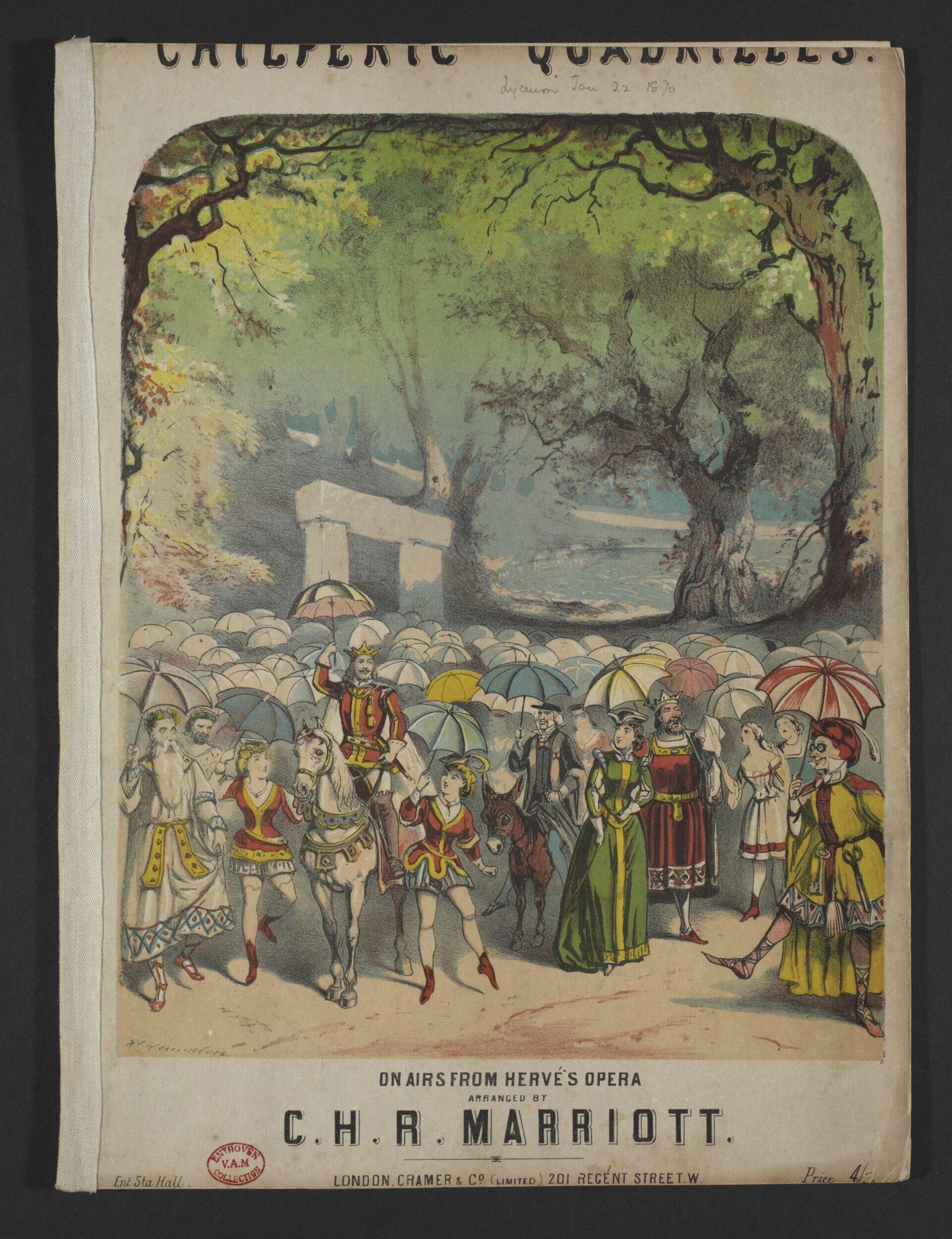
Chipéric Quadrilles
Hamerton, Robert Jacob
- Collection:
- Sheet music
- Source:
- Victoria and Albert Museum
- Rights:
- Rights vary by item — check the source record before reusing this image. Source record ↗
- Recorded as:
- V&A — check rights per item
This work shows how operatic dance music circulated beyond the theatre and how the quadrille—a highly formal, almost mathematical social dance—was romanticized and theatricalized in popular culture. It documents both the dance itself and the economics and aesthetics of music publishing that made operatic culture domestic.
What you are looking at
A crowd of elegantly dressed figures mills beneath an arched natural portico formed by ancient gnarled trees, their foliage creating a green canopy overhead. A white classical structure—perhaps a temple or pavilion—is visible in the middle distance beyond the trees, and blue water suggests a lake or sea. The foreground is densely populated with men and women in richly colored costumes: reds, yellows, greens, and golds predominate. Many hold umbrellas in muted pastels—whites, greys, blues, and pale oranges—creating a visual rhythm across the composition. The figures are arranged in loose groups rather than in strict formation, suggesting a promenade or social gathering. The light is soft and theatrical, rendering the scene with the dreamlike quality of an operatic set piece. The whole image is framed by an ornate rounded border suggesting a stage proscenium.
The dancing
The figures are upright and mobile rather than locked in partnered holds. Several small groups suggest conversation or flirtation—a man in armor or military dress stands centrally with civilians around him. Women's bodies are displayed in full skirts and period gowns; men wear doublets, hose, and decorative garments in bright jewel tones. The weight is distributed for standing and strolling rather than for dance steps; no clear balletic alignment or frame is evident. The arrangement is picturesque and narrative rather than kinetic.
The dance depicted
This illustrates a quadrille, likely from the comic opera *Chilpéric* (or *Chilpéric*) by Jacques Offenbach, which premiered in 1864. Quadrilles were social dances for four couples or eight dancers arranged in a square, performed in ballrooms throughout the 19th century, but here they appear transposed into an operatic and picturesque frame. The image does not depict the quadrille in active execution—no one is clearly in the steps or holds of a quadrille figure—but rather the *tableau* or social scene in which a quadrille might occur. The music arrangement credited to C.H.R. Marriott is dance music extracted and arranged from the opera, intended for home or ballroom performance.
How it was made
This is a colored lithograph, evidenced by the soft gradations of color, the flattened perspective, and the painterly treatment of foliage and light. Lithography allowed this image to be mass-produced and distributed cheaply as sheet music cover art, which was a primary circulation format for opera excerpts and dance music in the Victorian era. The color has been applied by hand or in separate stone passes, creating the luminous watercolor effect. The technique was ideal for theatrical publicity and popular music dissemination.
About this work
This is the cover illustration to a piano arrangement of a quadrille from Offenbach's operetta *Chilpéric*, published by London Chamber & Co. in the 1870s. It depicts the operatic scenario rather than an actual dance lesson or ballroom scene—a theatrical fantasy of a historical moment rendered as a picturesque garden promenade. The quadrille, though one of the most codified social dances of the era, is here absorbed into the operatic aesthetic: narrative, costume, spectacle, and mood matter more than the precision of the steps. The work belongs to a vast body of 19th-century music publishing that made operatic dance music—waltzes, quadrilles, galops—available to middle-class households, democratizing both the operatic repertory and the social dances it featured.
How to look at it
Notice how the artist has suspended the narrative of the quadrille: no couple is actively dancing, and the scene reads as a *between-moments* tableau, a social gathering rather than a kinetic event. The ornate border frames the image as a stage set, and the arcaded trees create a fantasy space outside everyday ballrooms. Look at the umbrellas—they serve no practical purpose but create a visual rhythm and reinforce the theatrical artifice. The costumes are vaguely historical (suggestive of Merovingian or early medieval dress to match the opera's plot) but rendered in the bright, saturated colors of stage costume, not authentic reconstruction. This is operatic escapism.
The artist
Robert Jacob Hamerton was a 19th-century music publisher and arranger active in London. The arrangement credited here to "C.H.R. Marriott" may refer to the same hand or a collaborator. Hamerton's firm specialized in operatic arrangements and popular music for domestic performance, a central business in Victorian cultural life. Beyond the publication details, little is documented of his biography.
The period
The quadrille dominated ballroom culture from the 1830s through the 1880s, taught in academies and danced at all levels of society. Offenbach's operettas, wildly popular across Europe from the 1860s onward, frequently featured dances and contributed to the operatic-comic tone that colored Victorian entertainment. The operetta's blend of spectacle, music, and social satire aligned with the period's appetite for theatrical fantasy. At the same time, the domestic piano and sheet music made operatic culture accessible to non-concert audiences; a family could own and perform arrangements of operatic quadrilles, waltzes, and galops at home. This democratization of operatic music was one of the defining features of 19th-century cultural consumption.
Where it lives
The work is held as a piece of sheet music in a collection or archive (source marked 'va'). It was published by London Chamber & Co., Limited, of 201 Regent Street, London, and sold at a price of 4/6 (four shillings and sixpence). The notation "Lyc[eum?] Jan 22 [18]70" appears in manuscript on the upper right, possibly indicating a performance or acquisition date.
Dance in this work
Questions about this work
What is a quadrille and who danced it?
A quadrille was a social dance for four couples arranged in a square, performed in sets to counted figures. It dominated European and American ballrooms from roughly 1830 to 1890 and was taught in dancing academies to all classes. It required instruction, was highly codified, and was considered a staple of genteel social life—the social dance of the Victorian era, much as the waltz was for the Romantic period.
Why did operas include quadrilles?
Operettas and comic operas of the 1860s–80s often featured dances and social scenes because they entertained a middle-class audience familiar with those dances from ballrooms. Featuring a quadrille on stage made the opera recognizable and fashionable; audiences could then purchase the music, learn the steps, and dance the opera's dances at home. It was a form of product placement and cross-marketing.
What does the costume and setting tell us?
The costumes are vaguely Frankish or early medieval, matching the opera's plot about the Merovingian king Chilpéric. However, they are operatic fantasy, not historical accuracy—bright colors, exaggerated silhouettes, and jewel tones. The arcaded tree setting is romantic and picturesque, evoking an idyllic past that never existed. This is how 19th-century theatre imagined history.
More dance artwork





