49 works in this view — arrow keys or swipe to move between them.
Dance in Art
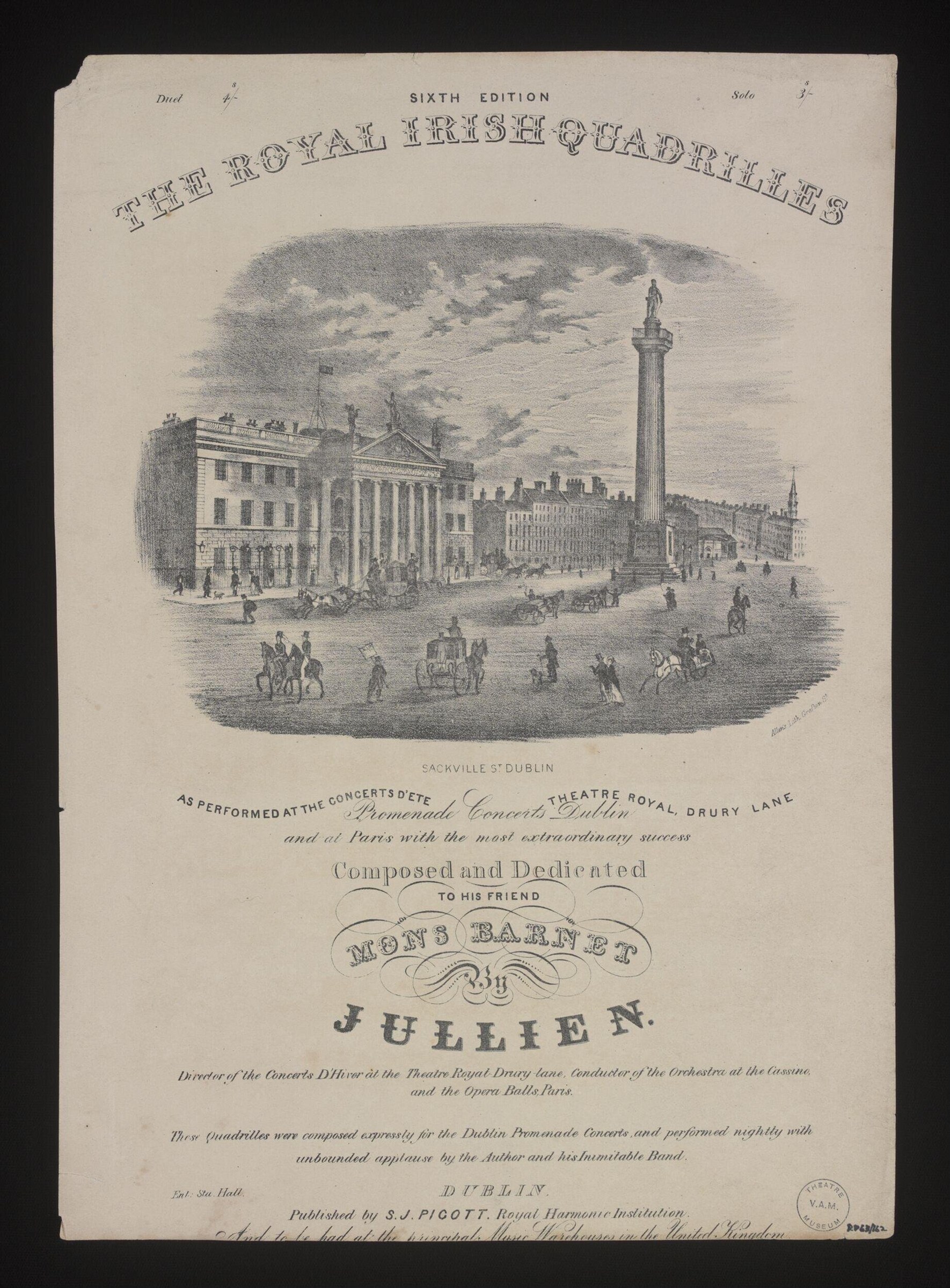
The Royal Irish Quadrilles
Jullien, Louis Antoine
- Collection:
- Sheet Music
- Source:
- Victoria and Albert Museum
- Rights:
- Rights vary by item — check the source record before reusing this image. Source record ↗
- Recorded as:
- V&A — check rights per item
This object illuminates the infrastructure of 19th-century ballroom culture: how dance music was composed, published, and promoted through integrated networks of concert halls, theaters, print distribution, and urban geography. Jullien was a pivotal figure in the professionalization and commercialization of dance music, and his quadrilles defined the sound and social context of ballroom dancing for an entire generation. The engraved title page documents not the dance itself but the framework in which it lived—a lesson in how material culture, architecture, and commercial publishing shaped what dancers encountered and performed.
What you are looking at
This is the title page of a printed musical score, a sixth edition, centered on a finely detailed engraving of Sackville Street in Dublin. The architectural view dominates the composition: a grand classical building with columns occupies the left foreground, while a tall monument or column rises prominently to the right, with Georgian townhouses receding along the street. The plaza below is animated with figures—pedestrians, a few riders on horseback, and horse-drawn carriages—scattered across the open square in casual groupings. The engraving captures a specific moment of urban social life, the kind of fashionable public gathering space where music and dance were performed and consumed. The composition is framed in an oval, and ornamental lettering and elaborate typography surround it, establishing this as a high-end commercial publication.
The dancing
The human figures scattered across Sackville Street are rendered too small for specific dance posture to be legible—they appear as silhouettes and small forms suggesting movement and social congregation rather than formal dance positions. A few figures seem to stand in conversational groups; riders sit astride horses; the overall distribution suggests the gentle traffic of urban promenade rather than choreographed ensemble. The engraver has prioritized the architectural setting and urban character over the precision of individual bodies, making this a record of venue and social context rather than dance technique.
The dance depicted
The work is titled *The Royal Irish Quadrilles* and is credited as composed by Louis Antoine Jullien, a major figure in 19th-century orchestral dance music. The score was performed at the Promenade Concerts in Dublin, at the Theatre Royal, Drury Lane in London, and in Paris. Quadrilles were the dominant fashionable ballroom form of the mid-to-late 19th century—sets of five figures danced by two to four couples in square formation. The engraving of Dublin's Sackville Street positions the music within the urban social world where such dances were performed: public promenades, concert venues, and ballrooms of the gentry and middle classes. The "extraordinary success" mentioned in the inscription suggests this particular suite became a popular attraction.
How it was made
This is a steel engraving, one of the standard commercial techniques for reproducing music and images for wide distribution in the 19th century. The fine lines, the delicate hatching in the sky and architecture, and the crisp detail of the townscape are characteristic of steel-plate engraving, which allowed for longer press runs than copper and thus broader circulation. The title page served as both advertisement and legitimation—a visual claim that this music was performed in prestigious venues by accomplished musicians and witnessed by fashionable crowds. The technique placed the work within the commercial music publishing industry and the urban print culture of London and Dublin.
About this work
This is the title page to a published orchestral score of quadrille music composed by Louis Antoine Jullien, one of the most commercially successful dance music composers of the 19th century. The engraving of Sackville Street in Dublin situates the music within the real geography and social life of urban Europe—marking it as tied to specific, fashionable performance venues and the promenade concert movement. The quadrille was the defining ballroom form of the era, danced by the educated and affluent in formal settings, and Jullien's arrangements were designed to be both technically accomplished and commercially appealing. The work belongs in a dance archive because it is material evidence of how dance music was produced, circulated, and marketed to the urban middle and upper classes; how specific venues and cities became associated with fashionable dance; and how visual design and commercial typography framed dance as a commodity within 19th-century print and concert culture.
How to look at it
The viewer should recognize that this is a commercial object, not a documentary record: the Sackville Street engraving was chosen for prestige and visual interest, not to document what an actual quadrille looked like. Instead, look at what the image claims: that this music belongs to fashionable urban society, that it is tied to specific venues and prestigious concert programs, and that it is sold as a luxury commodity to consumers who recognize Dublin and London as markers of cultural authority. The tiny figures moving through the plaza are almost incidental—the real subject is the architecture and the social order it represents. This is how dance music entered the home and the consciousness of the Victorian middle class: as a printed commodity bearing the marks of urban authority and fashionable sanction.
The artist
Louis Antoine Jullien (1812–1860) was a French conductor and composer who became famous for his orchestral arrangements of popular dances and for his theatrical command of the concert venue. He pioneered the 'Promenade Concert'—open-air or semi-public orchestral performances designed for social gathering and dancing—and toured extensively across Europe and America with his orchestra and his touring dance suites. His quadrilles were arranged for full orchestra and published in multiple editions; they were performed in the most prestigious concert halls and ballrooms of London, Paris, Dublin, and beyond. Jullien's commercial acumen and theatrical flair made him one of the most successful composers of social dance music in the 19th century, and his music shaped the sound and prestige of the quadrille at its commercial height.
The period
The quadrille reached the height of its fashionable dominance in the 1840s and 1850s, exactly the era of this sixth edition. The dance had evolved from French court and salon practice into the defining ballroom form of the Victorian era, danced by the gentry, professional classes, and aspiring middle classes across Europe and America. Public promenade concerts and ballroom assemblies were major sites of urban social life, and composers like Jullien supplied the music that structure these gatherings. The mid-19th century also saw the explosion of commercial music publishing: sheet music, orchestral scores, and title pages with architectural engravings were marketing tools as much as functional documents, designed to project fashionability, urban sophistication, and commercial success. The engraving of a Dublin street on a London-published score reflects the pan-European circulation of both music and the urban gentility it represented.
Where it lives
This is a printed score, sixth edition, published by S. J. Picott's Royal Harmonic Institution. The holding collection is listed as sheet music in the Virginia Museum archives. It represents the commercial music publishing industry of the 19th century and the infrastructure through which dance music reached performers and listeners.
Dance in this work
Questions about this work
Who was Louis Antoine Jullien and why is he important to dance history?
Jullien (1812–1860) was a French conductor and composer who became one of the most commercially successful dance music composers of the 19th century. He invented and popularized the 'Promenade Concert'—a hybrid of concert hall performance and ballroom dancing—and his orchestral arrangements of quadrilles and other dances defined the sound of ballroom culture at its fashionable height. His music was performed in the most prestigious venues in London, Paris, Dublin, and America, and his commercial success made him a model for how dance music could be professionalized and mass-marketed.
What is a quadrille and why does it matter?
A quadrille is a ballroom dance for two to four couples arranged in a square, consisting of five distinct figures danced in sequence. It was the dominant fashionable ballroom dance from roughly the 1820s through the 1880s, especially among the educated and affluent classes. Quadrilles required coordination, memory, and social confidence, and they were central to social rituals like debutante balls, formal assemblies, and public promenades. The quadrille was so culturally significant that its decline after the 1890s marked a major shift in social dance practice.
Why is Sackville Street in Dublin on the cover of a music score published in London?
The engraving of a prestigious Dublin location was a marketing choice: it signaled that this music had been performed in major cities and prestigious venues, and it gave the purchaser a sense of geographic authority and cosmopolitan reach. Title pages of commercial music often featured celebrated architecture and public spaces as a way of claiming cultural legitimacy and fashionable sanction. The image promised the buyer that they were acquiring music that circulated among the affluent and educated across the United Kingdom and Europe.
More dance artwork





