49 works in this view — arrow keys or swipe to move between them.
Dance in Art
Polka Quadrilles
Jullien, Louis Antoine
- Collection:
- Sheet Music
- Source:
- Victoria and Albert Museum
- Rights:
- Rights vary by item — check the source record before reusing this image. Source record ↗
- Recorded as:
- V&A — check rights per item
This work is essential documentation of how social dances were taught and circulated in the 19th century, before film or notation. It shows that dancers learned from images as much as from instruction, and that the music and the movement were inseparable commercial products. For historians of dance and costume, it provides precise detail about the closed hold, the frame, the silhouette of skirts, and the posture considered correct in the 1860s–70s.
What you are looking at
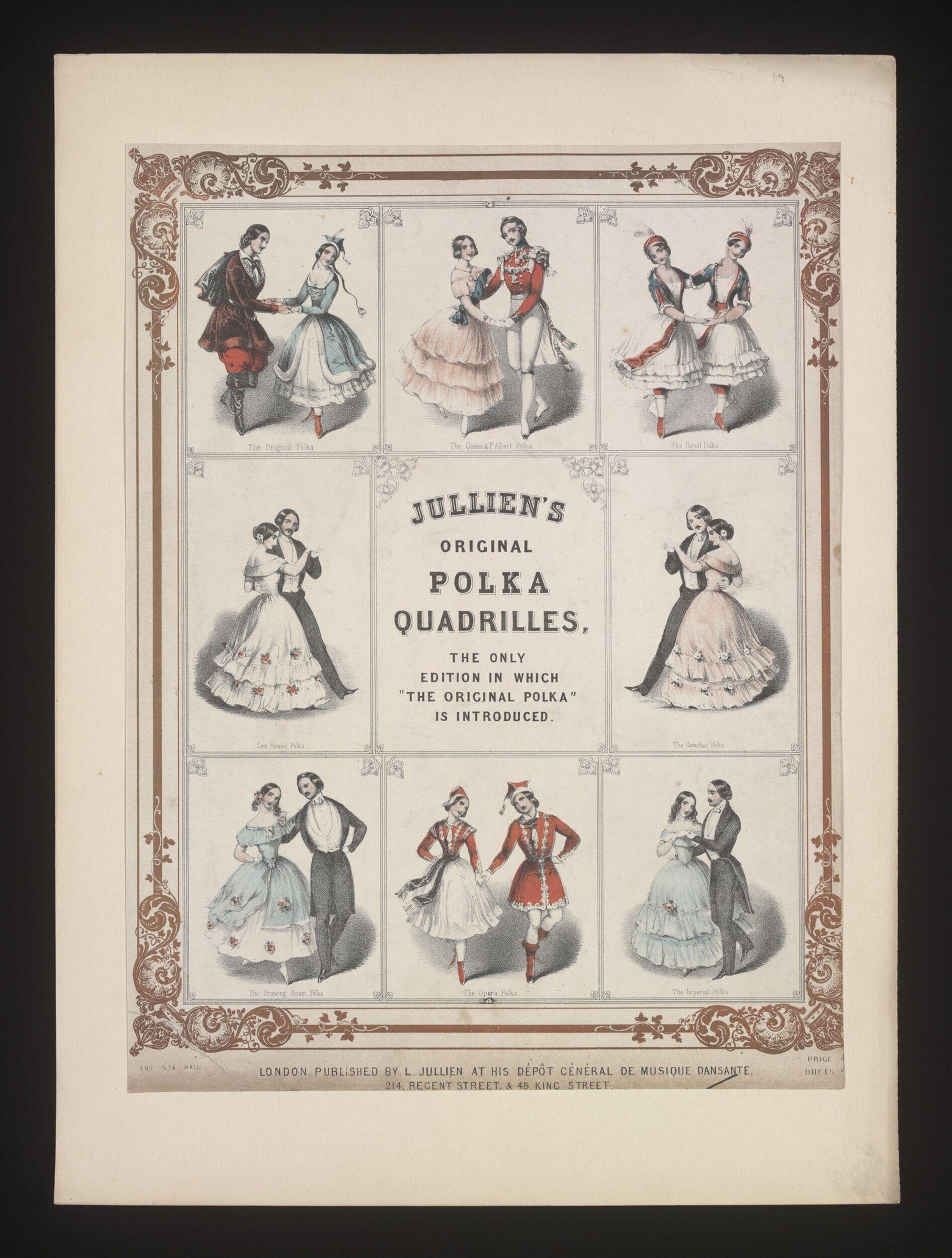
This is a sheet music cover featuring nine hand-colored vignettes arranged around a central title block. Each vignette depicts a couple performing different figures from polka quadrilles, the social dances that dominated ballrooms in the mid-19th century. The dancers wear the formal evening dress of the period: the men in dark coats with colored waistcoats or trim, the women in full-skirted white or pale dresses with off-shoulder necklines, decorated with ribbons and ruffles. The settings are plain—bare stages or ballroom floors with no architectural detail—which focuses attention entirely on the dancers' bodies and costumes. The arrangement progresses through variations: some show a man and woman in a closed hold, others depict two women together, still others show the moment of a turn or the gathering gesture before movement. The color palette is restrained—sepia tones for the engraved lines, with hand coloring in reds, blues, and flesh tones applied over the print. The ornate brown border, with its rococo scrollwork and corner flourishes, frames the whole as a prestigious music publication.
The dancing
The couples are shown in the closed ballroom hold standard to the period: the man's right hand on the woman's back, her left hand resting on his shoulder, their other hands joined at shoulder height. The frames are upright and formal, with the dancers' bodies held at a slight distance from each other. In several panels, the women's skirts are caught mid-swing, showing the silhouette of movement without exaggerating it. The artists have taken care to show the variety of figures within quadrille dancing—some panels show the promenade position, others the separated positions used in allemande or chassé figures. Weight appears to be centered and controlled rather than dynamic; the dancers are posed at moments of transition rather than at peaks of physical effort.
The dance depicted
This is sheet music for polka quadrilles—a hybrid social dance form that combined the four-couple square formation and figures of the traditional quadrille with the tempo and character of the polka. Polka quadrilles were a staple of mid-Victorian ballrooms, danced at both formal and semi-formal occasions by mixed groups of amateurs. The title promises that this edition is "the only edition in which 'The Original Polka' is introduced," suggesting that Jullien was marketing a particular arrangement or novelty within the already-popular quadrille repertory. The image shows not the music itself but the dance figures that the music would accompany—a common format for dance music publications of this era, which needed to reach dancers who could read movement if not notation.
How it was made
This is a hand-colored lithograph or engraving, printed in black line and colored by hand after printing. The technique is evident in the crisp outlines and the slight irregularities in the color application, which stops just short of the lines in places and occasionally overlaps. This production method was the standard for popular music publication in the mid-19th century: lithography allowed for the reproduction of detailed figure studies and ornamental borders, while hand coloring added prestige and made each copy slightly individual. The imprint at the foot identifies the publisher as L. Jullien at his depot in London (214 Regent Street and 40 King Street), establishing this as a commercial music publication intended for home and ballroom use by paying customers.
About this work
This is a music cover for a set of polka quadrilles published by Louis Antoine Jullien in mid-19th-century London. It is not a representation of a single moment or performance, but rather a visual catalogue of the figures and positions that dancers would execute to the accompanying music. The nine vignettes show the standard vocabulary of the dance in the dress and posture of the period, providing both dancers and musicians with a visual reference for the movement they were about to perform together. As a commercial music publication, it documents not elite or theatrical dance but the social dancing of the middle classes—the ballroom entertainment that formed the everyday world of dance for the educated urban public.
How to look at it
Look first at the variety of positions shown across the nine panels: not all are identical holds or moments. The cover is teaching through example, showing the range of positions and figures that make up a single dance form. Notice the precision of the women's skirts—the way fabric is drawn to show weight and movement without exaggeration, a skill that required both artistic knowledge of dance and tailoring. Observe how the artists have managed to convey the formality and control of the period's ballroom etiquette: even in motion, the dancers maintain an upright frame and a distance from their partners that would have been the mark of propriety.
The artist
Louis Antoine Jullien (1812–1860) was a French conductor, composer, and music publisher who made his career in London. He was a prolific composer of dance music—quadrilles, polkas, waltzes, and galops—and a major publisher of popular music for amateur performers. His publications were luxuriously produced and widely distributed, making him one of the most visible names in Victorian music publishing. Jullien was known for theatrical programming and for marketing novelty arrangements; his claim to publish "the only edition" of the Original Polka is characteristic of his sales strategy.
The period
The polka quadrille emerged in the 1840s–50s as ballroom culture absorbed the newly fashionable polka from Central Europe. The traditional quadrille, which had dominated ballrooms since the early 1800s, was adapted to incorporate polka steps and tempo, creating a hybrid that allowed dancers to enjoy the novelty of the polka within the familiar structure of the quadrille. By the 1860s, polka quadrilles were one of the standard dances in the ballroom repertory, and music publishers competed to sell arrangements. The period was the height of Victorian ballroom culture, when social dancing was a required accomplishment for the middle and upper classes, and when printed music and dance instruction formed a vast commercial market.
Where it lives
This is a sheet music cover, part of the sheet music collection held in the Gallery of Dance in Art. The object served as both a commercial product for sale and a functional guide for dancers and musicians preparing a performance or practice.
Dance in this work
Questions about this work
What is a quadrille?
A quadrille is a square formation social dance for four couples (eight dancers), performed in a sequence of five figures. Each figure lasts 32 bars of music and uses a different combination of steps and positions. Quadrilles were the dominant social dance of the 19th century and were danced at all levels of society. A polka quadrille is a quadrille that incorporates polka steps and rhythm.
Who danced polka quadrilles?
Polka quadrilles were danced by the middle and upper classes at balls, assemblies, and private parties. They required no professional training and were taught through dance instruction books, live instruction, and by learning from experienced dancers. Music publishers like Jullien published both the music and instructional materials, making the dances accessible to amateurs.
How did dancers learn from images like this?
Visual instruction was the primary method before film and notation systems became standard. A skilled dancer could read the posture, frame, and positioning shown in an image and understand the figure being danced. These covers also served as memory aids and as publicity that advertised the music and made the dance appealing through images of fashionable dress and ballroom elegance.
Why are there nine different vignettes?
Each vignette shows a different figure or moment within the polka quadrille. The images together form a visual inventory of the movements and positions that dancers would execute across the entire piece, giving both dancers and musicians a reference for how the music and movement aligned.
More dance artwork





