49 works in this view — arrow keys or swipe to move between them.
Dance in Art
Henriette Quadrilles
Rodwell, George Herbert Buonaparte
- Collection:
- Sheet Music
- Source:
- Victoria and Albert Museum
- Rights:
- Rights vary by item — check the source record before reusing this image. Source record ↗
- Recorded as:
- V&A — check rights per item
For historians of ballroom dance, this image is a primary document of how quadrilles were actually danced and staged in the 1840s–1850s, capturing posture, dress, spatial arrangement, and the role of spectators. For art historians, it exemplifies the visual culture of commercial dance publishing and the way theatrical engravings constructed the ballroom as a spectacle for consumption by the reading public.
What you are looking at
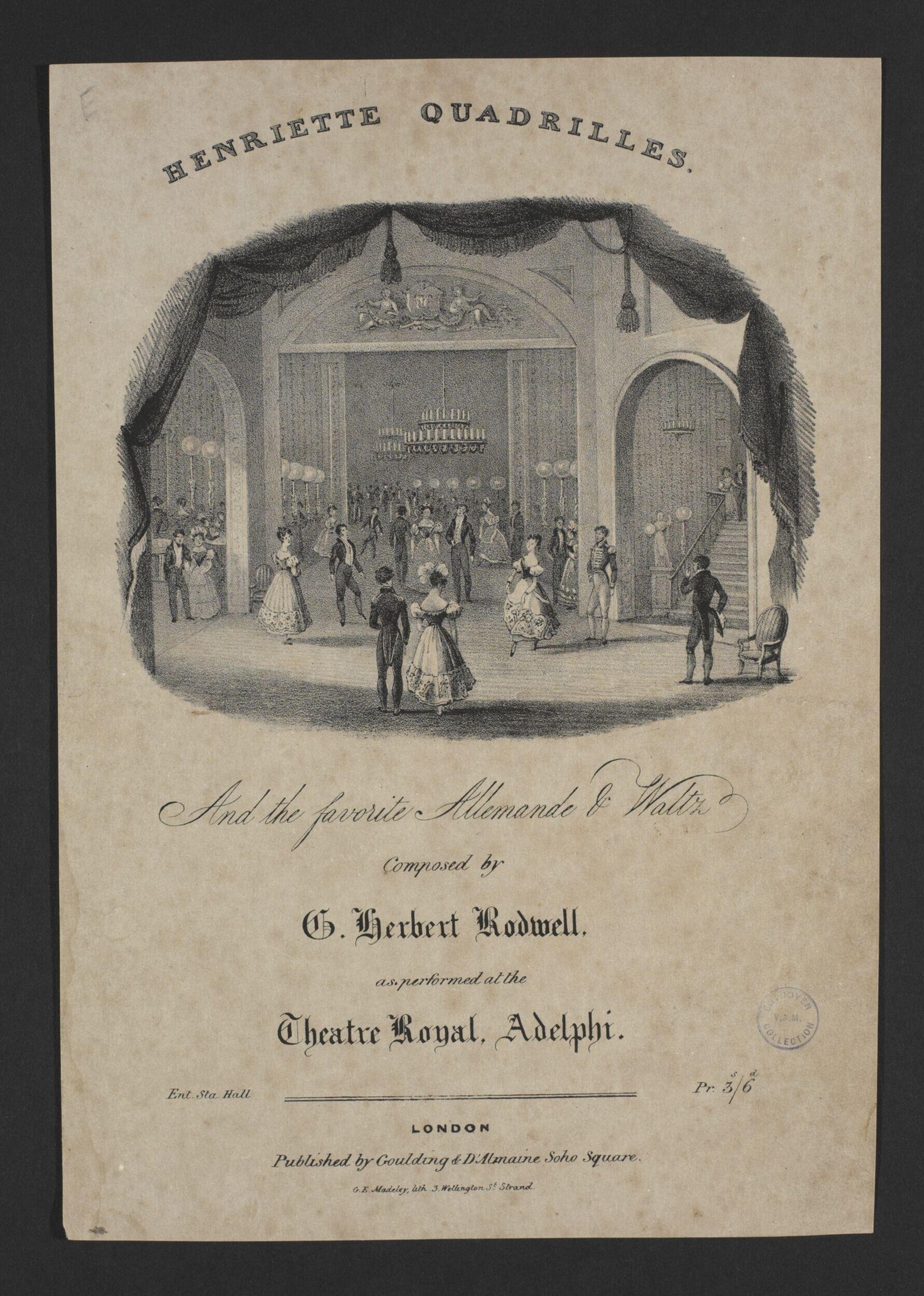
This engraved frontispiece depicts a grand ballroom during a formal quadrille, viewed through a decorative proscenium arch draped with swags and tassels. The scene is set on a polished floor within a high-ceilinged interior lit by a large chandelier visible at the center top. Multiple couples and spectators populate the space in formal dress: the women wear full-skirted gowns of the 1840s–1850s period, while the men stand in dark tailcoats. The composition employs a theatrical perspective, with couples arranged both in the foreground and receding into the middle ground. At right, a few figures stand as observers or wait their turn. The artist has rendered the scene with careful attention to the interplay of light and shadow across the architecture and figures, using the sharp lines of engraving to suggest the formality and structured geometry of the quadrille formation.
The dancing
The dancers are arranged in distinct couples and groups characteristic of the quadrille format. Most visible couples stand in upright, formal posture with arms held at chest or side in the restrained manner of mid-nineteenth-century ballroom dance. Several figures appear to be in motion—a woman in the left-center foreground has her skirt caught mid-turn, suggesting the rotational figures of the dance. The men and women maintain the closed-hold or side-by-side positioning conventional to the era. Spectators and seated figures occupy the periphery, as was customary at formal balls where quadrilles were performed in sequence.
The dance depicted
This is a quadrille, the dominant social dance of the Regency and mid-Victorian era. The quadrille was danced by four couples arranged in a square formation, executing a series of prescribed figures to orchestrated music—typically in duple meter with distinct musical phrases cueing each figure. 'Henriette Quadrilles' suggests this may have been a published set of quadrille music with figures named after a notable dancer or patron named Henriette, a common practice for commercially released dance music of the period. The scene depicts the formal, public performance of such a dance at a fashionable ball, where the quadrille's geometric precision and clear hierarchy of couples made it ideal for large gatherings.
How it was made
This is an engraving, a relief printing technique that allowed precise reproduction and wide circulation of popular imagery in the mid-nineteenth century. The fine parallel lines and careful cross-hatching visible throughout create tone and texture, while the bold outlines define form. Engravings of ballroom and theatrical scenes were standard commercial products in London during this period, distributed as sheet-music covers, theatrical souvenirs, and fashion documentation. The technique's precision suited the formal, architectural framing of the scene and the detailed rendering of costume.
About this work
This engraved cover for orchestral quadrille music documents the aesthetic and social practice of mid-nineteenth-century ballroom dance at its height. The quadrille dominated fashionable society from the 1830s through the 1880s and was understood as both a display of discipline and elegance and an occasion for courtship and social hierarchy. Henriette Quadrilles is one of hundreds of named quadrille sets published in London during this era, many marketed by dancers' names or theatrical associations. The proscenium framing and theatrical lighting treat the ballroom as a stage, a convention reflecting the quadrille's emergence from French court dance and its central role in the performance of social status.
How to look at it
Notice the theatrical proscenium arch that frames the scene—a convention that treats social dancing as spectacle rather than mere recreation. This framing was essential to the marketing of quadrille music and reflected the era's understanding of the ballroom as a stage. Observe the woman at left whose skirt is caught in motion, the only figure whose body clearly indicates active turning; this is the moment of a specific figure within the quadrille sequence. Pay attention to the formal dress and posture of all figures: the restraint and upright carriage of both men and women were central to the aesthetic of 'proper' ballroom dancing. The presence of stationary observers at the edges confirms that even social dancing was partly a public performance.
The artist
George Herbert Buonaparte Rodwell (1803–1852) was a prolific English composer, conductor, and theatrical impresario active in London. He composed extensively for the stage, particularly for Drury Lane and other major theatres, and wrote numerous quadrilles and other dance music for publication. His works were among the most commercially successful dance music of the 1840s–1850s. Rodwell was known for attaching fashionable or theatrical names to his quadrille sets in order to enhance their marketability—a standard practice.
The period
The quadrille was at the absolute center of genteel social dancing in Britain during the 1840s–1850s. It had arrived from France in the early 1800s and by mid-century had become the defining dance of the ballroom, replacing the country dance and longways sets of the previous generation. Published quadrille music with named figures was a booming commercial sector, with composers, musicians, and dancing masters competing to issue new sets. The theatrical framing of ballroom scenes in prints and covers reflected the period's fascination with the ballroom as a space of performance and social display, a fascination also evident in the popularity of novels set in balls and the rise of professional ballroom choreography. Engraved sheet-music covers were a key medium through which middle-class households consumed and displayed knowledge of fashionable dance.
Where it lives
Sheet-music cover engraving, published by Goulding & D'Almaine in London. This object belongs to a vast commercial archive of dance music covers produced for the English publishing trade in the mid-nineteenth century. Such covers were sold separately or bound into collections and serve as primary visual evidence of how ballroom dances were performed and understood.
Dance in this work
Questions about this work
What is a quadrille?
A quadrille is a social dance for four couples arranged in a square, dancing to a structured sequence of musical figures. Each figure was performed by all four couples together or by specific couples in turn. The music typically lasted 5–8 minutes and was performed in duple meter with clear musical phrases marking each new figure. Quadrilles dominated fashionable ballrooms from the 1830s through the 1880s.
Why are there so many named quadrilles?
Composers and publishers created thousands of quadrille sets, often giving them names of fashionable dancers, theatres, cities, or current events to make them marketable and memorable. 'Henriette Quadrilles' likely refers to a dancer or patron named Henriette. These named sets were collected and published in volumes so ballrooms and dancing masters could perform new material throughout the season.
What does the proscenium arch mean?
The theatrical arch framing the scene treats the ballroom as a stage and the dancers as performers for an audience. This was a common convention in engraved sheet-music covers and reflected the era's understanding of the ballroom as a space of public performance and social display, not private recreation.
Who was George Rodwell?
George Herbert Buonaparte Rodwell was a successful English composer and conductor of the 1840s–1850s who wrote extensively for London theatres and published numerous quadrilles and other dance music. His prolific output made him one of the leading commercial composers of ballroom music during the height of the quadrille era.
More dance artwork





