49 works in this view — arrow keys or swipe to move between them.
Dance in Art
<i>Norma Quadrilles</i>
Jefferys and Nelson
- Collection:
- Sheet music
- Source:
- Victoria and Albert Museum
- Rights:
- Rights vary by item — check the source record before reusing this image. Source record ↗
- Recorded as:
- V&A — check rights per item
This is a rare document of dance pedagogy from the height of the quadrille's popularity. It shows not the movement itself but the preparation and instruction that preceded it—the stance, the dress code, and the hierarchical relationship between teacher and student that structured ballroom dancing in the nineteenth century. For historians of dance and social practice, it is evidence of how technical knowledge was transmitted and standardized across the ballrooms of Britain.
What you are looking at
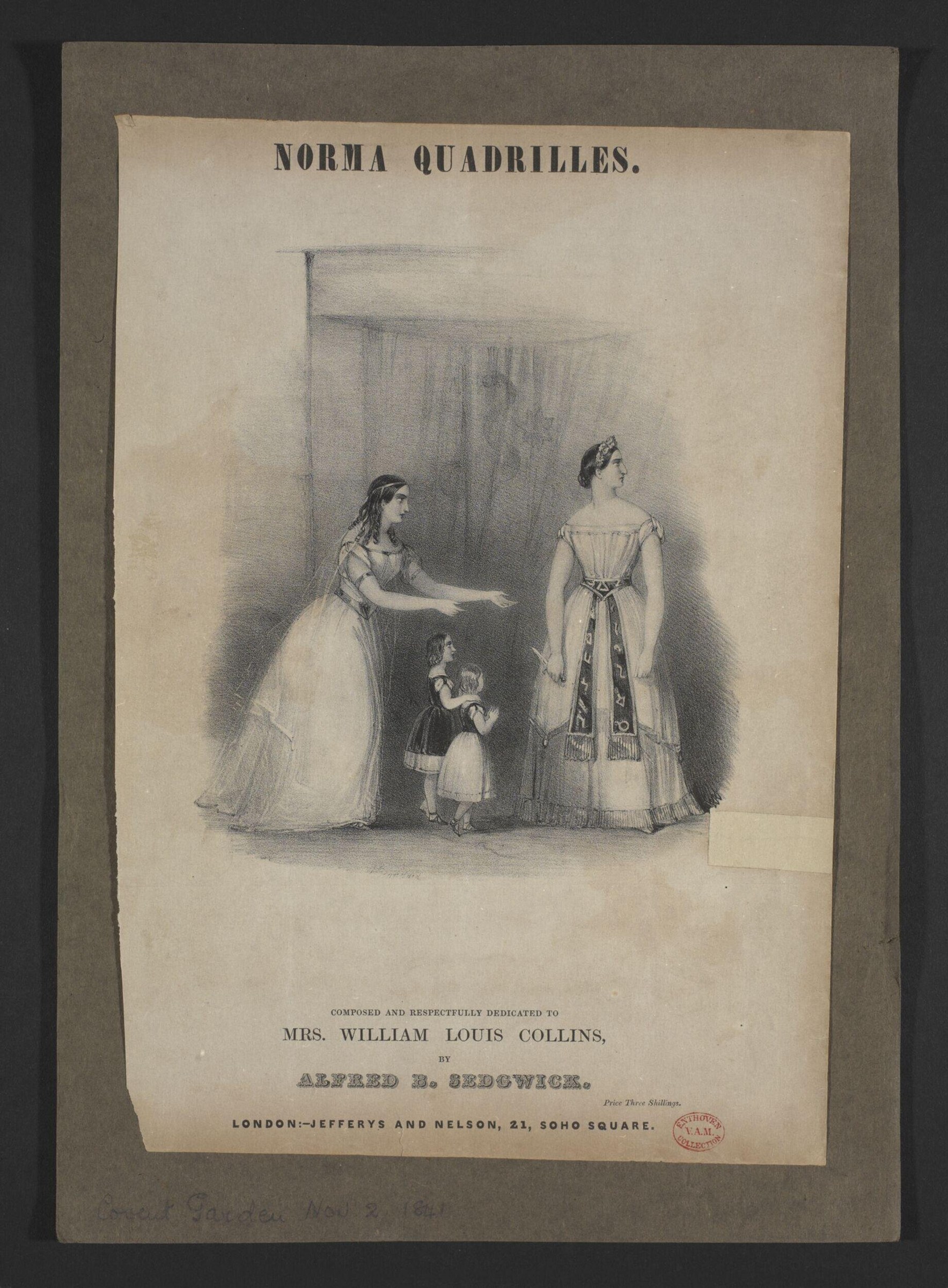
A pencil or charcoal drawing depicts three female figures in an interior setting defined by draped curtains in the background. On the left, a young girl in a white muslin dress stands with one arm raised, gesturing toward the center. In the middle, a smaller child in dark clothing with a white collar stands between the two older figures. On the right, a young woman in a white dress with a decorative sash or ribbon at the waist stands in profile, her posture upright and formal. The three figures are arranged in a compositional line that suggests a teaching or demonstration moment, with careful attention to the delicate fabrics of their gowns—the voluminous skirts, the simple necklines, and the refined details of Regency-era dress. The drawing employs careful shading to create volume and depth, with the background suggested rather than detailed.
The dancing
The left figure's raised arm and forward-leaning posture suggest she is demonstrating or instructing. The central child stands passively between the two older figures, presumably learning. The right figure maintains an erect, composed stance with hands at her sides. All three are shown in formal, upright posture consistent with ballroom etiquette rather than active movement. The arrangement is static and hierarchical rather than dynamic—this reads as a lesson or presentation rather than the moment of dancing itself.
The dance depicted
The title and publication context indicate this is instructional material for the quadrille, the most fashionable group dance of the 1840s. The quadrille was a figure dance performed by four couples in a square formation, executed to lively music. The composition here appears to show a teacher or more experienced dancer demonstrating form and posture to younger students, typical of how quadrilles were taught in ballrooms and drawing rooms. The three figures may represent a simplified teaching scenario rather than an actual quadrille formation.
How it was made
This is a lithograph or engraving—a print rather than a painted original. The medium is established from the image by the characteristic line work, the tonal modeling through parallel shading lines, and the formal typography of the title and publication information. Sheet music covers of the 1840s were commonly produced by lithography, a technique that allowed rapid reproduction and distribution. The print was issued by Jefferys and Nelson, music publishers at Soho Square, London, indicating this was a commercial publication circulated among middle-class households for home instruction and performance.
About this work
This is a teaching print accompanying the sheet music for a quadrille, one of the most popular dances of Regency and early Victorian society. The image functions as both an aesthetic object—demonstrating the refined posture and fashionable dress of the period—and a practical instructional aid, showing the upright carriage and formal presentation expected of dancers. Quadrilles were group dances for mixed couples, and this print's dedication to Mrs. William Louis Collins suggests it may have commemorated a dance master or patron of note in London society. The work belongs in a gallery of dance imagery both as a record of how a major social dance was taught and as evidence of the commercial ecosystem around dance in the nineteenth century.
How to look at it
Attend to the formal, composed postures of all three figures: no one is in motion or mid-step. The figure on the left is not dancing but demonstrating, her raised arm showing the proper arm carriage. This is a moment of instruction frozen, not performance. The dress is also instructive—note the simplicity and elegance of the gowns, the lack of ornament, and the emphasis on a clean vertical line from shoulder to floor. The composition is triangular and balanced, emphasizing symmetry and decorum rather than the liveliness that the actual quadrille figures would have demanded.
The artist
The lithograph is credited to Alfred B. Sedgwick and published by Jefferys and Nelson, a significant music publishing house in Victorian London. Sedgwick appears to have worked as a commercial artist producing sheet music covers and dance instruction images. The refined draftsmanship and clear instructional purpose suggest he was experienced in this genre of popular graphic work.
The period
The quadrille dominated European and American ballrooms from the 1830s through the 1860s, displacing the cotillion as the primary group dance. It was considered more orderly and less subject to improvisation than earlier dances, making it ideal for the expanding middle-class ballroom culture of the Victorian era. Dance instruction became increasingly systematized and commercialized during this period, with printed guides, music, and imagery produced for home use. The dedication to Mrs. Collins may reflect the role of women—often experienced dancers or widows—as informal dance teachers in fashionable society.
Where it lives
This sheet music cover is held in a collection of dance-related printed materials. The publication information—'Price Three Shillings. LONDON: JEFFERYS AND NELSON, 21, SOHO SQUARE'—establishes its place within the mid-Victorian music publishing trade and dates it to the 1840s when the quadrille was at peak popularity.
Dance in this work
Questions about this work
What is a quadrille?
A quadrille is a group dance for four couples arranged in a square, performed to lively music in a sequence of five figures. It was the dominant ballroom dance of the Victorian era, more orderly and formal than the earlier cotillion. The name comes from the French 'quadrille' (a small square), and it originated in France in the late eighteenth century.
Why does this look more like a lesson than a dance?
Because it is. This is a teaching image to accompany sheet music, showing the posture and decorum expected of dancers rather than capturing the movement of the quadrille itself. The static arrangement, the hierarchical positioning, and the formal upright carriage all signal instruction rather than performance.
Who was Mrs. William Louis Collins?
The dedication does not appear in the visible image, but such dedications often honored a patron or a woman of rank who had commissioned the music or was known as a dancer or dance teacher. Without additional documentation, we cannot identify her further.
More dance artwork





