49 works in this view — arrow keys or swipe to move between them.
Dance in Art
Olympia Quadrilles
Alfred Concanen
- Collection:
- Source:
- Victoria and Albert Museum
- Rights:
- Rights vary by item — check the source record before reusing this image. Source record ↗
- Recorded as:
- V&A — check rights per item
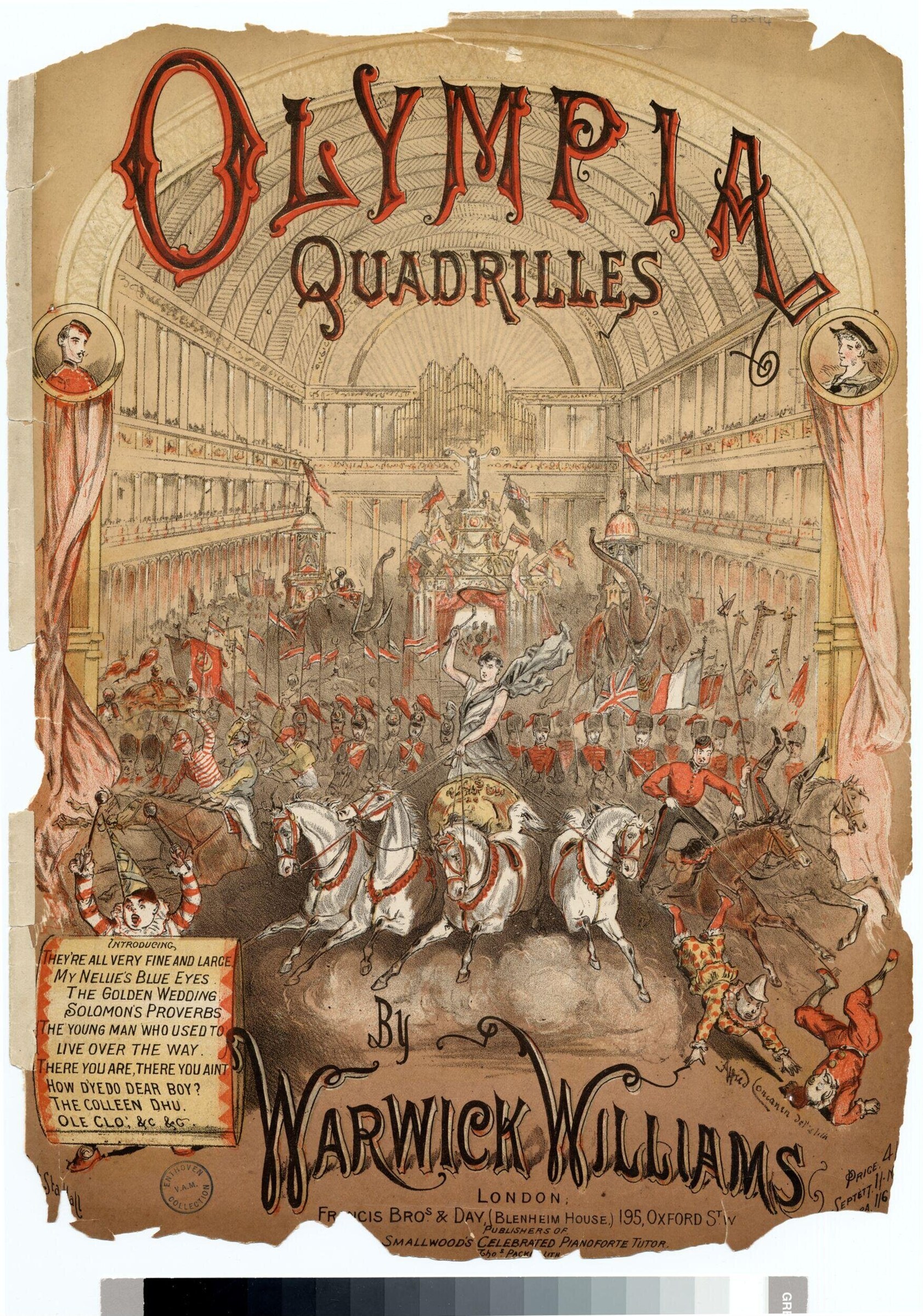
This print is rare evidence of how the quadrille—a social dance—was transformed into public spectacle and military display in the late 19th century. It shows the quadrille not as an intimate parlor amusement but as a form of mass entertainment capable of absorbing completely foreign media (mounted performance, arena setting, military uniform) while remaining recognizably a quadrille. For dance historians, it proves the quadrille's cultural dominance extended far beyond its original ballroom context.
What you are looking at
A theatrical interior depicts a grand equestrian quadrille taking place within an enormous amphitheater or circus building. The space is vaulted and columned, with tiered galleries running the length of both sides packed with spectators in formal dress. The floor is an arena, and four white horses with ornately decorated saddles and bridles carry riders in scarlet and gold military uniforms. These mounted dancers execute synchronized figures while musicians in the orchestra pit play beneath an elaborate organ. The composition is densely packed with supporting performers in the arena—soldiers in red coats, attendants, and civilians—and the upper galleries teem with well-dressed observers, many wearing hats and formal evening wear. Flags and ceremonial decorations festoon the space. The theatrical framing emphasizes spectacle: heavy red velvet curtains hang to either side, and the perspective is drawn from the pit looking up toward the distant vaulted roof.
The dancing
The four mounted riders sit upright in formal equestrian posture, their horses stepping in synchronized rhythm through a geometric formation. The riders' bodies are held vertical and controlled, displaying the classical carriage of military or court horsemanship. Their uniforms—scarlet with gold trim—and the precision of the horse placement suggest disciplined, choreographed movement rather than recreational riding. The dense crowd of standing figures in the arena between and around the horse movements act as visual ballast, framing the central figures and emphasizing their elevated status. No footwork is visible; the dance action is carried entirely by the mounted performers and the geometry of their spatial relationship.
The dance depicted
The 'Olympia Quadrilles' depicts a quadrille performed on horseback—a spectacular form of ballroom dance adapted for mounted performers, typically associated with military or court entertainments of the 19th century. The quadrille, the era's most popular couples' dance, was performed by four pairs in geometric squares and precise figures; here the medium is four horses instead of dancers on foot. The setting (an amphitheater or circus building) and the scale of the production suggest this was a celebrated public spectacle, likely a set-piece in a larger theatrical or equestrian entertainment. The precision of the horses' alignment and the formal uniforms of the riders indicate that this required both skilled horsemanship and ballroom choreographic knowledge.
How it was made
This is a hand-colored wood engraving or lithographic print, evidenced by the fine linear hatching visible in the architectural details, the bold outlines of the figures, and the way color has been applied in distinct flat zones—particularly the red of the uniforms and the pink of the curtains. The technique allowed mass circulation as a promotional or commemorative image; the credit line to Warwick Williams and Francis Bros. & Day (a London publisher based at Blenheim House, Oxford Street) confirms it was a commercial product. The decorative border and the inset box listing the numbers in the 'Olympia' suite indicate this was one of a series—a common marketing strategy for theatrical and sporting spectacles of the period.
About this work
The 'Olympia Quadrilles' records a spectacular mounted version of the 19th-century ballroom's most iconic dance form, reimagined as military pageantry and equestrian skill. This is both a dance document and a theatrical event poster, capturing a moment when ballroom choreography crossed into circus and arena spectacle. The work shows how deeply the quadrille had saturated Victorian entertainment culture—so thoroughly that it could be restaged not just in ballrooms or music halls, but on horseback, in front of thousands, in a grand amphitheater. The artist has chosen a moment of perfect geometric alignment, emphasizing the dance's essence: the creation of order and precise spatial relationship through coordinated movement. For dancers and historians, it is primary evidence of how the quadrille adapted to new audiences and scales beyond the drawing room, and proof that even military entertainment in the Gilded Age was organized according to ballroom geometry.
How to look at it
Trace the four horses' positions and note how they form a perfect square or diamond, even in the frozen moment of the print—this geometric precision is the quadrille itself, translated to the arena. Observe how the crowd frames this central formation; the print's composition emphasizes the vastness of the audience and the scale of production, making the mounted dancers appear both more impressive and more formal. Note the uniforms: the scarlet and gold signal military identity, which was central to Gilded Age spectacle. Finally, look at the technical control implied by the horses' posture and alignment—this was skilled performance, not a gimmick.
The artist
Warwick Williams is listed as the artist/creator on the print. Little is documented about him beyond his commercial work producing theatrical and entertainment imagery for the London publishing house Francis Bros. & Day in the late 19th century. The style is consistent with theatrical promotion prints of the period—bold, decorative, designed to catch the eye and convey the spectacle rather than documentary precision.
The period
The Olympia was a famous London music hall and exhibition space, and this print likely commemorates a specific production mounted there in the 1890s, a decade when the quadrille, though aging as a ballroom dance, enjoyed sustained popularity in theatrical form. The Gilded Age saw ballroom dances adapted repeatedly into circus acts, military formations, and theatrical spectacles—a phenomenon driven by both the quadrille's mathematical structure (which lent itself to visual novelty) and the era's appetite for 'refined' entertainment that retained ballroom credentials while achieving unprecedented scale. Hand-colored prints like this were the primary way these entertainments were publicized, and they often outlasted the performances themselves, becoming records of ephemeral events.
Where it lives
This is a commercial theatrical print published by Francis Bros. & Day, London-based music-hall and entertainment publishers. The location Blenheim House, Oxford Street, confirms the London context. The 'Olympia' in the title refers to the Olympia exhibition hall (later a music hall), a major London entertainment venue. The print appears to be one of a series marketing different 'Olympia' productions.
Dance in this work
Questions about this work
Was this a real performance or an artist's fantasy?
Most likely real. The specificity of the venue (Olympia), the named publisher, the credit to Warwick Williams, and the promotional format all suggest this commemorates an actual production. The quadrille-on-horseback was a real form of entertainment, though spectacular and expensive—circus and music-hall spectacles often featured mounted quadrilles. The print was the primary way such ephemeral performances were recorded and publicized.
Why would anyone perform a quadrille on horseback?
The quadrille's mathematical precision and four-couple structure translated visually to an arena setting and could absorb the prestige of military dress and horsemanship. Gilded Age entertainment capitalized on novelty and scale; a mounted quadrille combined ballroom respectability with spectacular athleticism and visual complexity. It was designed to impress a paying audience with refined choreography executed at an extraordinary level of technical difficulty.
Is this evidence the quadrille was still popular in the 1890s?
Yes, though in transformed contexts. By the 1890s the quadrille was no longer the essential ballroom dance for courtship and social mixing—waltzes and Two-Steps had taken over. But the quadrille retained cultural prestige and was repeatedly adapted into theatrical, military, and circus contexts, suggesting that while it had aged as everyday practice, it remained potent as a symbol of order, tradition, and refined coordination.
More dance artwork





