49 works in this view — arrow keys or swipe to move between them.
Dance in Art
The Bouquet Quadrilles
Saunders, T. W.
- Collection:
- Sheet Music
- Source:
- Victoria and Albert Museum
- Rights:
- Rights vary by item — check the source record before reusing this image. Source record ↗
- Recorded as:
- V&A — check rights per item
The quadrille is now largely extinct as a social practice, making published scores like this among the few direct records of what was danced, at what tempo, and in what harmonic language during the nineteenth-century ballroom's heyday. The image of the dancing figure signals how dance was marketed and consumed as sheet music—not as movement notation, but as a visual commodity and as accompaniment to piano performance. Understanding how music and movement were bound together in parlor culture is essential to reconstructing the sensory and social world of nineteenth-century dance.
What you are looking at
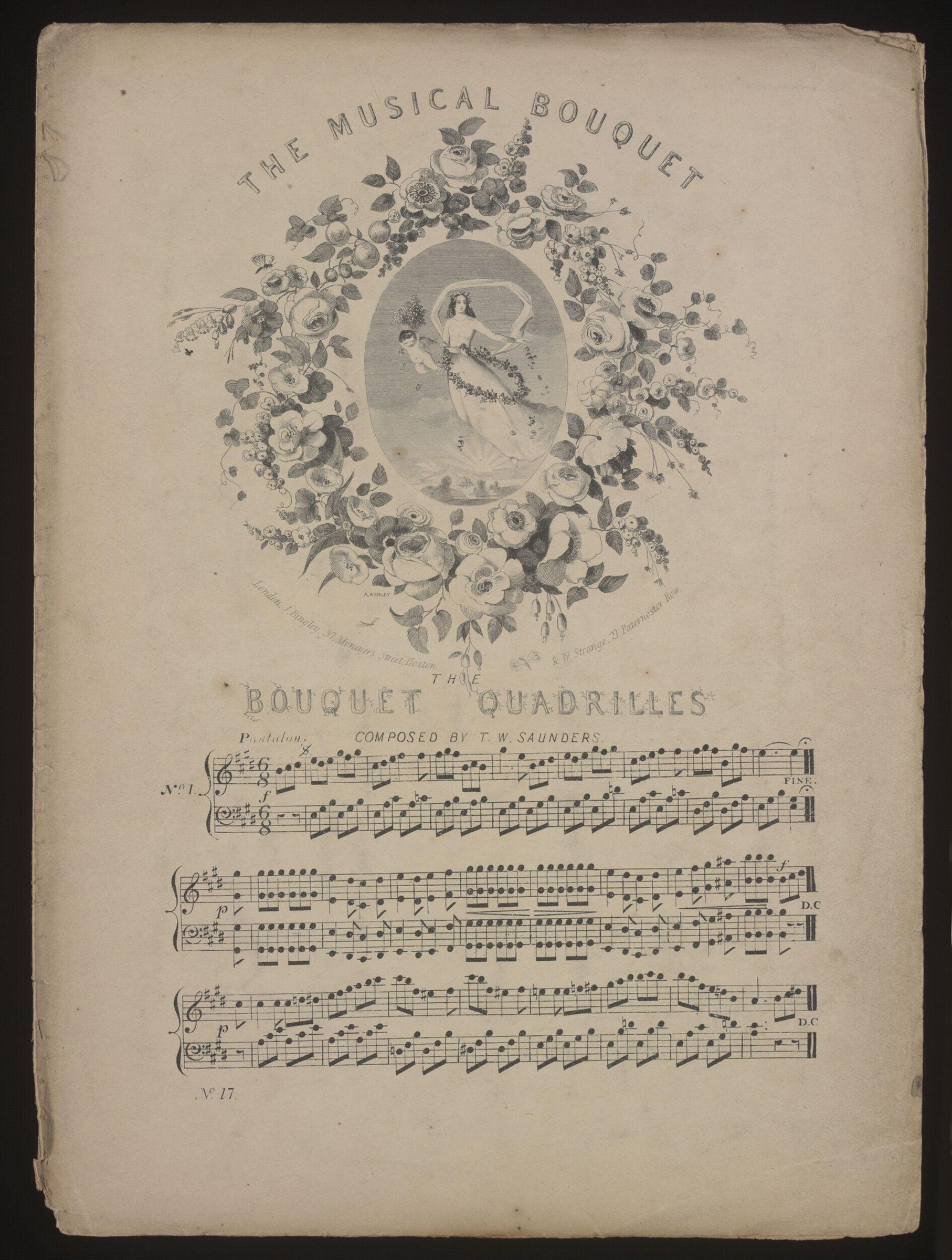
This is the title page and opening music for a published piano composition. The page is dominated by an ornamental wreath of roses, lilies, and cascading botanical forms that frames a central oval vignette. Within that oval sits a single female figure in a flowing white dress, posed in a graceful attitude with one leg extended and arms raised, set against a clouded background. The figure appears mid-movement, captured in a moment of balletic suspension. The title "The Musical Bouquet" arcs above the wreath, and below it "The Bouquet Quadrilles" is inscribed, with composer attribution to T. W. Saunders. Musical notation occupies the lower portion of the page—two complete sections of piano score in what appears to be E major, marked with dynamic indications (p for piano, D.C. for da capo), suggesting this is a multi-part work meant for parlor performance.
The dancing
The single dancing figure is rendered in silhouette within the oval, her body positioned in a classical balletic attitude: one leg supporting, the other raised, the torso upright and graceful, the arms held aloft in a lifted frame. Her posture suggests elevation and control—the codified bearing of trained social dance or theatrical ballet of the period. The silhouette technique removes detail but preserves the essential line and elongation of the figure, emphasizing the verticality and refinement associated with fashionable dance instruction.
The dance depicted
The work is a quadrille, a set dance for four couples that dominated ballroom culture from the 1820s through the late nineteenth century. The quadrilles originated in France and became a staple of bourgeois social dancing in Britain and America. This composition belongs to the parlor music tradition—pieces published for amateur pianists to play at home for domestic dancing or as concert pieces. The title "The Bouquet Quadrilles" is typical of the sentimental, nature-themed nomenclature common to quadrille sets of this period. The musical notation shows a two-part structure with repeats, standard for quadrilles, which typically comprised five figures of 32 bars each.
How it was made
This is a printed sheet music cover and opening page, executed as a lithograph or engraving (medium type not recorded in the catalogue). The ornamental wreath and central vignette are rendered in fine tonal gradation suggesting either lithographic crayon work or steel engraving; the precision of line and the delicate halftone modeling favor engraving. The musical notation is typeset, indicating professional publication. The elaborate decorative border—itself a form of visual marketing—signals this was a commercial product aimed at middle-class households with access to a piano and sufficient leisure and training to read and perform music. Such publications proliferated in nineteenth-century urban centers and were a major vector for the dissemination of dance repertory and style.
About this work
This is a published quadrille composition from the nineteenth century, presented as a parlor music score with decorative frontispiece. The quadrille was the dominant social ballroom dance form of the era, danced by couples in formal dress at balls, assemblies, and private entertainments. The work exemplifies the commercial music publishing industry that served the bourgeois market for dance music and instruction. The silhouetted female dancer in the vignette—poised, refined, and lifted—embodies the aesthetic values of nineteenth-century ballroom dance: elegance, control, and the theatrical polish of trained movement adapted for social use.
How to look at it
Look at the pose of the silhouetted dancer and note the lifted, elongated carriage—the figure is not relaxed or naturalistic but trained and composed, held in a moment of suspension that makes visible the control demanded by ballroom dance. The ornamental frame itself is worth attention: the roses and botanical excess surrounding the dancer signal that this is not a document of peasant or folk dance, but a refined, cultivated social practice tied to bourgeois aesthetics and consumption. The sheet music below anchors the image; it reminds us that quadrilles were experienced primarily as music, and that the dancer's body was always in coordination with the piano's tempo and phrasing. The silhouette technique, conventional in nineteenth-century sheet music covers, obscures individual identity and dress detail, emphasizing instead the abstract, codified line of ballroom posture.
The artist
T. W. Saunders is known as a composer of social dances and quadrilles from the mid-nineteenth century. Saunders was one of many publishing composers who supplied the steady demand for new quadrille figures and variations; such composers rarely achieved individual fame but were essential to the infrastructure of dance culture. Saunders' work represents the standard commercial output of the period—competent, stylistically conventional, and designed for immediate consumption by dancing pupils and domestic performers.
The period
The quadrille dominated European and American ballrooms from approximately 1820 to 1900, reaching peak popularity mid-century. By the 1850s-1870s, when this score likely appeared, quadrille publishing was at its height: new sets were released regularly, often with names derived from fashionable topics, literature, or romantic themes. The parlor piano was becoming standard furniture in middle-class homes, and the market for sheet music expanded dramatically. Dance instruction manuals proliferated simultaneously, teaching not only the quadrille's figures but also the deportment and aesthetic ideals embedded in the movement. Lithographic and engraved music covers became increasingly ornate and sentimental, reflecting Victorian aesthetics and the commercialization of leisure culture.
Where it lives
The work is catalogued as sheet music held in a collection marked 'va' (provenance not recorded). The object is a printed publication, part of the commercial sheet music industry of the nineteenth century, not a unique manuscript or artwork. Copies of such works typically circulated widely among music sellers and through mail order.
Dance in this work
Questions about this work
What is a quadrille?
A quadrille is a set dance for four couples (eight people), performed in a square formation. It typically consisted of five figures of 32 bars each, with each figure using a different arrangement of the couples. Quadrilles originated in France in the early 1800s and became the dominant social ballroom dance throughout the nineteenth century, eventually displaced by the waltz and later by modern ballroom technique in the twentieth century.
Who danced quadrilles?
Quadrilles were danced primarily by the middle and upper classes at balls, assemblies, and private entertainments. They required instruction and a formal setting with a piano or small orchestra. Unlike folk dances, quadrilles were learned through dedicated dance instruction and performed in fashionable attire—men in evening dress, women in long gowns. They were central to courtship rituals and social hierarchies of the ballroom.
Why was this music published with a picture of a dancer?
Sheet music covers often featured romantic or allegorical images of dancing women to market the product to middle-class consumers. The silhouetted dancer in an attitude of grace and elevation was an advertisement for the refined entertainment the music promised. Publishers invested in elegant lithographic covers to distinguish their products in a crowded marketplace and to appeal to household pianists who wanted both musical content and visual beauty.
How do we know how this was danced if we only have the music?
Dance instruction manuals published during the same period provide systematic descriptions of quadrille figures, positions, and carriage. Combined with music notation, choreographic notation (though rare), surviving photographs, and written accounts from dancers and observers, historians can reconstruct the movement patterns and aesthetic values of quadrille dance with reasonable confidence. The music alone tells us tempo, phrasing, and harmonic character, but not footwork or arm positions.
More dance artwork





