49 works in this view — arrow keys or swipe to move between them.
Dance in Art
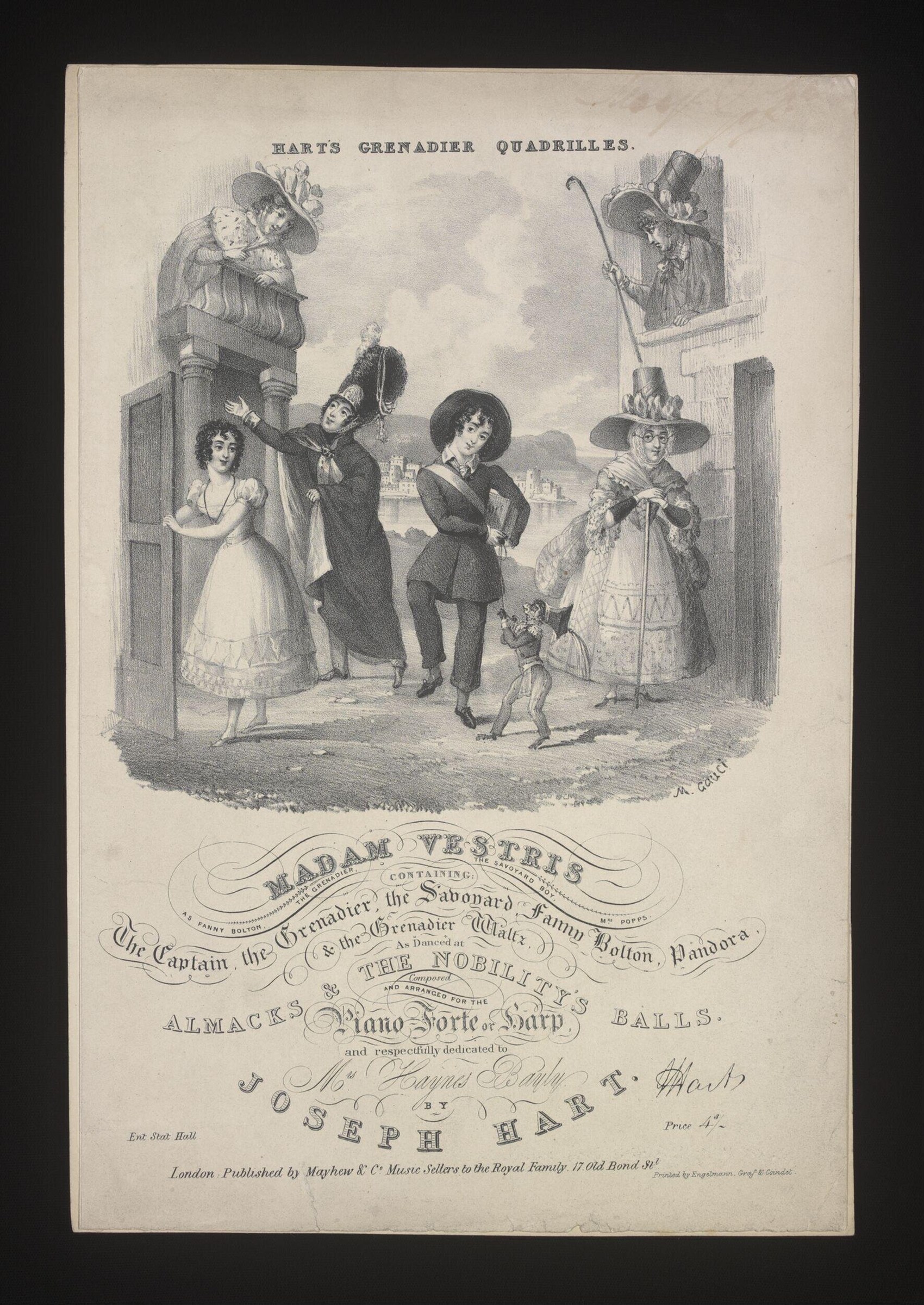
Harts Grenadier Quadrilles
Hart, Joseph
- Collection:
- Sheet Music
- Source:
- Victoria and Albert Museum
- Rights:
- Rights vary by item — check the source record before reusing this image. Source record ↗
- Recorded as:
- V&A — check rights per item
Quadrille sheet music covers are rare primary evidence for how ballroom dance was marketed, consumed, and understood as social theater rather than technical accomplishment in the nineteenth century. This image reveals the inseparability of dance from celebrity performance, theatrical fashion, and the commercial publishing world that capitalized on dance crazes.
What you are looking at
A crowded street scene in what appears to be a fashionable urban setting, with classical architecture and a distant cityscape visible beyond. A group of figures gathers in animated conversation and display: a woman in a white muslin dress with high waist and short sleeves stands to the left; two men in dark tailcoats occupy the center, one gesturing upward with exaggerated movement; to the right, an elderly woman in a bonnet and long dress leans on a cane, while a small child in a white dress plays at her feet. Above the scene, two additional figures perch on architectural elements—one cradling an infant, the other gesturing with a cane—suggesting a satirical or theatrical hierarchy. The engraving employs crosshatching to create dramatic light and shadow, with the foreground figures rendered in sharp detail while the background dissolves into atmospheric distance.
The dancing
The composition is choreographed for social comedy rather than dance technique. The central male figure strikes an exaggerated upward-reaching pose with one arm extended, suggesting theatrical gesture rather than ballroom position. The woman in white maintains an upright posture characteristic of Regency-era deportment, with arms at her sides or gently positioned. The grouping suggests a moment of social interaction frozen mid-conversation—no closed holds or paired dance formation is visible, though the scattered arrangement and active postures suggest movement and liveliness rather than static conversation.
The dance depicted
This is a quadrille, one of the most fashionable social dances of the 1820s–1840s, though the image captures not a moment of actual dancing but rather the theatrical social world surrounding it. The title references 'Harts Grenadier Quadrilles,' suggesting this is sheet music cover art advertising a specific quadrille composition for piano. The figures do not depict active quadrille dancers in formation, but rather the fashionable society attending or preparing for such an event—this is a scene of social performance rather than choreographic documentation.
How it was made
This is a steel engraving, a reproductive medium that allowed wide distribution of popular entertainment ephemera in the nineteenth century. The title and publication information printed beneath indicate this was sheet music cover art produced by Mapleson & Co., a London music publisher, suggesting circulation among piano-owning households of the middle and upper classes. The fine crosshatching technique allows the engraver to create atmospheric depth and social specificity—the quality of dress fabrics, the textures of the architectural setting, and the nuanced expressions of the figures are all rendered with the precision this audience expected.
About this work
This engraving serves as the cover for a published piano score of the 'Harts Grenadier Quadrilles,' one of hundreds of quadrille compositions marketed to fashionable British society in the early nineteenth century. Rather than depicting actual dance technique, it stages a scene of social aspiration and theatrical display: the title 'Madam Vestris' identifies the famous dancer and comedienne who performed quadrilles and other dances in London theatres, and the elaborate composition—with its figures on pedestals gesturing dramatically—suggests this is as much satire of fashionable affectation as documentation of a dance form. The quadrille itself was a four-couple square dance with military precision, derived from French quadrille tradition but embraced enthusiastically in Regency and early Victorian Britain as the mark of refined society.
How to look at it
Attend to the social hierarchy suggested by the vertical arrangement of figures: the pedestaled figures above gesture theatrical command while the fashionable couple below enact their social roles. The contrast between the precise detail of the foreground fashions (the woman's Regency-style dress, the men's tailcoats) and the atmospheric distance suggests this is about the social performance of fashion and dance rather than the technical execution of steps. The exaggerated gesture of the central male figure—a theatrical reach-and-point rather than ballroom posture—signals that this is satire of social aspiration as much as documentation of dance.
The artist
The engraver's mark 'A. Concanen' appears in the lower right corner. Alfred Concanen (1809–1852) was a prolific theatrical and satirical illustrator working in London during the height of the Regency and early Victorian period, known for his work on sheet music covers, theatrical prints, and popular satirical images. His style combined precise social observation with theatrical exaggeration, making him particularly suited to capturing the intersection of ballroom dance and theatrical performance.
The period
The quadrille was the dominant social dance of the 1820s–1840s in Britain, having arrived from France where it developed from earlier contredanses. Published quadrille scores proliferated with extraordinary speed—publishers issued new compositions constantly, often tying them to famous dancers, military regiments, or current theatrical sensations. The attribution to 'Madam Vestris' (Lucia Vestris, 1797–1856), one of the most celebrated performers of the era, indicates that theatrical quadrilles performed on stage were actively distinguished from ballroom versions, though the format remained the same. This was the apex of quadrille fashion before the waltz began to displace it in the 1840s.
Where it lives
This is a steel engraving from a published sheet music score, housed in the collection as printed dance ephemera. The title page information indicates publication by Mapleson & Co. of Old Bond Street, London, a major publisher of popular music in the early nineteenth century, suggesting this was produced for wide commercial distribution to piano-playing households.
Dance in this work
Questions about this work
Who was Madam Vestris and why is she on a quadrille cover?
Lucia Vestris (1797–1856) was among the most celebrated dancers and performers of early Victorian England, famous for her comic dancing and theatrical presence. Publishers marketed quadrilles tied to famous performers because dance was celebrity entertainment; audiences wanted to own the music associated with dancers they admired in theatres.
Why doesn't this look like people actually dancing?
This is not a depiction of quadrille technique but rather a theatrical scene of fashionable society—the social world around the dance. Sheet music cover art of this period often staged witty social commentary rather than documenting choreography, because the cover needed to appeal to buyers' sense of style and aspiration.
What is a quadrille?
The quadrille is a square dance for four couples, typically danced in sets, with prescribed figures and movements derived from earlier contredanses. It was the most fashionable ballroom dance in Britain from the 1820s through the 1840s, performed both in private drawing rooms and on theatrical stages. Each published quadrille score contained variations and new tunes that made them collectible and status-enhancing.
Why were there so many published quadrille scores?
The quadrille craze created enormous demand for new compositions—composers and publishers competed to produce fresh variations, and dancers and music teachers relied on new scores constantly. Publishing a quadrille with a famous dancer's name or a topical reference helped market it to piano-owning households eager to stay current with fashionable dance.
More dance artwork





