49 works in this view — arrow keys or swipe to move between them.
Dance in Art
Macbeth Quadrilles
Lock, Matthew
- Collection:
- Sheet Music
- Source:
- Victoria and Albert Museum
- Rights:
- Rights vary by item — check the source record before reusing this image. Source record ↗
- Recorded as:
- V&A — check rights per item
Quadrille-writing based on literary and theatrical sources was a significant commercial practice in the nineteenth century, and this work is evidence of how Shakespeare in particular was adapted for popular consumption and domestic performance through dance. It demonstrates that quadrilles were not merely social dances but serious choreographic and musical works, often tied to named scenes, characters, and dramatic narratives. The title-page imagery also records what Macbeth-themed social dance looked like to Victorian audiences—how the play's supernatural and tragic content was visualized and embodied in the formal, restrained aesthetic of period ballroom practice.
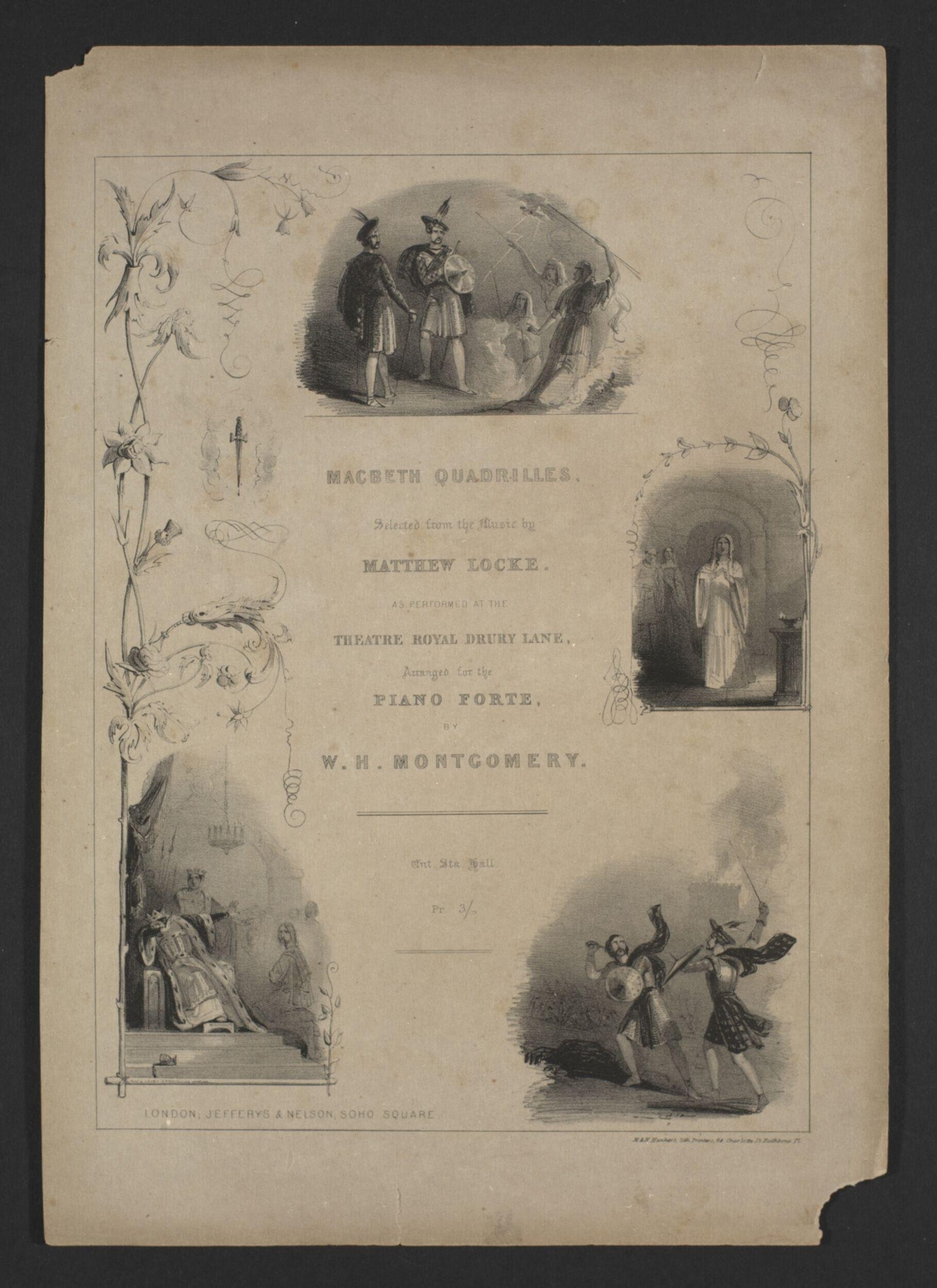
What you are looking at
This is the title page of a published work featuring four engraved vignettes arranged around a decorative floral border. The central upper image shows three figures in Regency dress—two men in dark coats and a woman in a long pale gown—arranged in conversation or instruction, possibly a dance lesson or social gathering. To the right, a single ghostly female figure in white stands in shadow, resembling the supernatural or ballroom aesthetic of Romantic drama. Below, on the left, sits a crowned or elaborately dressed figure in a theatrical pose of authority or lament, while the right panel shows two figures in period dress in active motion, possibly depicting a moment of dramatic action or dance. The overall composition evokes the theatrical world of Shakespeare's Macbeth adapted for the drawing room: domestic, refined, and visually restrained, with careful use of light and shadow to create mood rather than spectacle.
The dancing
The figures throughout are rendered in the refined, upright posture of Regency-era polite society. In the upper vignette, the bodies are arranged in a conversational triangle with controlled, dignified stance. The female figures on the right panels display the elongated, ethereal quality typical of Romantic theatrical imagery—the standing figure has an almost weightless, supernatural quality achieved through pale tone and insubstantial rendering. The lower left figure adopts a formal seated pose of high status or distress. The moving figures in the lower right show active, gestural movement with raised arms, suggesting either theatrical action or energetic social dance, though the postures remain composed and genteel rather than wild.
The dance depicted
The work is titled *Macbeth Quadrilles*, indicating it is sheet music for quadrilles—a formal, structured social dance of the Regency and Victorian era performed by couples in a square formation. Quadrilles were among the most popular ballroom dances of the period and were commonly adapted to thematic or literary subjects for drawing-room performance and publication. The vignettes suggest scenes from Shakespeare's Macbeth adapted into choreographed social dance, likely performed at the Theatre Royal Drury Lane as noted on the title page. The images show moments of dramatic encounter and confrontation reinterpreted through the language of formal ballroom spectacle, turning Shakespeare's tragedy into refined, structured entertainment for middling and upper-class amateurs.
How it was made
This is a steel or copper engraving, identifiable by the fine parallel hatching and cross-hatching used to create tone and shadow, the sharp crisp lines, and the delicate floral ornamental border. Engraving was the standard process for reproducing music and theatrical imagery for mass circulation in the nineteenth century, allowing for multiple impressions and wide distribution to sheet-music purchasers. The technique's precision and reproducibility made it ideal for commercial music publishing, and the decorative surround indicates this was a substantial, respectable publication aimed at educated households with pianos and drawing rooms. The publisher (Jefferys & Nelson, Soho Square, London, as printed at the base) was a London music publisher of the mid-nineteenth century.
About this work
This is the illustrated title page of published sheet music for quadrilles—formal, choreographed ballroom dances—based on scenes from Shakespeare's Macbeth. The work was composed by Matthew Locke and arranged for piano forte by W. H. Montgomery, and performed at the Theatre Royal Drury Lane, then published by Jefferys & Nelson in London. The four vignettes, rendered in fine steel engraving, depict moments from the play reinterpreted as scenes of refined social encounter and dramatic gesture suitable for amateur ballroom performance. It represents a significant intersection of theatrical adaptation, popular music publishing, and domestic drawing-room culture in the nineteenth century—the moment when Shakespeare was not only read and staged but danced, in carefully structured forms, by piano-owning families in their homes. The work belongs in a dance history because it shows how classical drama was actively choreographed and incorporated into the everyday social practices of the era.
How to look at it
The vignettes should be read as a sequence or set of related dramatic moments rather than a continuous narrative. Notice how the engraver uses light (the pale female figure, the spotlit seated figure) to create mood and focus within each small frame—this was a deliberate technique to suggest theatrical lighting and emotional intensity. The upper and lower panels on the right show female figures in contrasting states: one ethereal and still, one in active motion with raised arms. Together they suggest the range of bodily states and emotional registers that the quadrilles were meant to evoke. The formal dress and composed postures throughout remind us that this is not a representation of wild or liberated movement, but rather of social dance as a coded, refined form of dramatic expression—the body disciplined and channeled into prescribed patterns while still conveying narrative and feeling.
The artist
Matthew Locke (c. 1621–1677) was a major English Baroque composer, but this *Macbeth Quadrilles* attribution is problematic. The work is dated unknown and published in the nineteenth century; it is unlikely to be directly composed by the historical Matthew Locke. It is more likely titled after Locke or adapted from earlier music. W. H. Montgomery is credited as the arranger for piano forte. The engraver is not named. The work emerges from the commercial London music-publishing world of the mid-nineteenth century, where quadrilles based on opera, ballet, and theatrical sources were a staple product.
The period
Quadrilles were the dominant social ballroom dance of the nineteenth century, particularly among the middle and upper classes. They were highly structured, geometric dances performed in a square by four couples, with distinct figures and musical phrases. From the 1840s onward, publishers produced vast quantities of quadrilles arranged from operatic airs, famous ballet tunes, and dramatic scenes, allowing amateur dancers to associate themselves with fashionable theatrical culture while remaining within the bounds of proper, orderly ballroom behavior. Shakespearean quadrilles were part of a broader practice of literary adaptation into dance form. The Romantic movement had heightened theatrical interest in Shakespeare's works, and they were frequently staged with spectacular scenic effects; the quadrilles represent a domesticated, bodily echo of that theatrical ambition. The Theatre Royal Drury Lane was London's premier theatrical venue, and the notation that these quadrilles were 'selected from the music' of a performance there lends them prestige and historical specificity.
Where it lives
The work is held as part of a sheet-music collection and derives from the Virginia source (marked 'va' in the record). It was published by Jefferys & Nelson, Soho Square, London, a mid-nineteenth-century music publisher. The object is a printed score with decorative title page, typical of commercial quadrille publications of the era.
Dance in this work
Questions about this work
What are quadrilles and who danced them?
Quadrilles are formal ballroom dances performed by four couples arranged in a square, moving through a series of set figures to music divided into distinct sections or 'changes.' They were the dominant social dance of the nineteenth century among the educated middle and upper classes. Quadrilles required instruction, practiced coordination, and access to ballrooms or drawing rooms with pianos, making them a marker of social respectability and cultural aspiration. They were danced at balls, assemblies, and in domestic settings by amateurs.
Why would Shakespeare be adapted into a quadrille?
Literary and theatrical sources were fashionable subjects for quadrille-writing, particularly from the 1840s onward. Publishing a quadrille 'from' a celebrated play or opera allowed amateur dancers to associate themselves with high culture and current theatrical fashion while performing a dance they knew and that was socially appropriate. It was a way of extending theatrical pleasure beyond the playhouse and into the domestic sphere. The quadrille structure allowed composers and publishers to organize dramatic or operatic material into orderly, repeatable movement phrases.
What does the Theatre Royal Drury Lane notation mean?
The title page states these quadrilles were 'selected from the music' of a performance at the Theatre Royal Drury Lane, London's principal theatrical venue. This likely means that they were adapted from the instrumental music used in a theatrical production of Macbeth staged there, lending the work prestige and documentary value. It suggests these quadrilles had a theatrical origin and could be recognized by audiences who had seen that production.
Why is the medium important for understanding this work?
Steel and copper engraving was the standard reproductive technology for sheet music and theatrical imagery in the nineteenth century. It allowed multiple copies to be printed affordably and distributed widely to piano-owning households. The fine, precise engraving seen here suggests a respectable, well-produced commercial publication—not an amateur or provincial effort. The decorative engraved border adds artistic status and visual appeal, marking this as a work of some commercial and cultural value.
More dance artwork





