49 works in this view — arrow keys or swipe to move between them.
Dance in Art
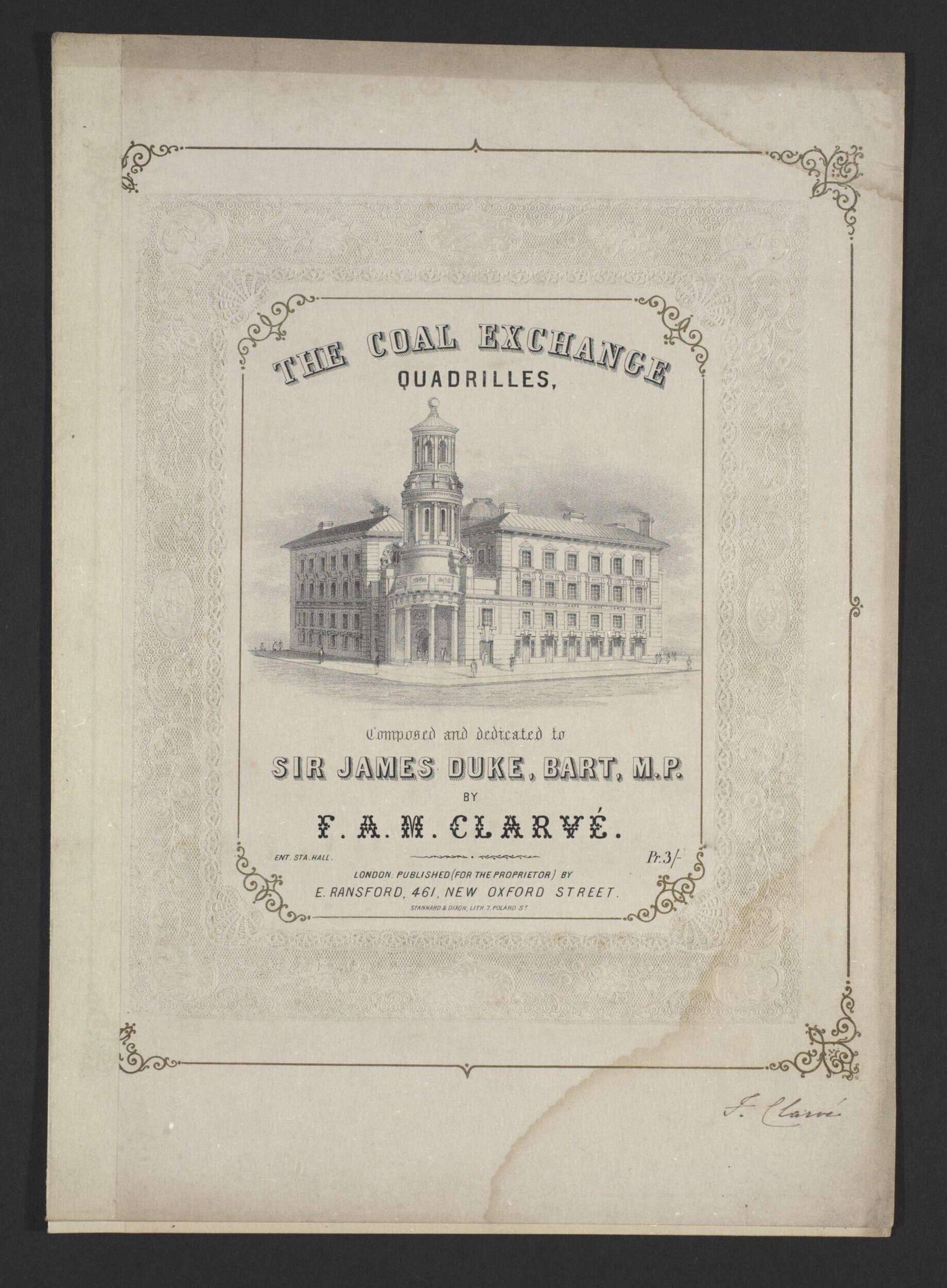
The Coal Exchange Quadrilles
Clarvé, F. A. M.
- Collection:
- Sheet Music
- Source:
- Victoria and Albert Museum
- Rights:
- Rights vary by item — check the source record before reusing this image. Source record ↗
- Recorded as:
- V&A — check rights per item
The quadrille was the dominant social dance form for much of the 19th century, and this titled page is a direct artifact of that culture. It shows how dance music was packaged, promoted, and dedicated to patrons; the architectural subject matter is also unusual and may reflect the specific occasion or venue for which the music was written.
What you are looking at
This is the title page of a piece of sheet music, ornately framed in a double border with scrollwork corner ornaments. At the center stands an architectural rendering of the Coal Exchange in the Quadrilles—a substantial four-story corner building with a prominent octagonal tower rising from its junction. The building shows regular window patterns across its façades and sits on a street corner with a few small figures visible at street level, suggesting urban scale and circulation. The engraving is finely detailed but restrained in tone, executed in black line and light wash on aged paper. Below the architectural image, the dedication reads "Composed and dedicated to SIR JAMES DUKE, BART, M.P." with composer attribution to "F. A. M. CLARVÉ." The publication line notes the work was "LONDON: PUBLISHED [FOR THE PROPRIETOR] BY E RANSFORD, 461 NEW OXFORD STREET."
The dancing
No figures actively dancing appear in this image. The tiny figures visible at street level are architectural incidentals, indicating scale and urban context rather than depicting choreographed movement. This is a title page rather than a scene of dance in progress.
The dance depicted
The Quadrilles were a social dance form of the 19th century, typically danced by two or four couples in a square formation, consisting of five figures or sections. The work is titled "The Coal Exchange Quadrilles," suggesting it was composed as dance music for the fashionable quadrille, popular in ballrooms throughout the Victorian era. The dedication to Sir James Duke implies this was a work of some social status, composed for performance at significant occasions. Without seeing the actual score or performance notation, the image itself reveals nothing about how the dance steps or formations were executed, though the dedication suggests it was intended for skilled or socially prominent dancers.
How it was made
This is a steel or copper line engraving, likely printed by lithographic or engraving press. The fine detail in the architectural rendering, the consistent line weights, and the decorative borders are characteristic of mid-19th-century sheet music title pages. The technique allowed for crisp reproduction and circulation to multiple publishers and purchasers. The aging and foxing visible on the paper is consistent with 19th-century hand-laid or wove paper stock.
About this work
This is the ornamental title page of a quadrille composition published in London in the mid-19th century. It commemorates the Coal Exchange building (a real London structure) and was dedicated to a baronet and Member of Parliament, suggesting the work held social prestige. The quadrille was among the most fashionable social dances of the Victorian era, danced at formal balls and assemblies by couples arranged in square formations. This page is a document of that world—not a depiction of dancing bodies, but of the music that accompanied and organized them. It sits at the intersection of architecture, music publishing, and social history.
How to look at it
Look at the architectural rendering itself: this is not a generic or invented building, but the specific Coal Exchange, likely a London trading house. The choice to feature this building on a dance music cover suggests either that the work was performed at the Exchange, or that the composer sought to associate the music with commercial prestige and modernity. The formal framing and decorative border elevate the page and signal that this is serious, respectable music for respectable society. The tiny street-level figures are a convention of architectural rendering that emphasizes scale and situation.
The artist
F. A. M. Clarvé is listed as composer on this title page. Beyond this attribution, little is recorded in the catalogue. The composer was active in London music publishing in the mid-19th century, a period when quadrille compositions were produced in great volume for the ballroom market.
The period
The quadrille dominated ballroom dancing from roughly the 1820s through the 1880s, especially in Britain and continental Europe. It was a structured but sociable dance, requiring no professional training and allowing couples to participate in a shared geometric pattern. The dedication to a sitting Member of Parliament and a baronet reflects the dance's association with respectable middle and upper-class society. The 19th century saw explosion in music publishing, and dance music was a major commercial category. Sheet music title pages became increasingly ornate and promotional, often featuring elaborate typography, architecture, or portraiture to signal prestige and attract purchasers.
Where it lives
This is a sheet music title page held as part of a collection (identified as source 'va'). It is a printed page, not a manuscript, and represents a commercial music publication from a London publisher.
Dance in this work
Questions about this work
What is a quadrille?
A quadrille is a social dance for four couples arranged in a square. It was performed to music in five sections or figures, with each section choreographed and danced in turn. Popular from the 1820s through the Victorian era, quadrilles were the standard dance at formal balls and required dancers to move in unison through prescribed formations.
Why would a dance composition be dedicated to a specific person?
Dedications were a form of patronage and prestige. A composer might dedicate a work to a wealthy, titled, or prominent person in exchange for financial support or to ensure the work was associated with respectability and social standing. Sir James Duke's status as a baronet and Member of Parliament made him an ideal dedicatee.
What does the Coal Exchange have to do with this dance?
The connection is unclear from the title page alone. The Coal Exchange was a real London building (a trading house for coal commerce). The quadrille may have been composed for a ball or assembly held there, or the composer may simply have chosen to name and honor the building as a sign of London commerce and modernity.
Why is this a print rather than a manuscript?
By the mid-19th century, sheet music publishing was a commercial enterprise. Printing allowed composers to sell copies to multiple pianists, dancers, and music sellers. A printed title page with decorative framing was a marketing tool that made the work look valuable and desirable.
More dance artwork





