49 works in this view — arrow keys or swipe to move between them.
Dance in Art
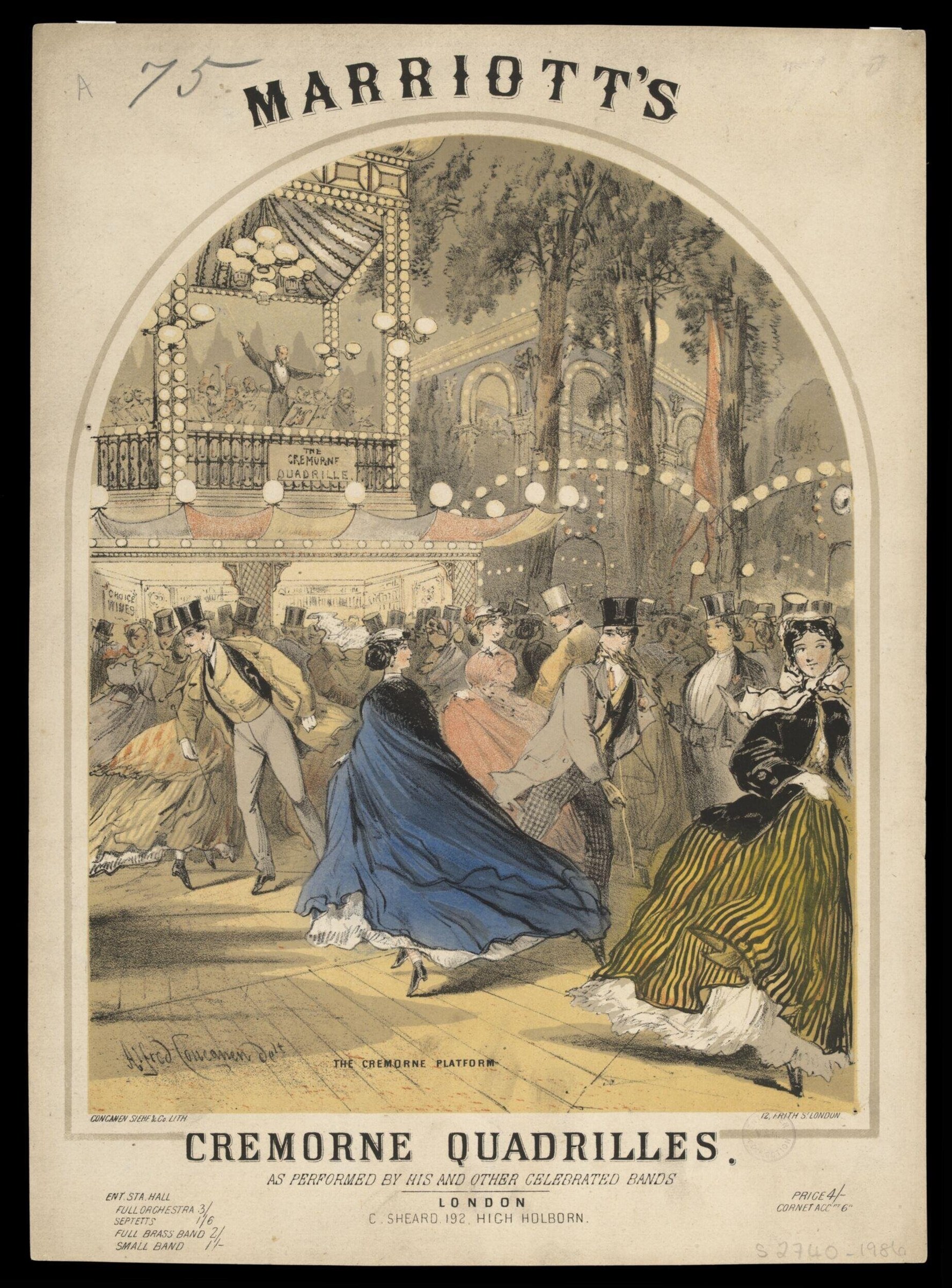
Marriott's Cremorne Quadrilles
Alfred Concanen
- Collection:
- Source:
- Victoria and Albert Museum
- Rights:
- Rights vary by item — check the source record before reusing this image. Source record ↗
- Recorded as:
- V&A — check rights per item
This print is a rare visual record of how the quadrille was actually performed and experienced in a public, mixed-gender ballroom setting in mid-Victorian England. The Cremorne Gardens were a real venue, and this image documents both the dance form and the social occasion, making it evidence for dancers and historians studying nineteenth-century ballroom culture, public entertainment, and the visual representation of dance in period media.
What you are looking at
A crowded indoor ballroom or assembly hall, densely packed with dancers and spectators in mid-nineteenth-century formal dress. The space is decorated with strings of spherical lanterns or lights hanging from the ceiling, creating an festive atmosphere. In the foreground, couples occupy the dance floor in various stages of the quadrille: some are stationary, others in motion. At left, a man in light-colored coat and hat stands facing a woman in a voluminous skirt. Center-right, a woman in a striking blue cape dominates the composition, her back to the viewer, her skirt billowing. To her right sits a woman in a boldly striped yellow jacket, observing. The background recedes into a columned loggia or gallery space with trees visible beyond, suggesting an open-air or partially roofed venue. The crowd fills every inch of available space: standing figures in top hats and formal coats mingle with seated observers. The chromolithographic technique allows subtle gradations of tone and color — ochre, gray, blue, yellow — giving the scene depth and a sense of theatrical spectacle.
The dancing
The dancers shown are in the characteristic closed and side-by-side positions of the quadrille. The woman in the blue cape is captured in a moment of rotation or travel across the floor, her body turned away and her skirt caught in the swirl of movement. Couples maintain formal posture with arms extended in the period-appropriate frame. The density of figures — some dancing, many standing and watching — suggests this is a participatory social event where spectation and dancing coexist. Arms, where visible, are extended in the ballroom frame proper to the quadrille form.
The dance depicted
This is a quadrille, a formation dance for four couples arranged in a square, hugely popular in Europe and North America during the mid-to-late nineteenth century. The composition of the image — the text label at bottom, the formal dress, the ballroom setting, and the visible positioning of couples in lines and open holds — all confirm this identification. The Cremorne Gardens was a real pleasure ground in London (Chelsea), famous for summer balls and public dances. This print documents social ballroom dancing at a fashionable public venue, where the quadrille was the dominant form. The print captures the spectacle and social energy of the mid-Victorian ballroom: the quadrille was both a participatory dance (those dancing) and a spectacle (those watching), and this image foregrounds both.
How it was made
This is a hand-colored chromolithograph, a printing technique that allowed for economical color reproduction and mass circulation. The technique required separate stone plates for each color layer, which accounts for the distinct, somewhat flat application of the blue, yellow, and ochre tones visible here. The fine linear detail — the building's architecture, the lanterns, the textile patterns — was likely drawn lithographically in black, with color added in subsequent passes. Chromolithography was the dominant method for producing affordable color prints of entertainments, fashionable events, and theatrical scenes in the nineteenth century, making works like this accessible to a broad middle-class audience and allowing for rapid distribution and commercial sale.
About this work
Marriott's Cremorne Quadrilles is a mid-nineteenth-century chromolithographic print depicting a public ball at the Cremorne Gardens, a famous pleasure ground in London. The artist Alfred Concanen, known for theatrical and social scene prints, has captured a moment of coordinated social dancing—the quadrille—in a fashionable public ballroom. The print is both a documentary image of how the quadrille was danced in a specific time and place, and a commercial product designed to commemorate or advertise the Cremorne as a destination for fashionable entertainment. The composition balances the formal geometry of the dance with the chaotic vitality of the crowd, showing how the quadrille functioned in nineteenth-century social life as both an ordered ritual and a spectacular social event.
How to look at it
The viewer should trace the formation of the quadrille: the couples arranged in their characteristic square positions, the open and closed holds, the direction of travel. Notice the moment chosen—the woman in the blue cape is in the midst of a turn or promenade, caught in dynamic movement. The print uses the density and chaos of the crowd—the standing figures, the lantern-lit atmosphere, the architectural framing—to convey the excitement and spectacle of the occasion, contrasting with the formal precision of the dance itself. The chromolithographic technique, with its flat color planes and linear detail, is characteristic of Victorian commercial print culture and shapes how the scene reads as both documentary and entertainment.
The artist
Alfred Concanen (1829–1901) was a theatrical lithographer and comic illustrator specializing in scenes of London entertainment, social occasions, and theatrical spectacle. He was prolific in the 1850s–1870s, producing hand-colored lithographs and chromolithographs for the London market, often depicting fashionable events, public gardens, and theatrical scenes. His work was designed for commercial circulation and popular consumption, serving as visual documentation of mid-Victorian leisure culture.
The period
The quadrille was at the height of its popularity in the 1850s–1870s, both in aristocratic drawing rooms and in public ballrooms and pleasure gardens. The Cremorne Gardens, which opened in 1845, were among London's most fashionable public entertainment venues, hosting weekly balls that attracted the middle and upper classes. Chromolithography, perfected in the 1830s–1840s, made color prints affordable and widely available, enabling commercial artists like Concanen to produce and sell thousands of copies of such scenes. The mid-Victorian ballroom was a space of structured social ritual—the quadrille's geometric formations and sequences embodied order and propriety—yet also one of public display and entertainment, where fashionable dress, music, and choreography were on display.
Where it lives
This is a commercial chromolithographic print from the mid-nineteenth century, held as a print. The title and artist name appear in the printed text on the sheet itself. Such prints were produced for sale to the public and would have been distributed through print shops and circulating libraries. The print is catalogued in a collection focused on visual art.
Dance in this work
Questions about this work
What is the Cremorne Gardens?
Cremorne Gardens was a public pleasure ground in Chelsea, London, open from 1845 to 1877. It hosted weekly summer balls, theatrical performances, concerts, and other entertainments, attracting fashionable middle- and upper-class visitors. The gardens were famous for their elegant ballrooms and outdoor spaces, making them a premier London leisure destination in the mid-Victorian era.
How is the quadrille danced?
The quadrille is a formation dance for four couples (eight dancers) arranged in a square. The dance consists of five figures, each comprising a sequence of steps and movements performed to musical phrases. Couples move through a series of promenades, châines (chain steps), and rotations, with the geometric formation maintained throughout. In social ballrooms like the Cremorne, the quadrille was led by a caller or followed from a published choreography, with the figures repeated in sequence.
Why was the quadrille so popular?
The quadrille offered structure and sociability: it required an even number of partners and dancers, was teachable, and had clearly defined figures and sequences. Unlike free-form country dances, it was codified and required some instruction, making it appeal to the aspirational middle classes eager to display propriety and refinement. It was also visually spectacular—the geometric formations and coordinated movement of eight dancers created an impressive effect, making it ideal for public ballrooms and fashionable occasions.
Who would have bought this print?
Middle- and upper-class Londoners who frequented or aspired to frequent the Cremorne Gardens would have purchased such prints as souvenirs, advertisements, or decorative items for the home. The affordable chromolithographic technique meant prints could be sold at a few shillings, making them accessible to a broad audience. The print served simultaneously as a memento of an outing, a record of fashionable social life, and an advertisement for the venue.
More dance artwork





