49 works in this view — arrow keys or swipe to move between them.
Dance in Art
The First Set of Caledonian Quadrilles
McEwen, James
- Collection:
- Sheet Music
- Source:
- Victoria and Albert Museum
- Rights:
- Rights vary by item — check the source record before reusing this image. Source record ↗
- Recorded as:
- V&A — check rights per item
The Caledonian Quadrilles show how printed music shaped ballroom dancing in the Regency period: specific tunes, named figures, and distribution to assemblies meant that the same dances could be performed in drawing rooms from London to the Scottish Highlands. The choice to illustrate the music with a picturesque Highland scene rather than the dance itself reveals how quadrilles were marketed and consumed as both cosmopolitan ballroom fashion and expressions of national or regional character—a pattern that shaped social dance throughout the 19th century.
What you are looking at
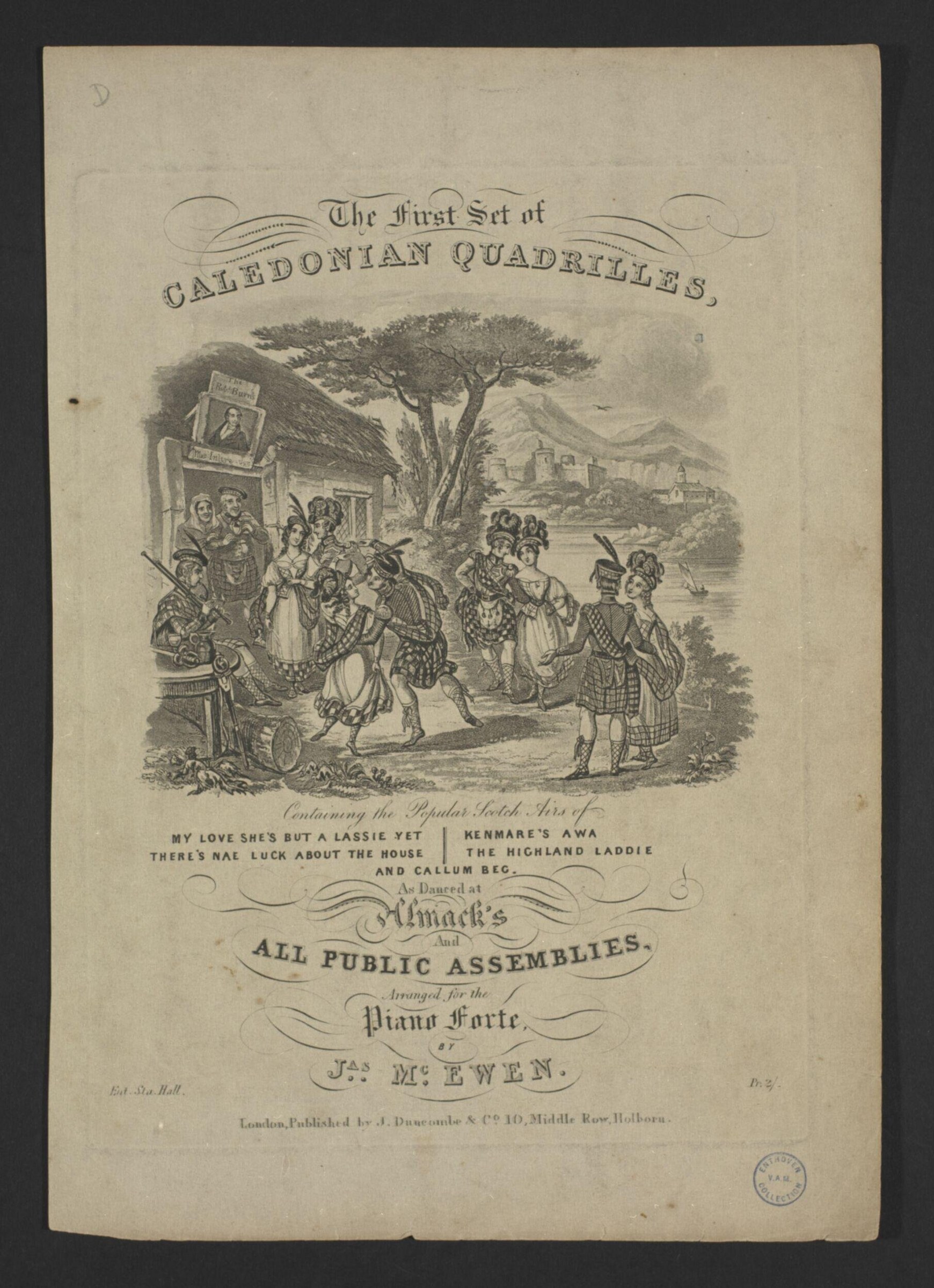
This is a picturesque Scottish village scene engraved to illustrate a set of quadrille music for piano. A large spreading tree dominates the center foreground, beneath which a group of figures in Highland dress are gathered in animated social grouping rather than formal dance formation. On the left, figures cluster around a low cottage with a thatched roof; in the background, a river winds past buildings including what appears to be a castle or fortified structure on the distant hillside. The landscape is rendered in fine detail with careful atmospheric perspective. The figures wear tartan, plaids, and period dress suggesting early 19th-century Highland costume. The engraving's composition emphasizes the romantic, picturesque quality of Scottish rural life rather than capturing a moment of actual dancing—the figures are posed conversationally, suggesting the social context in which these dances occurred rather than the dance itself.
The dancing
The group of approximately eight to ten figures shows no clear dance formation or partnering hold. They stand and gather informally beneath and around the tree, some facing inward toward conversation rather than arranged in the lines or circles that quadrille requires. The figures on the left near the cottage are similarly grouped for social interaction. No visible footwork, arm positions, or geometric spacing characteristic of quadrille choreography are depicted. The artist has chosen to illustrate the social gathering rather than the moment of dancing.
The dance depicted
This is music for the Caledonian Quadrilles, a set of Scottish quadrilles popular at Regency-era assemblies and public gatherings. The quadrille was a group dance for four couples arranged in a square, with five distinct figures, typically danced to sets of four 8-bar phrases. The engraving's title names specific popular Scottish tunes adapted for the dance: 'My Love She's But a Lassie Yet', 'There's Nae Luck About the House', 'Kenmare's Awa', 'The Highland Laddie', and 'Callum Beg'. By framing the music with a Highland village scene rather than depicting dancers in formation, the publisher emphasizes the Scottish character and the social assembly context in which these dances were performed, particularly at public assemblies like those held at Almack's (named on the title page).
How it was made
This is a steel or copper engraving, a reproductive print technique well-suited to music publishing. The fine parallel lines of the engraved surface create subtle gradations of tone in the landscape, evident in the foliage of the tree, the atmospheric distance, and the architectural details. The engraving allows for both the decorative vignette and fine lettering required for a music title page. The technique was standard for music publication of this period, enabling affordable reproduction in multiple copies for distribution to drawing rooms and assembly venues. The composition—landscape vignette above, publication information below—follows the conventions of early 19th-century English music title pages.
About this work
This is the engraved title page for a piano arrangement of the Caledonian Quadrilles, a set of Scottish dances published in London around the 1820s–1830s. Rather than showing quadrille dancers in formation, the engraver has illustrated the social and geographical context: a romantic Highland landscape with figures in Scottish dress gathered beneath a great tree. The work represents the quadrille as a social dance embedded in national (Scottish) identity and the domestic or public assembly context in which it was danced. It belongs in a gallery about dance because it documents both the music and the cultural imagination surrounding one of the most popular ballroom dances of the Regency era—a dance form that crossed between elite ballrooms like Almack's and provincial assembly rooms throughout Britain.
How to look at it
Observe the deliberate choice not to show dancers in motion or formation. The engraver positions figures in social grouping under the tree and around the cottage, emphasizing assembly and gathering rather than the geometric square and progressive figures that the quadrille requires. Look at how the landscape dominates—the romantic Highland setting with river, distant castle, and great spreading tree—suggesting that the appeal of these dances lay partly in their association with Scottish culture and picturesque scenery. The publication information at the bottom ('As Danced at Almack's and ALL PUBLIC ASSEMBLIES') anchors the dance in specific prestigious venues, connecting rural romantic imagery with urban ballroom practice.
The artist
James McEwen is recorded as arranger or publisher of this work. Little is currently known of McEwen's broader practice or biography. The work appears as a music publication with engraved illustration, a common mode of production for dance music in this period, in which the arranger or publisher's name often appears without distinction from the engraver's contribution.
The period
The Caledonian Quadrilles date to the height of the quadrille's dominance in British ballroom culture, roughly 1815–1840. The quadrille had been introduced to English high society from France around 1815 and became the fashionable group dance at Almack's assembly rooms and country house balls. Scottish and English country dance tunes (like those named here) were constantly adapted and arranged as quadrille sets, allowing local and regional musical traditions to circulate through elite and respectable middle-class dancing. The engraved music print was the primary means of disseminating these dances; a single published set could standardize choreography across multiple venues and regions. The romantic picturesque imagery of the Highlands was commercially valuable in this period, particularly after the popularity of Scott's novels.
Where it lives
This is a sheet music title page held in the collection as printed music. It was published in London by J. Duncombe & Co of 10 Middle Row, Holborn. The format—engraved vignette, title, tune names, publisher details—is standard for English music publication of the 1820s–1830s.
Dance in this work
Questions about this work
Why is there no dance happening in this picture if it's music for a dance?
Music title pages of this era often used picturesque or thematic imagery rather than literal depictions of dancers. Here, the Highland landscape and figures in Scottish dress establish the national and romantic character of the tunes, while the names of specific dances and venues below promise that buyers will learn how to dance them. The engraving sells the cultural identity and prestige of the work rather than instructing in choreography.
What is a quadrille?
A quadrille is a ballroom dance for four couples arranged in a square, with five main figures (typically each 8 or 16 bars of music). It was the most fashionable group dance in Britain from about 1815 onward, danced at assemblies and private balls. A set of quadrilles would consist of several musically distinct figures danced in sequence, often using familiar or newly arranged popular tunes.
Who danced the Caledonian Quadrilles?
The title page advertises these as danced 'at Almack's and ALL PUBLIC ASSEMBLIES'—meaning they were performed by respectable middle and upper-class dancers at both elite London assembly rooms and provincial public balls. The Scottish character of the tunes made them particularly popular at assemblies in Scotland and northern England, though they circulated widely through printed copies.
What do the tune names tell us?
The five named tunes—'My Love She's But a Lassie Yet', 'There's Nae Luck About the House', 'Kenmare's Awa', 'The Highland Laddie', and 'Callum Beg'—are Scottish or Scottish-flavored melodies, some of which were traditional or had literary origins. By adapting these familiar tunes as quadrille music, the publisher made the dance accessible to dancers who knew the tunes and appealing to audiences who valued Scottish culture and the romantic picturesque.
More dance artwork





