49 works in this view — arrow keys or swipe to move between them.
Dance in Art
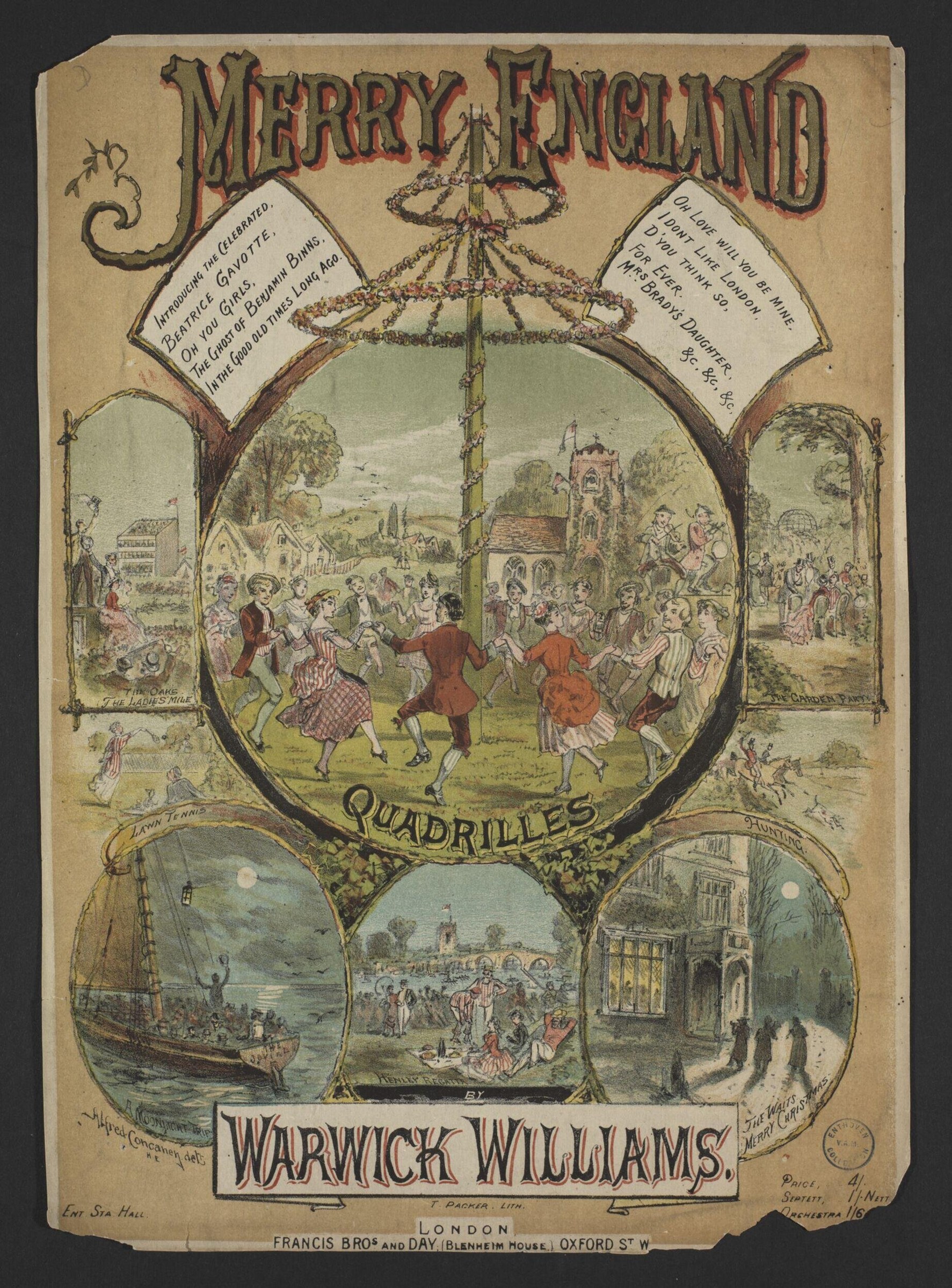
Merry England Quadrilles
Warwick Williams
- Collection:
- Sheet Music
- Source:
- Victoria and Albert Museum
- Rights:
- Rights vary by item — check the source record before reusing this image. Source record ↗
- Recorded as:
- V&A — check rights per item
The quadrille dominated social dancing in the 19th century but is now largely forgotten; this image preserves both the visual appearance of the dance in motion and the commercial ecosystem of music publishing that made it accessible to amateurs. The "Merry England" theme shows how quadrilles became vehicles for cultural nostalgia and seasonal celebration, a practice that influenced ballroom and social dancing well into the 20th century. For dancers today, the open postures and informal grouping visible here contradict the stiff, geometric image of Victorian ballroom dance that survives in popular memory.
What you are looking at
This is the cover of a quadrille instruction or dance music publication, framed as an elaborate theatrical composition. At the center, within an oval frame bordered by leafy garland, six figures in mid-19th-century dress dance around a pole decorated with mistletoe—the traditional symbol of the title "Merry England." The dancers wear vivid reds, pinks, and checked fabrics typical of 1860s-70s popular dress. The scene is set in an idealized English village landscape visible through the oval, with a church tower and cottages in the background. Below this main image are three smaller circular vignettes showing subsidiary scenes: a moonlit river with figures by a boat to the left, a festive gathering in what appears to be a village square in the center, and a church interior on the right. The composition is densely decorated with ornamental borders, ribbons, and period typography. The title "Merry England Quadrilles" appears in large ornamental letters at top and bottom, with the composer "Warwick Williams" credited at the base. Two decorative cartouches flanking the mistletoe pole contain printed text—instructions or verse relating to the dance.
The dancing
Six dancers in the central oval are arranged in a loose circle around the mistletoe pole. The nearest pair—a woman in a checked pink skirt and a man in a red coat—face each other with arms raised and extended, suggesting an open, celebratory hold rather than the closed ballroom position. The other four figures maintain similar open postures, with visible separation between dancers. The bodies are upright and energetic, with the skirts of the women caught mid-motion, suggesting rapid turning or swaying. The artist has emphasized social enjoyment and informal gathering over technical precision of step or frame.
The dance depicted
This is a quadrille, the most popular social dance of the mid-Victorian era, as stated explicitly in the title and image. The quadrille was a set dance for four couples (or in this case, three pairs visible) arranged in a square, performed to lively music in four or six sections. The "Merry England" version appears to celebrate English folk tradition and seasonal festivity—the mistletoe pole evokes Christmas and pagan winter customs—rather than court formality. The open, buoyant postures and rural setting suggest this is a country or village quadrille, less formal than the ballroom versions danced in London drawing rooms. The composition prioritizes the festive social occasion over technical display.
How it was made
This is a hand-colored lithograph or chromolithograph, a technology that allowed affordable, colorful reproduction of dance instruction covers and popular sheet music from the 1850s onward. The color register is slightly loose in places, particularly in the borders and secondary vignettes, which is characteristic of period chromolithography. The technique allowed both the main instruction image and decorative borders to be printed together, making this an economical format for distribution to middle-class music teachers and amateur dancers. The combination of detailed illustration with printed text on scrolls suggests this served as both a decorative object and a functional guide.
About this work
This is a Victorian-era quadrille instruction cover by composer Warwick Williams, published by Francis Bros. and Day in London (Blenheim House, Oxford Street). It documents both the music and the social custom of dancing the quadrille in mid-19th-century England, specifically a themed version celebrating English rural festivity and Christmas tradition. The image is more valuable as a record of how the dance was performed and understood than as a precise choreographic notation: it shows the open, energetic postures, mixed-sex groupings, and festive context of the quadrille as a social rather than courtly dance. The work belongs in a dance history collection as evidence of the enormous popularity of the quadrille in Britain and its evolution from formal ballroom etiquette toward themed, narrative, and seasonal variations.
How to look at it
Note the exact moment the artist chose: the dancers are at the height of a turn or sway, with skirts flying and arms extended, rather than posed in a neat formation. This captures the lived experience of the dance—its energy and joy—rather than its geometric structure. Attend to the open postures and separation between dancers: there is no tightly held couple dancing in closed ballroom position, which tells you this is a social or folk variant rather than formal ballroom quadrille. The landscape setting and village church in the background, unusual for dance instruction covers, signal that this version emphasizes cultural and seasonal narrative. The three subsidiary vignettes, depicting moonlit courtship, village gathering, and sacred space, suggest the quadrille was understood as a multivalent social ritual, not merely a technical exercise.
The artist
Warwick Williams was a prolific composer of quadrilles and popular dances in mid-Victorian London. Quadrille composition was a lucrative trade: a successful composer could publish dozens of variations on the form, each tied to a current event, seasonal occasion, or cultural theme. Williams' output appears typical of the period—themed quadrilles for publication by major London music houses, designed for amateur pianists and orchestras. No major biographical information is readily available, which reflects the status of such composers as commercial artisans rather than celebrated artists.
The period
The quadrille dominated British and European social dancing from roughly 1820 to 1900, with particular vigor in the middle decades of the 19th century. By the 1860s-70s (when this cover was likely produced, based on dress and printing style), the quadrille had evolved from a formal court dance into a flexible popular form, with themed and seasonal variations proliferating. Publishers competed by producing elaborate, colorful covers that served as both instruction aids and decorative household objects. At the same moment, the waltz and polka were rising in popularity, but the quadrille remained the anchor of formal balls and amateur dance instruction. This cover's celebration of "Merry England" and rural festivity reflects a broader Victorian nostalgia for pre-industrial English culture, even as industrial printing technology made such imagery affordable for the middle classes.
Where it lives
This is sheet music published by Francis Bros. and Day of London (Blenheim House, Oxford Street), major music publishers of the period. The work is held as part of a sheet music collection, which places it within the vast popular music trade of Victorian Britain rather than the fine art tradition. Such covers were produced in large quantities and were rarely preserved carefully, making surviving examples valuable evidence of period printing, dance practice, and commercial culture.
Dance in this work
Questions about this work
What is a quadrille and how was it danced?
A quadrille is a set dance for four couples (eight people) arranged in a square, danced to lively music in repeated sections or "figures." Each figure had a prescribed pattern of movement—forward and back, turning, circling—but the execution was flexible and varied widely by region and social context. This cover shows a three-couple variant, possibly simplified for amateur use. The dance was social and participatory rather than a performance or display of skill, though at the highest levels formal ballroom quadrilles were highly codified.
Why is this called 'Merry England' and what does the mistletoe symbolize?
The title and imagery evoke an idealized, pre-industrial English countryside and Christmas festivity. The mistletoe pole was a traditional Christmas decoration, linking the dance to seasonal celebration and pagan winter customs that Victorians associated with "olde England." This theming was common in mid-Victorian dance composition: composers and publishers marketed quadrilles with titles and imagery tied to current events, holidays, famous people, or nostalgic cultural narratives, making the dance into a kind of social storytelling.
Who would have danced this and where?
Middle- and upper-class amateurs—the market for sheet music and dance instruction. A family or social group would purchase or borrow the music, learn the steps from a dancing master or an instruction book, and perform the quadrille at home or at a local assembly. The quadrille was the staple of both formal balls and informal social gatherings, making it a universal skill for people of social standing in the 19th century.
What does the printing technique tell us?
This is a chromolithograph or hand-colored lithograph, a technology that made colorful, detailed illustrations affordable for mass distribution. The slight looseness of the color register in the borders is typical of period production. Such covers served dual purposes: they were functional guides for musicians and dancers, but also decorative objects that people kept and displayed. The investment in elaborate illustration and color indicates that sheet music covers were understood as commodities worthy of visual appeal, not mere functional documents.
More dance artwork





