49 works in this view — arrow keys or swipe to move between them.
Dance in Art
Vilikins and Dinah Quadrille
Normann, Jules
- Collection:
- Sheet Music
- Source:
- Victoria and Albert Museum
- Rights:
- Rights vary by item — check the source record before reusing this image. Source record ↗
- Recorded as:
- V&A — check rights per item
The quadrille was the dance that shaped how Victorians understood movement, formation, and social interaction on the dance floor. This object—a printed score with its accompanying social illustration—shows how dance music was actually consumed: not as concert music but as a domestic commodity, a published service to the amateur pianist and the drawing-room dancer. For historians of dance and society, such printed quadrilles are primary documents of how the dance was taught, performed, and imagined.
What you are looking at
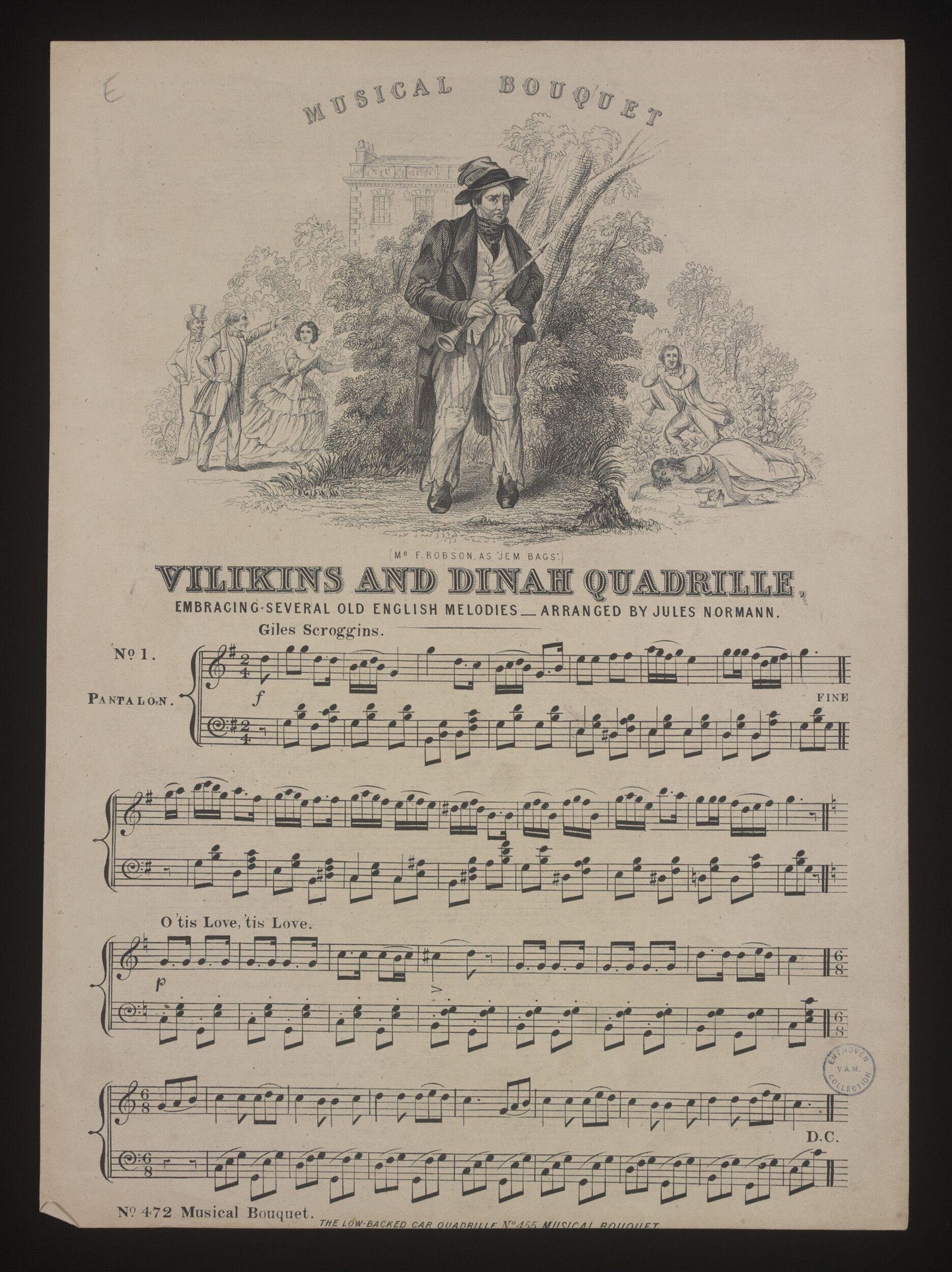
This is the title page and opening musical score for a quadrille arrangement, printed as sheet music. At the top, an engraved illustration shows a man in mid-19th-century dress—dark jacket, light trousers, and a hat—standing in a relaxed pose against a backdrop of trees and a classical building. Around him are five other figures in period costume: men in tailcoats on the left, and women in full skirts on the right, arranged as though observing or participating in a social dance gathering. The setting is outdoors or in a garden, with foliage sketched lightly in the background. The overall tone is one of genteel leisure and courtship. Below this vignette, the title announces "VILIKINS AND DINAH QUADRILLE" and credits the arrangement to Jules Normann based on melodies by Giles Scroggins. The music that follows is notated in two staves (treble and bass), marked "PASTALON" and "FINE," in what appears to be 2/4 time. The piece includes several short melodic phrases typical of dance music intended for social ballroom use.
The dancing
The central male figure stands in an upright, relaxed posture, weight on one leg, with his arms at ease—the stance of someone pausing or about to begin a movement rather than executing one. The surrounding figures are arranged in loose clusters suggesting conversation or readiness to dance, without any clear paired hold or closed position visible. The women's full skirts and the men's formal tailcoats indicate this is formal ballroom attire rather than theatrical costume. The composition suggests a moment of social pause rather than active dancing—a waiting or introduction scene rather than a figure in progress.
The dance depicted
This is a quadrille, the dominant ballroom dance of the 19th century, arranged for piano from an English popular song or melody. The quadrille was a square dance performed by four couples in a rectangular formation, divided into five or six distinct musical sections (called "figures"), each with its own melody and choreographic pattern. The printed music confirms the quadrille form through its sectional structure and the notation marking. Quadrilles based on popular songs or theatrical tunes were enormously common throughout the Victorian era, and this arrangement of "Vilikins and Dinah" (a popular English song, likely from the mid-19th century) would have been performed in drawing rooms and at public balls. The illustration captures the social context—the leisured, mixed-gender gathering of the quadrille as a courtship ritual and display of accomplished dancing.
How it was made
This is a wood or steel engraving, a technique that allowed detailed reproduction suitable for mass printing in sheet music collections. The fine linework and the ability to render both the illustration and the musical notation on a single plate made engraving the standard method for music publishing in this period. The inscription at the bottom identifies this as "No. 172 Musical Bouquet," suggesting it was part of a published series of popular dance and vocal music—a commercial product for the amateur musician and dancer in the home. The quality and clarity of the engraving, combined with the standardized layout, indicates professional publication by a music house of some standing, likely London-based given the English cultural context.
About this work
This is a printed quadrille arrangement from the mid-to-late 19th century, part of a commercial series of popular dance music. It combines an engraved illustration of the social world of ballroom dancing with the full musical notation needed for a pianist to accompany dancers. The quadrille was the defining dance of the Victorian era—a formal, geometric, square dance performed by four couples in strict formations, and the most prestigious dance at any public or private ball. This particular arrangement is of an English popular song, adapted for the ballroom; such arrangements were the staple of music publishing for amateur performers. The work sits at the intersection of commercial music publishing, social dance practice, and the visual culture of courtship and leisure that dominated 19th-century popular print.
How to look at it
The viewer should note the compositional choice to show the figures in a state of pause or social gathering rather than in mid-movement. This reflects both the nature of the quadrille (a dance of distinct, separated figures with moments of stillness between them) and the conventions of 19th-century social illustration, which typically presented dance as a moment of refined leisure rather than energetic motion. The formal dress, the outdoor garden setting, and the relaxed posture of the central figure all communicate the ballroom dance as a ritual of courtship and social performance—a far more static image than the kinetic reality of the dance itself.
The artist
Jules Normann was a music arranger and publisher active in the mid-to-late 19th century, working within the commercial music publishing trade that produced vast quantities of quadrille arrangements, polka variations, and dance music for amateur performers. Arrangers like Normann were industrial workers in the music trade rather than composers in the high-art tradition; their skill lay in taking popular melodies and adapting them to the strict forms and conventions of ballroom dance music. The "Musical Bouquet" series to which this work belongs was a standardized, commercial product—the equivalent of a modern sheet-music subscription service or download catalog.
The period
The quadrille dominated European and American ballroom culture from roughly 1820 to 1900. By the mid-19th century, when this piece was likely printed, the quadrille was established as the centerpiece of formal dancing—the first dance at a ball, the most prestigious in terms of technique, and the one most frequently performed in published arrangements and instruction manuals. English popular songs ("Vilikins and Dinah" was a well-known ballad) were repeatedly adapted as quadrille melodies because they were recognizable and singable, giving dancers and musicians a shared cultural reference. The engraved illustration reflects the contemporary artistic convention of depicting dance as a social occasion rather than a technical performance—the leisure world of mixed-gender courtship and display.
Where it lives
This work is cataloged as sheet music, part of the "Musical Bouquet" series (No. 172). The series was a commercial publication of popular dance arrangements, likely produced in London by a music house whose name does not appear in the current record. Such printed series were distributed to music shops, circulating libraries, and amateur musicians across the English-speaking world.
Dance in this work
Questions about this work
What is a quadrille?
A quadrille is a square dance for four couples (eight people) arranged in a rectangular formation. It was divided into five or six distinct musical sections called "figures," each with its own melody and choreography. Danced primarily in the 19th century, it was the most prestigious and formally structured ballroom dance of the era.
Who would have used this sheet music?
This was intended for amateur pianists in the home or at public dance halls. A pianist would sit at the instrument and play from this score while dancers performed the quadrille in the room. Such arrangements made popular tunes available to amateur musicians without the need for a composer's original orchestration.
Why is the engraving accompanied by musical notation?
Sheet music from this period often included a small illustration to identify the piece, indicate its social context, and appeal to buyers. The illustration serves as both a title vignette and a visual representation of the dance's place in Victorian social life—giving the practical notation a cultural frame.
What does 'Musical Bouquet' mean?
It was the title of a commercial series of popular dance and vocal arrangements published in the mid-to-late 19th century. Each number in the series (this is No. 172) contained a complete piece of sheet music with an engraved title vignette. It was similar to a modern subscription or catalog of popular sheet music.
More dance artwork





