49 works in this view — arrow keys or swipe to move between them.
Dance in Art
Grecian Bend Quadrille
Coote
- Collection:
- Sheet Music
- Source:
- Victoria and Albert Museum
- Rights:
- Rights vary by item — check the source record before reusing this image. Source record ↗
- Recorded as:
- V&A — check rights per item
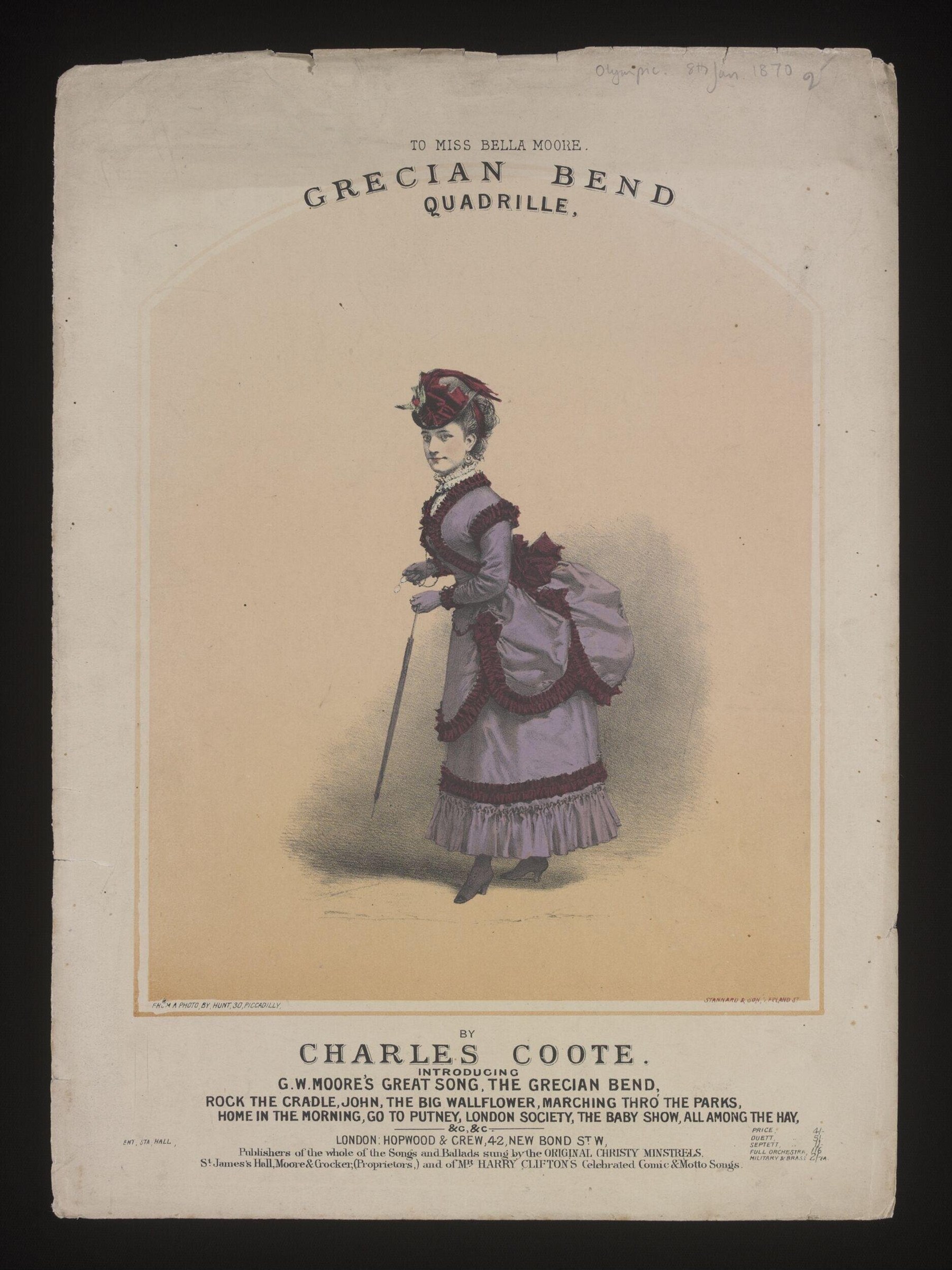
The Grecian Bend Quadrille is a rare visual document of how fashion and posture shaped social dancing in the Victorian era. The image shows that the period's most distinctive body silhouette was not merely sartorial but was embedded in the movement vocabulary and stance of an actual dance—a reminder that what we call "posture" or "style" in dance is always inseparable from the garments that frame the body.
What you are looking at
A single woman stands in three-quarter view against a neutral ground, wearing a lavender silk dress with dark accents typical of the 1870s–80s. The bodice is fitted and dark, the skirt voluminous and gathered at the back into a pronounced bustle. She wears a matching hat adorned with feathers or ribbons, tilted at a fashionable angle. In her gloved right hand she holds a long cane or walking stick, angled downward at her side. Her left arm is bent and held near her waist in a poised, formal manner. Her posture is upright and elegant, weight balanced on both feet, with the characteristic forward-leaning silhouette known as the "Grecian bend"—a fashionable posture of the period that exaggerated the curve of the back and arch of the body. The figure is rendered in soft watercolor or hand-colored lithography with careful attention to fabric texture and shadow.
The dancing
The dancer is a solitary female figure with arms held in a restrained, formal frame. The right arm extends downward holding the cane; the left arm bends at the elbow in a modest, composed position. The knees and ankles are not clearly visible beneath the voluminous skirt, so footwork cannot be assessed. The weight appears centered and the posture is upright yet with the characteristic forward tilt that gives the "Grecian bend" its distinctive look. There is no partner and no movement in other dancers—the image captures a static pose rather than a moment of active dancing.
The dance depicted
This is sheet music for the Grecian Bend Quadrille, composed by Charles Coote and dedicated to Miss Bella Moore. The Grecian Bend was a social dance craze of the 1870s, named after the exaggerated forward-leaning posture it required. The quadrille was a four-couple square formation dance danced in sets, and this version took its theme from the fashionable silhouette of the era. The image documents the posture that defined the style—the distinctive backward arch and forward lean of the torso—rather than showing the figures in formation or active step. The cane is a fashionable accessory of the period and may have been a prop used in performance or demonstration of this novelty dance.
How it was made
This is a printed sheet music cover, rendered in hand-colored lithography or watercolor print. The image shows the typical commercial production of Victorian popular music: a colored illustration on a decorative card stock, with printed title, composer credit, and publisher information at base. The soft palette, careful rendering of fabric, and theatrical presentation indicate this was produced for a mass market—quadrilles and novelty dances were sold as sheet music to middle-class homes and dance halls. The inclusion of a dedicated illustration suggests this was a popular or fashionable piece warranting an attractive cover.
About this work
The Grecian Bend Quadrille is a sheet music cover illustrating one of the 1870s' most fashionable social dances, a novelty quadrille named after and designed to showcase the exaggerated "Grecian bend" posture that dominated women's silhouette and movement of the era. The image shows a solitary woman in period dress, her body tilted in the characteristic forward lean and backward arch, holding a cane in one gloved hand and maintaining the restrained, formal frame expected of a fashionable dancer. As a commercial product, it documents both the dance itself and the material culture of Victorian parlor dancing—the sheet music, the fashionable dress, and the theatrical presentation of a social dance as a commercial commodity for home performance.
How to look at it
Look closely at the posture: the forward tilt of the entire torso, the arch of the back, and the way the weight appears to rest on the balls of the feet in a poised but exaggerated lean. This is the "Grecian bend" itself—not a moment within a step but a postural baseline that the dancer maintained throughout. The cane, held at the side, is a fashionable accessory and possibly also a prop used in the dance. Notice how the dress is rendered: the fabric weight, the bustle, the gathered skirt all emphasize the silhouette. This is a fashion plate as much as a dance image, and that fusion is precisely the point—the Grecian Bend was a dance that showcased a body shaped by fashion.
The artist
Charles Coote was a composer and publisher of popular social dances in Victorian London. Little is known of his biography, but his output includes quadrilles, polkas, and other ballroom forms marketed to the amateur pianist and dancer. He published through Hopwood & Crew, a London music publisher of the period, suggesting he was part of the established commercial music trade that supplied middle-class homes with entertainment and dance instruction.
The period
The Grecian Bend was a fashion-driven dance craze of the 1870s, emerging during the period of the exaggerated bustle and the S-bend corset that created an unprecedented forward tilt and backward arch in the female silhouette. At the same time, the quadrille—inherited from the Regency ballroom and the European court—was the dominant social dance form for organized group dancing. The novelty dances of this period (the Grecian Bend, the Redowa, the polka variations) were often named after and designed to display the fashionable silhouette, making them documents of material culture as much as choreography. Sheet music covers like this one were a major vehicle for disseminating both dances and images of fashionable dress to a broad middle-class audience.
Where it lives
This is a printed sheet music cover from the Hopwood & Crew music publishing house in London. The object type is commercial popular music distributed to piano-owning households and dance halls for amateur performance and instruction. The collection and source are recorded as 'Sheet Music' in the catalogue.
Dance in this work
Questions about this work
What is the Grecian Bend?
The Grecian Bend was a fashionable posture and novelty dance of the 1870s characterized by an exaggerated forward tilt of the torso and backward arch of the back. It was named after and designed to display the distinctive silhouette created by tight-laced corsetry and bustle construction of the era. The posture became so fashionable that it inspired a quadrille dance to showcase it, complete with sheet music covers like this one.
Was this dance performed alone or in a group?
The Grecian Bend Quadrille was a quadrille, meaning it was danced in a set of four couples (eight dancers) in a square formation, as was typical of Victorian ballroom quadrilles. The cover illustration shows a solitary figure as a fashion plate and postural demonstration rather than as a scene of actual performance, which would have featured multiple dancers in formation.
How did dancers perform with that exaggerated posture?
The Grecian bend posture was maintained throughout the dance as a stylistic baseline. Modern dancers find it extremely challenging: the forward tilt required significant core engagement and a distinctive weight distribution quite different from earlier ballroom standards. The corsetry of the period both constrained and enabled this posture, making it a product of both fashion technology and body training.
Why is there a cane in the image?
The cane was a fashionable accessory for women of the period and appears in many fashion plates and dance illustrations of the 1870s–80s. It may also have been incorporated into the choreography of the Grecian Bend Quadrille as a hand prop, though the sheet music itself would not indicate this.
More dance artwork





