49 works in this view — arrow keys or swipe to move between them.
Dance in Art
Octoroon Quadrille
Charles Coote
- Collection:
- Music
- Source:
- Victoria and Albert Museum
- Rights:
- Rights vary by item — check the source record before reusing this image. Source record ↗
- Recorded as:
- V&A — check rights per item
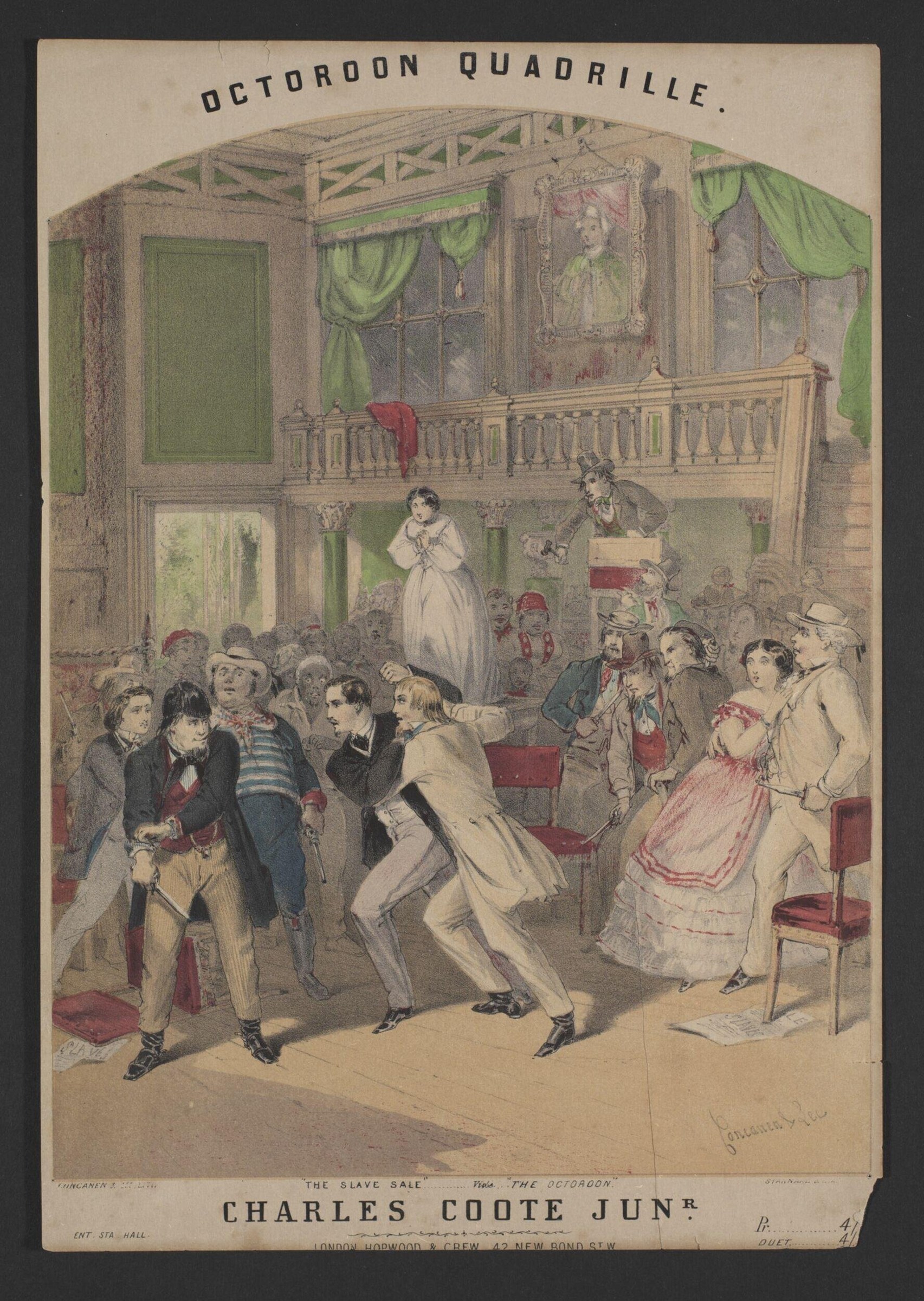
This work documents how the ballroom and the quadrille were used as stages for social satire and racial commentary in the mid-nineteenth century. It is evidence that dance spaces were sites where bodily excess, mockery, and the visual politics of race were actively performed, and that popular prints circulated these meanings to a broad audience. For historians of dance, it reveals the gap between the prescribed elegance of quadrille technique and the transgressive or comic potential of the ballroom body.
What you are looking at
A theatrical or ballroom interior animated by a crowd of men and women in Regency-era dress (high-waisted gowns, tailcoats, tall hats). The architecture is grand: fluted pilasters, a deep two-storey space with a balustraded mezzanine level from which patrons observe. A portrait in an ornate frame hangs above; green swag drapery, red upholstery, and gilt detail frame the scene. In the centre foreground, a man in white breeches and dark coat executes a dramatic lunge or bow, his torso bent sharply forward, one leg extended behind him—a posture of exaggerated courtesy or comic caricature. Around him, spectators stand in clusters; some regard him with raised hands or expressions of surprise or amusement. The composition suggests a moment of theatrical comedy or social disruption within a formal gathering. The engraver has rendered the crowd with specificity: individuals have distinct faces and attitudes, creating a narrative of reaction rather than a synchronized ensemble.
The dancing
The central male figure is the pivot of attention: his body is bent into a steep forward inclination with one leg trailing, creating an unstable, exaggerated posture—not a dance position but a comic or satirical gesture. The surrounding figures stand in scattered groups, some turning toward him, others in conversation; none are in dance hold or formation. The women wear the high-waisted muslin gowns typical of the 1810s; the men wear tailcoats and breeches. The postures are those of social interaction and spectatorship, not coordinated movement. If this is meant to show quadrille dancing, it does so only in the title and setting, not in the depicted bodies.
The dance depicted
The title declares this 'Octoroon Quadrille,' and the setting—a grand ballroom with musicians' gallery, formal dress, and assembled company—is consistent with a quadrille from the 1810s–1860s. However, the actual gesture shown is ambiguous: the central figure's exaggerated bow or lunge reads more as comedy, satire, or caricature than as a dance step. The quadrille was a four-couple figure dance performed to a series of distinct musical sections; the image may represent a climactic or grotesque moment within a quadrille, or it may use the ballroom setting as a frame for social satire. The title 'Octoroon' carries a racial designation, suggesting this engraving comments on race and social hierarchy in a ballroom context—a reading reinforced by the theatrical excess of the central gesture.
How it was made
This is a hand-coloured engraving or aquatint, printed on paper and then tinted with watercolour or glazing pigment. The fine-line work in the architecture and costumes is consistent with engraving; the broad areas of colour—the green drapery, flesh tones, red upholstery—suggest aquatint or hand-colouration. This technique allowed for wide distribution as a broadsheet or as an illustration in a periodical; the small scale and portable format indicate it was meant for popular consumption. The precision of the line work and the narrative detail suggest it was copied or adapted from a theatrical print or caricature series, possibly connected to a stage performance or public spectacle.
About this work
This is a hand-coloured engraving of a ballroom scene titled 'Octoroon Quadrille,' created by Charles Coote Jr. in 1861. It depicts a grand Regency-era interior crowded with formally dressed spectators observing a central male figure in an exaggerated, unbalanced posture that reads as caricature or satire rather than formal dance. The quadrille was the signature social dance of the ballroom in this period, and the title invokes that form, but the visual content suggests theatrical comedy or social commentary on race within the ballroom context. The print belongs to a tradition of colour-printed ballroom caricatures—ephemeral visual commentary on fashion, manners, and social transgression.
How to look at it
Focus on the central figure's posture and the surrounding crowd's reaction. The bent, unstable quality of his gesture suggests not a normative dance step but a moment of rupture or comic excess—a body failing to maintain the composure demanded by ballroom culture. Observe how the crowd frames this disruption: some spectators are animated, gestural, turned toward the figure; others remain in formal clusters, indifferent or unmoved. The architectural grandeur of the ballroom creates a sharp contrast with the bodily excess shown within it. This is caricature: the artist chose a moment of maximum social discomfort or absurdity to freeze and print for public consumption.
The artist
Charles Coote Jr. was a London-based engraver and printer active in the mid-nineteenth century. He worked primarily in social and theatrical caricature, producing hand-coloured satirical prints for the popular market. His work documented and commented upon contemporary fashions, manners, and public spectacles. He was part of a lineage of English caricaturists (inheriting the tradition of Gillray and Cruikshank) who used the engraved print as a vehicle for social and political commentary.
The period
The quadrille emerged in Paris in the 1820s and became the dominant ballroom dance across Europe and America by the 1850s–1860s. It was a democratic, codified dance—less elite than the country dance or cotillion, more uniform, taught in dancing schools and performed in public and private ballrooms. The 1860s saw the quadrille established as the standard opening figure of the evening's dancing. Simultaneously, the mid-nineteenth century saw intensifying visual commentary on race, slavery, and blackness in popular culture, particularly in London and Paris. The title 'Octoroon' (a person of one-eighth African ancestry) references both the racial categories of American slavery and the contemporary theatrical fascination with racial types and caricature. The ballroom—a space of social aspiration and bodily discipline—becomes a stage for the projection of racial anxieties and comic transgression.
Where it lives
This engraving is held in a Music collection (Virginia, according to the source code 'va'), suggesting it may have been catalogued alongside printed music, libretti, or theatrical materials. It is a commercial print, likely purchased or distributed as a broadsheet or periodical illustration. The inscription at the base credits Coote and identifies it as part of a series ('The Slave Sale' / 'The Octoroon'); this suggests it was one of several related caricatures circulating as a suite.
Dance in this work
Questions about this work
Is this a real dance or a caricature?
The setting and title invoke the quadrille, the standard ballroom dance of the 1860s, but the central figure's gesture is exaggerated to the point of caricature. The artist has used the ballroom as a framing device for social satire rather than documenting actual quadrille technique. The print belongs to a tradition of ballroom caricature in which bodily excess, transgression, and mockery are the point.
What does 'Octoroon' mean in the title?
'Octoroon' refers to a person of one-eighth African ancestry—a racial category used in American law and slavery. The term carries deep historical weight: it evokes the legal categories of slavery and miscegenation. In the 1860s, it was also used in theatrical and literary contexts to denote racial types. The engraving appears to use this title to comment on race and social hierarchy within a ballroom context, though the exact meaning of the association remains ambiguous and would have been inflected by the viewer's historical moment.
Was Charles Coote Jr. a known artist?
Coote was a working engraver and printer in mid-nineteenth-century London, specializing in hand-coloured social and theatrical caricature. He was part of a productive commercial enterprise (Coote & Co.) that produced popular prints for the mass market. He is not a major figure in art history, but his work is representative of the genre of satirical ballroom and theatrical prints that were widely consumed in this period.
Why is this in a dance collection?
Although the print is primarily a social and racial caricature, it depicts a ballroom setting and invokes a specific dance (the quadrille). It is evidence of how dance spaces and dance bodies were used in popular visual culture as stages for social commentary. For dance history, it documents the ballroom as a contested space and the quadrille as a form that could be both normative and transgressive.
More dance artwork





