49 works in this view — arrow keys or swipe to move between them.
Dance in Art
The Punchinello Quadrille
Strange, William
- Collection:
- Source:
- Victoria and Albert Museum
- Rights:
- Rights vary by item — check the source record before reusing this image. Source record ↗
- Recorded as:
- V&A — check rights per item
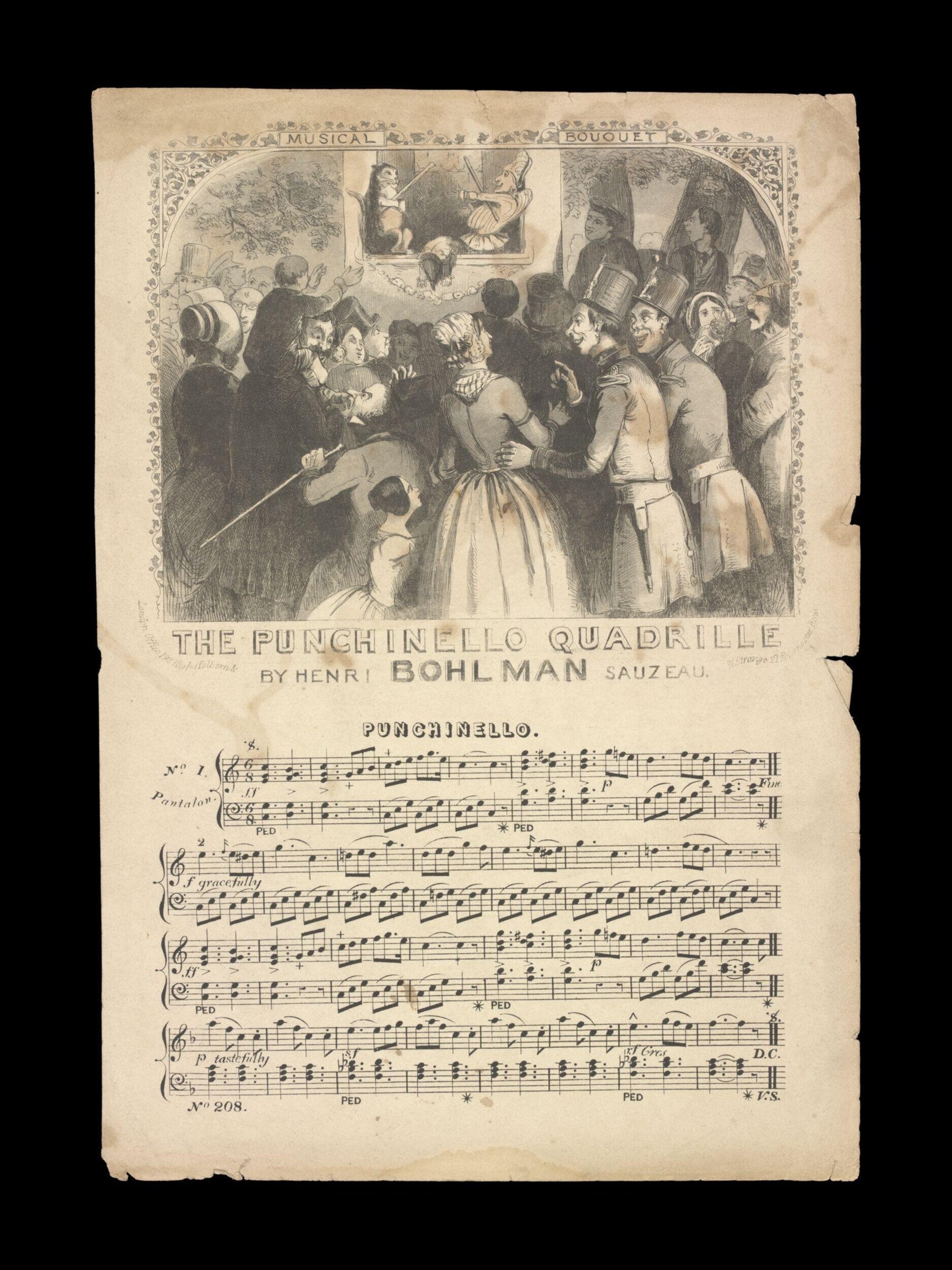
The print documents the quadrille at the height of its fashion and social significance, capturing not the dance's technical form but its cultural meaning as an object of satire. For historians and dancers, this reveals how even the most canonical ballroom dances were subject to parody and how satirical prints shaped public perception of dance. The inclusion of an actual musical score transforms the print into evidence of how dance music was circulated and consumed in the nineteenth century.
What you are looking at
A crowded ballroom or assembly room is thronged with fashionably dressed figures in what appears to be a comic or satirical scene. The composition is framed by decorative borders labeled "A MUSICAL BOUQUET" at top and "THE PUNCHINELLO QUADRILLE" at bottom. The central figures are tightly clustered, dancing or attempting to dance amid evident chaos and exaggeration: men in military dress uniforms, tall hats, and tailcoats press close to women in full skirts and bonnets. Above the crowd, a framed vignette shows a woman at a harpsichord or similar keyboard instrument, presumably providing the music. The figures' poses suggest energetic, somewhat ungainly movement—some lean back, others push forward, creating a sense of controlled mayhem typical of satirical prints of the era. The atmosphere is one of social comedy rather than elegant grace.
The dancing
The dancers exhibit exaggerated, somewhat stiff postures characteristic of satirical representation. Several figures are captured mid-turn or mid-step, with arms raised and skirts flaring. The men's military uniforms dominate, their posture often rigid and formal. Women's full skirts and bonnets are prominently displayed, with the fabric of the skirts rendered to show volume and movement. The grouping is dense and overlapping rather than the neat formations of a formal quadrille, suggesting either artistic liberty or deliberate mockery of the dance's conventions. No clear couple formations are evident; instead, the crowd reads as a mass of competing, jostling figures.
The dance depicted
This is a satirical representation of the quadrille, one of the most fashionable ballroom dances of the 1840s. The quadrille was a four-couple figure dance performed in square formation, but the print exaggerates and mocks its conventions. The title references the Punchinello—a stock comic character from commedia dell'arte—suggesting this is a burlesque or comic variant rather than instruction or celebration of the dance proper. The musical score reproduced below confirms the quadrille idiom (marked "Punchinello," No. 7, in duple meter typical of the form). The satire likely targets both the dance itself and the social pretension of the ballroom, a favorite subject of Victorian-era satirical prints.
How it was made
This is a wood engraving or steel engraving, recognizable from the fine linear hatching, the decorative border, the serif typeface, and the characteristic black-and-white tonal range. The print was produced for commercial distribution—likely as a single sheet, possibly part of a periodical or a series. The presence of the musical score printed below the image was common in the nineteenth century, making this both a visual entertainment and a functional music publication. The engraving technique allowed for mass reproduction and wide circulation among middle-class audiences, establishing this as popular ephemera rather than fine art.
About this work
This is a satirical print commemorating the quadrille craze of the 1840s, rendered as comic social commentary on fashionable ballroom dancing. The print combines a densely populated, exaggerated dance scene with an actual musical score, functioning simultaneously as visual joke, social critique, and musical publication. It belongs in a dance gallery as evidence of how the quadrille was received and parodied in popular culture, and as a record of the dance's dominance in mid-Victorian social life. The work represents the quadrille not as a formal accomplishment but as a subject ripe for ridicule—a shift in cultural attitude that reflects broader tensions about propriety, fashion, and class in the period.
How to look at it
Attend to the deliberate disorder of the composition: the figures are packed and overlapping rather than arranged in the formal square formations the quadrille required. Notice the exaggerated dress—the absurdly tall hats, the bulbous skirts, the military uniforms rendered as costume rather than fashion. The musical score below grounds the satire in actual practice: this is not fantasy but an attack on a real, widespread social form. The vignette of the musician at top confirms that what is being mocked is the entire ballroom apparatus, not just the dancers themselves. The artist chose the moment of apparent chaos mid-dance, not the beginning or a neat formation.
The artist
William Strange is recorded as the artist. Little is documented about Strange's practice, though the style and execution suggest he was a working engraver and illustrator in the commercial print trade of the 1840s. The attribution and the hand visible in the image mark this as a professional production rather than amateur satire.
The period
The quadrille dominated European and American ballrooms from the 1840s through the 1880s, evolving from French salon dance into a ubiquitous feature of middle-class social life. It was taught, published, and performed obsessively, which made it equally subject to ridicule. The 1840s saw a proliferation of satirical prints mocking fashion, manners, and social pretension; this print sits within that tradition. Musical publications combined with satirical imagery were common, as composers and publishers capitalized on dance crazes. By mid-century, the quadrille's very popularity had made it a target for mockery by those seeking to critique the artificiality of ballroom society.
Where it lives
This is a commercially produced print, catalogued as part of a collection focused on dance imagery. The printing technique, typography, and style suggest publication in London or another major print center in the 1840s. It is held as a print (likely an engraving or similar relief or intaglio print), signaling its status as popular, reproducible media rather than a unique artwork.
Dance in this work
Questions about this work
What is the quadrille?
The quadrille was a four-couple square-formation ballroom dance that dominated European and American social dancing from the 1840s through the late nineteenth century. It consisted of five named figures (typically Pantalon, Été, Poule, Trénis, and Finale), performed in sequence to instrumental music. It was fashionable, required instruction, and was danced at all levels of society—which made it both celebrated and satirized.
Why is this print called 'Punchinello Quadrille'?
Punchinello (or Pulcinella) is a stock comic character from commedia dell'arte, traditionally portrayed as clumsy, greedy, and foolish. Titling the dance variant after him signals that this is a burlesque or comic version—the quadrille rendered absurd. The print mocks the pretensions of ballroom dance by placing it in the tradition of popular farce.
What does the music score at the bottom tell us?
The presence of an actual musical score (No. 7, marked Punchinello, for piano) shows that this print was both entertainment and a functional music publication. It allowed buyers to learn the melody and perform it, blending satirical visual commentary with practical use. This was a common format in the nineteenth century, particularly for popular dances.
How was this print made and distributed?
This is a wood or steel engraving, a technique that allowed for mass reproduction from a single plate. Prints like this were sold individually or as part of periodicals and series, reaching middle-class urban audiences. The commercial nature of the production and distribution made it a form of popular media—more like a modern cartoon or meme than fine art.
More dance artwork





