49 works in this view — arrow keys or swipe to move between them.
Dance in Art
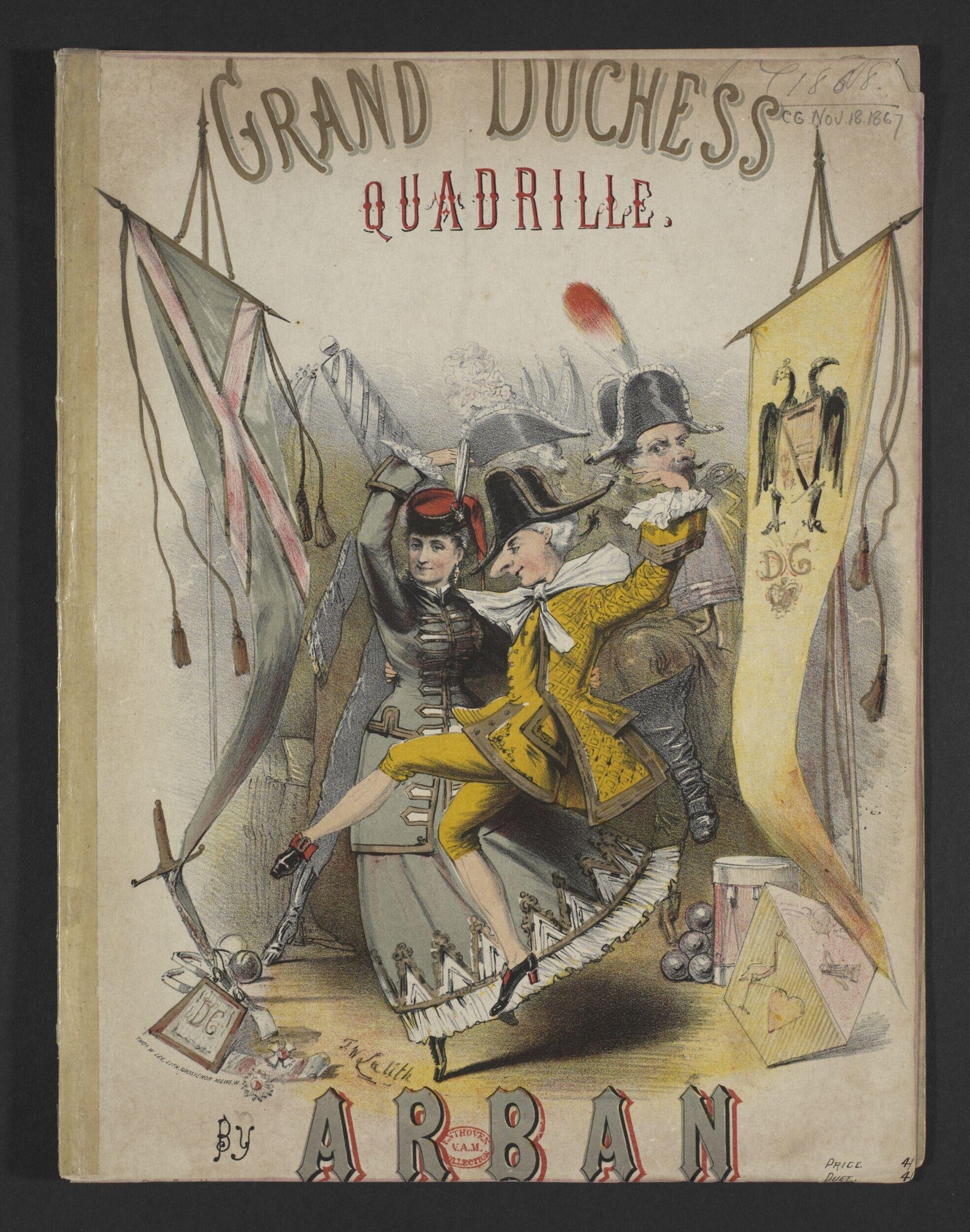
Grand Duchess Quadrille
Lee, Thomas Wales
- Collection:
- Sheet music
- Source:
- Victoria and Albert Museum
- Rights:
- Rights vary by item — check the source record before reusing this image. Source record ↗
- Recorded as:
- V&A — check rights per item
This work reveals the relationship between social dance and popular commercial culture in the Victorian era. It shows that the quadrille, while a serious social institution, was also a subject of satire, caricature, and theatrical play. The image demonstrates how dance could be used to sell sheet music through visual spectacle and topical reference—a strategy that shaped mass entertainment and consumer culture.
What you are looking at
This is the cover of a piece of sheet music titled *Grand Duchess Quadrille* by Lee, published in 1867. The image depicts a lively ballroom scene in colored lithography, with a young woman in a dark military-style jacket with gold braid and buttons at center, her leg extended in a high kick, seated or reclining across the lap of a man in a yellow coat and tall feathered hat. A second figure in similar formal dress gestures upward behind them. The setting is a military campaign tent or pavilion, indicated by draped fabric, pennants, and flags—including a yellow banner with heraldic insignia—hanging from tent poles. A small ceremonial shield or emblem sits at ground level to the left. The composition is theatrical and comedic, suggesting a carnivalesque or burlesque treatment of military romance rather than a serious dance instruction or ballroom manual.
The dancing
The central woman is rendered with exaggerated dynamism: her torso is thrown back in an extended, unstable posture across the man's lap, with one leg kicked high. Her arms are spread open. The man cradles and gestures dramatically. A third figure in the background mirrors similar theatrical gestures. There is no closed ballroom hold, no upright frame, and no conventional partnering position visible. The bodies occupy space in a way that is burlesque or pantomimic rather than ballroom-disciplined.
The dance depicted
The title identifies this as a quadrille—a four-couple figure dance that dominated ballroom culture from the 1840s onward and was one of the most fashionable social dances of the era. However, the image does not depict a quadrille in the conventional sense. The poses are too exaggerated, the setting (a military tent) is too specific and farcical, and the overall tone is comedic rather than instructional. This is almost certainly a satirical or burlesque piece: a parody quadrille, possibly commemorating or mocking a specific military or social event (the reference to 'Grand Duchess' suggests a royal or aristocratic subject). The dance itself is treated as theatrical spectacle rather than as a social practice to be learned.
How it was made
This is a hand-colored lithograph, a process that allowed for mass production of colorful popular prints. The tonal lithography is skillfully executed—note the soft modeling of fabrics, the careful gradation of the draped tent cloth, and the vivid but naturalistic coloring of the uniforms and flesh. Lithography made such works affordable for middle-class consumers and ideal for sheet music covers, where visual appeal directly drove sales. The technique allowed the artist to combine fine detail (the officer's medals, the feathering) with bold compositional gestures.
About this work
This is the decorated cover of an 1867 published quadrille, a social dance composition in four movements for piano or small ensemble. It is not an instructional image but a promotional one—designed to sell sheet music by making the dance seem fashionable, amusing, and attached to a specific (likely topical) narrative. The quadrille was the dominant ballroom dance of the mid-to-late 19th century, and quadrille compositions were commercially vital to music publishers. This particular piece uses satire and military drag to appeal to its audience: the woman's unconventional, high-kicking posture, the burlesque tone, and the exotic military setting all signal that this is meant to be novelty entertainment rather than a standard social dance. The work belongs in a dance gallery because it documents how dance music was marketed and how the quadrille itself could be treated as subject for parody and theatrical reinvention.
How to look at it
Note the tension between the title (a formal social dance) and the image (a burlesque tableau). The 'Grand Duchess' quadrille is presented not as a serious instructional subject but as a joke—the exaggerated postures, the farcical setting, and the theatrical lighting all signal parody. The artist has frozen a moment that could never actually occur in a ballroom: the woman's extreme leg extension and recumbent posture are meant to be visually arresting and amusing, not an accurate representation of quadrille technique. The military setting establishes the satirical scenario. A viewer of the period would have recognized both the quadrille's conventions and their deliberate violation here.
The artist
Thomas Wales Lee was an active composer and arranger of dance music in mid-19th-century Britain and America. He produced numerous quadrilles, polkas, and other fashionable pieces, many with amusing or topical titles and covers designed to catch the public eye. His work represents the commercial dance-music industry of the period—prolific, fashionable, and responsive to popular taste.
The period
The 1860s were the height of the quadrille's international popularity. It had originated in France in the early 19th century and by the 1860s was danced in ballrooms across Europe and North America, with hundreds of published compositions and variations. At the same time, ballroom culture was increasingly subject to satire and burlesque in popular entertainment—the rigid formality of quadrille figures offered rich material for parody. This was also an era of intense military spectacle (the American Civil War was ongoing in 1867), and military costume appeared frequently in popular visual culture. The lithographed sheet music cover was the dominant form of music marketing and visual branding of the period.
Where it lives
This is a sheet music cover, held as part of a published score from 1867. The catalogue record identifies it as held in a music collection. Quadrille sheet music covers are a valuable historical source for both dance history and popular visual culture of the era.
Dance in this work
Questions about this work
What is a quadrille?
A quadrille is a four-couple figure dance performed by eight people in a square formation, with five distinct figures or sections. It originated in France in the early 1800s and became one of the most popular ballroom dances of the 19th century. Hundreds of quadrille compositions were published, and learning to dance them was standard for respectable social participation. Each composition had its own figures and music.
Why is this sheet music cover so theatrical and silly?
This is a satirical or burlesque quadrille—not a standard social dance but a musical and visual joke. The exaggerated military setting, the woman's improper posture, and the overall tone are meant to be amusing. Publishers used topical references and comedy to sell sheet music, and this 'Grand Duchess' title (possibly referencing a specific royal event or scandal) made the piece a novelty item rather than a serious instructional one.
What does the lithography technique tell us?
Hand-colored lithography made attractive, affordable printed images for mass audiences. The color and detail of this cover were marketing tools designed to catch the eye of potential buyers in music shops. The technique allowed the artist to combine commercial appeal with fine artistic detail, making the dance seem glamorous and entertaining.
More dance artwork





