49 works in this view — arrow keys or swipe to move between them.
Dance in Art
Costume
Wilhelm
- Collection:
- Theatre costume
- Source:
- Victoria and Albert Museum
- Rights:
- Rights vary by item — check the source record before reusing this image. Source record ↗
- Recorded as:
- V&A — check rights per item
Theatrical costumes are the embodiment of how dance was imagined, designed, and experienced before film. This garment tells us how a dancer's body was framed for an audience, what movements it enabled or constrained, and what narrative or character the production team intended to convey. Preserved costumes are rare and fragile; their survival and documentation is essential to understanding the visual practice of early 20th-century dance.
What you are looking at
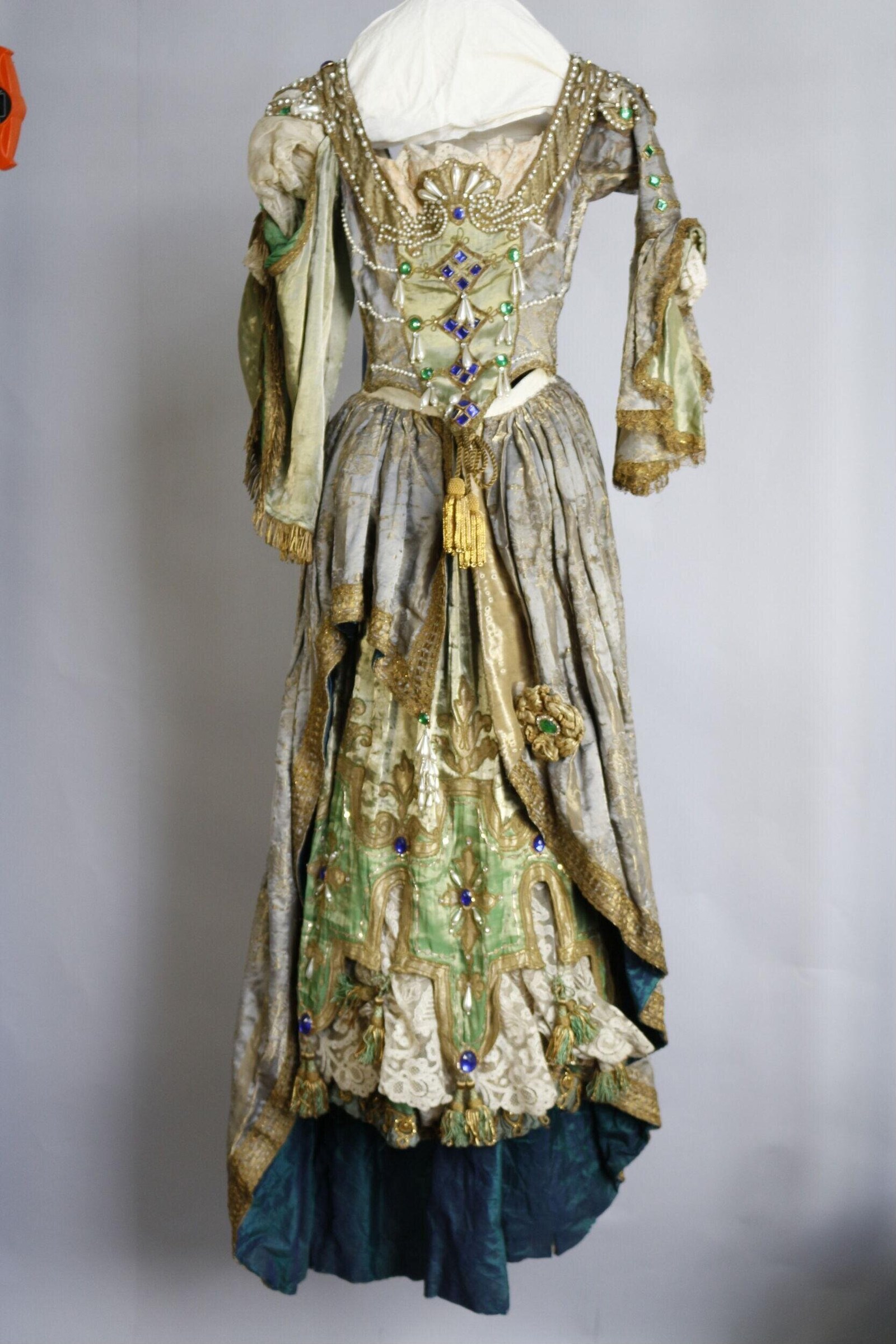
A single figure in a theatrical costume stands posed against a neutral background, displayed on a dress form or mannequin. The garment is an elaborate early 20th-century stage costume in cream, gold, and pale grey tones, with a voluminous skirt and fitted bodice richly decorated with applied ornament. The bodice features allover beading and jeweled embellishment in blue and green stones arranged in geometric patterns, with draped pearl strands forming swags across the chest. The skirt comprises multiple layers: a fitted grey underskirt, a heavily embellished cream and gold overskirt with floral or rococo motifs, and a pale blue underskirt visible at the hem, creating a complex silhouette of historical fantasy rather than historical accuracy. Long sleeves with flared cuffs and attached drapery extend from the bodice. A white collar or chemisette sits at the neckline. The overall impression is of an exotic or aristocratic character from an early 20th-century opera, ballet, or theatrical production—likely a role for a soprano or prima ballerina.
The dancing
The costume is displayed on a dress form without a visible figure, so we cannot assess actual movement, hold, or frame. The silhouette suggests a formal, upright carriage: the fitted bodice would constrain the torso and upper body, while the full skirt would allow for movement in the lower body, particularly turns and sweeping gestures. The elaborate train and layering imply a role of nobility or high status, performed with formal bearing and perhaps processional or parade-like movement rather than athletic or rapid choreography.
The dance depicted
The theatrical context and date (1912) suggest this is a costume from opera or theatrical dance rather than social dance. The silhouette, jeweled ornamentation, and exotic flavor point toward roles in works such as grand operas set in imaginary or historical courts—likely a female lead role. The construction allows for the formal, stately movement associated with pre-World War I theatrical ballet and opera, where dancers performed in structured, courtly or fantasy settings rather than naturalistic characters. Without additional documentation, the specific dance style cannot be determined beyond the theatrical context.
How it was made
This is a constructed theatrical costume: tailored fabric (silk or similar), hand-sewn beading, and applied jeweled ornament, likely rhinestones or colored glass. The beading and stoning technique required substantial labor and expense, indicating a major production with significant resources. The construction shows sophisticated dressmaking skill and the layering of materials to achieve the voluminous silhouette. Such costumes were built to withstand stage movement and were often reused or altered across productions and performers.
About this work
This is a theatrical dance costume from an early 20th-century European production, likely from a grand ballet or opera. The date and attribution to 'Wilhelm' suggest it comes from the costume and design workshops that supplied major opera houses and ballet companies during the Edwardian era. The costume embodies the pre-modern theatrical aesthetic of the 1910s, when dance roles—especially female leads—were costumed in elaborate fantasy dress that referenced historical styles, orientalism, and aristocratic fantasy rather than naturalism or abstraction. Such costumes are rarely preserved intact, making this a valuable document of theatrical practice and the material culture of dance performance in this period.
How to look at it
Examine the construction: the hand-beading and stoning, the seams and fastenings, the layering of fabrics in the skirt. These reveal the labor and cost invested in a single costume. Notice how the fitted bodice and full skirt would function as a costume for movement: the torso is constrained, directing the eye upward to the face and upper body, while the skirt allows sweeping turns and processional movement. The color palette—pale golds and creams with jewel tones—would read effectively from a distance under stage lighting of the period.
The artist
Wilhelm is listed as the artist or maker, but the attribution is unclear—this may be a costume house, a head designer, or a master tailor whose name became attached to the work. Costume making in the early 1900s was a specialized trade, and major production houses—particularly those supplying grand opera and ballet—employed teams of designers, cutters, and embroiderers under a master name. The quality and complexity of this garment suggest it came from a significant workshop, possibly in Vienna, Berlin, or another major European theatrical center.
The period
In 1912, theatrical dance was dominated by the Russian Imperial Ballet and the Ballets Russes (founded 1909), which set new standards for visual spectacle and costume design. Early 20th-century theatrical dance favored elaborate, historically-inspired or exoticized costumes; Léon Bakst's designs for the Ballets Russes established the aesthetic standard. Simultaneously, the earliest experiments in modernist dance—Isadora Duncan, the German Ausdruckstanz—were rejecting elaborate costume in favor of the body itself. This garment sits squarely in the traditionalist, spectacle-driven camp of 1912, representing the tail end of the 19th-century theatrical tradition.
Where it lives
The costume is held in a collection of theatrical costumes and is catalogued as a 1912 work attributed to Wilhelm. It is a complete stage garment, preserved as a document of theatrical production rather than as an example of fashion or social dress.
Dance in this work
Questions about this work
Could this costume actually be worn and danced in?
Yes, but with significant constraints. The fitted bodice limits spinal and torso movement; the skirt layers are heavy but allow rotation and sweeping leg movements. A trained dancer would adapt to these constraints. The costume was designed for a specific choreography and performer, not for a range of movement. Stage endurance and costume maintenance between performances would have been concerns.
What role would have worn this costume?
The ornamentation, silhouette, and color suggest a female lead role of high social status or exotic fantasy—a princess, sorceress, or legendary queen in grand opera or theatrical ballet. The elaborate jeweling and fabric indicate a starring role, not an ensemble or secondary character.
Who was Wilhelm?
The catalogue does not specify. 'Wilhelm' may be a costume house, master tailor, or head designer; such attributions in theatrical collections often refer to workshops or firms rather than individual artists. Costume making in major European opera houses was a collective enterprise.
How would this have looked on stage?
Under incandescent stage lighting of the 1910s, the jeweled beading and metallic embroidery would have caught and reflected light, creating sparkle and shimmer that read across the theater. The pale golds and creams would glow; the blue accents would recede. The voluminous skirt would catch light in movement, creating a sense of mass and grandeur. From the audience, the costume would read as opulent and otherworldly.
More dance artwork





