49 works in this view — arrow keys or swipe to move between them.
Dance in Art
The Love Song
Billedcentralen Politikens Presse
- Collection:
- Photograph
- Source:
- Victoria and Albert Museum
- Rights:
- Rights vary by item — check the source record before reusing this image. Source record ↗
- Recorded as:
- V&A — check rights per item
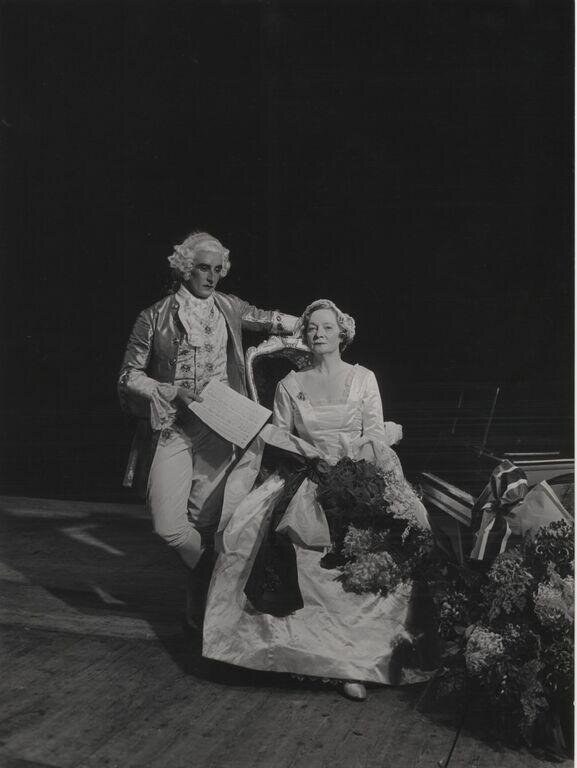
This photograph documents the meeting point between historical dance vocabulary and twentieth-century theatrical drama—how trained dancers used the formal bearing and spatial relationships of eighteenth-century courtship to tell contemporary stories. The image shows that "dance" in theatrical contexts of this period included not only movement in motion but also the formal, significant stasis of ballroom propriety and its emotional charge.
What you are looking at
A black-and-white photograph captures two figures in an interior theatrical space against a dark background. On the left, an older man in formal eighteenth-century dress—silk breeches, embroidered coat, and powdered hair—stands in profile, holding a large document or letter in one hand. On the right sits a younger woman in a simple white muslin gown with puffed sleeves, her posture upright and formal. Between them sits or stands a small dark figure, possibly a child or cherub-like form. A single powerful light source models the figures sharply against the black void, creating an almost sculptural quality. The composition is intimate and staged, suggesting a moment of courtship or emotional transaction—the letter as catalyst. The woman's gaze is directed away, her expression composed but reserved; the man leans slightly toward her. The dress suggests either a historical period piece or a theatrical representation of one, rendered in the photographic documentary style typical of 1930s theatre documentation.
The dancing
Both figures maintain an upright, formal carriage typical of courtship or ballroom propriety. The man is leaning slightly forward from the waist, his body angled toward the woman in a gesture of supplication or presentation; his free arm hangs at his side. The woman sits with a straight spine and shoulders back, her hands folded or resting in her lap—her posture closed and resistant. Neither figure's feet are visible enough to determine footwork. The spatial relationship between them—the distance maintained, the turn of their heads away from each other—suggests tension or restraint within a formal social dance or scene.
The dance depicted
This appears to be a photograph of a theatrical production rather than social dance documentation. The formal eighteenth-century dress and the letter as a dramatic prop suggest a staged scene, possibly from a romantic comedy or operetta of the kind popular in 1930s Scandinavian theatre. If dance is present, it would be as gesture and formal movement within dramatic dialogue—the ballroom comportment and courtship ritual implied by the costume and spatial relationship. The title "The Love Song" points to a romantic narrative moment rather than an actual dance performance, though the formal training visible in both figures' bearing suggests they may be ballet or theatrical dancers performing a dramatic scene.
How it was made
This is a black-and-white photograph, likely from a theatre archive or production documentation. The lighting is theatrical—a single strong source creating sharp contrast and volumetric modeling of the figures. The composition and printing suggest professional stage photography, probably taken during a performance or dress rehearsal, of the kind standard in Scandinavian and European theatre documentation of the 1930s. The photograph's clarity and archival quality suggest it was taken by a professional theatre photographer and preserved as part of production records.
About this work
This is a production photograph from a theatrical work—most likely a ballet, operetta, or dramatic stage piece—performed in Scandinavia in 1932. The image documents a moment of formal courtship or romantic negotiation between two characters in eighteenth-century costume. The photograph belongs in a dance archive both as evidence of how theatrical dance companies staged narrative and sentiment through gesture and tableau, and as a document of the formal ballroom vocabularies that trained dancers drew upon for dramatic scenes. The 1930s was a period of great ferment in theatrical choreography across Northern Europe, and this image shows how classical court dress and formal bearing were being repurposed for contemporary emotional expression.
How to look at it
Notice the deliberate spatial distance between the two figures and the direction of their gazes—both turned away from each other despite their emotional proximity. This is a photograph of restraint and social formality deployed as emotional expression. The letter functions as the dramatic catalyst, held out as evidence or plea. Watch how the man's lean toward the woman contrasts with her upright stillness; this is the language of ballroom dance—approach and retreat, invitation and reserve—translated into narrative theatre. The lighting is doing theatrical work too: the single source makes these figures monumental and isolates them in a void, emphasizing their emotional solitude even in proximity.
The artist
Billedcentralen Politikens Presse was a Danish photographic agency and production company associated with Politiken, one of Denmark's major newspapers. It maintained extensive archives of theatre, dance, and cultural events in Denmark during the early twentieth century, serving as both a press photography service and a theatre documentation bureau. The agency's photographs were distributed to newspapers and cultural institutions and are now held in Danish public collections.
The period
The 1930s saw a broader European movement toward "neo-classical" ballet and dramatic theatre that drew on historical court dress and formal movement vocabularies. In Scandinavia, companies like the Royal Danish Ballet and numerous smaller theatrical ensembles were staging narrative works that combined romantic drama with formal gesture. The photograph reflects this moment of renewed interest in eighteenth-century aesthetics as material for contemporary emotional expression, particularly in the staging of courtship and romantic conflict. Simultaneously, photography itself—especially theatrical photography—was becoming more sophisticated in its use of lighting and composition to convey psychological and emotional states.
Where it lives
This photograph is held in a Danish public collection and is credited to Billedcentralen Politikens Presse, the photographic archive of Politiken newspaper. It was likely taken during a production in Copenhagen or elsewhere in Denmark and preserved as part of the newspaper's or theatre's documentation records.
Dance in this work
Questions about this work
Is this actually a dance photograph, or just a theatrical scene?
It is a photograph of a theatrical production. If the performers are dancers (which their training and bearing suggest), they are performing a dramatic scene that uses ballroom formality and gesture rather than choreographed dance movement. In early twentieth-century theatre, this distinction was less absolute; trained dancers often performed in dramatic works, and formal gesture was considered part of their craft.
What is the significance of the letter?
The letter is a dramatic prop that structures the scene's emotional conflict. In eighteenth-century courtship narratives (whether historical or theatrical recreations), a letter often represents an unspoken plea, a declaration, or a barrier to direct communication. Its presence here signals that this is a moment of negotiation between desire and propriety.
What does the eighteenth-century costume tell us?
The formal dress—silk breeches, embroidered coat, muslin gown—signals a historical setting or a theatrical evocation of one. It also reflects the ballroom movement vocabularies of that period, which trained dancers in the 1930s would have studied as part of their classical training. The costume grounds the scene in a world of regulated social movement and courtship ritual.
More dance artwork





