49 works in this view — arrow keys or swipe to move between them.
Dance in Art
Unknown
- Collection:
- Source:
- Victoria and Albert Museum
- Rights:
- Rights vary by item — check the source record before reusing this image. Source record ↗
- Recorded as:
- V&A — check rights per item
The image preserves the actual silhouette and carriage of early 19th-century social dancers at a moment before photography, showing not codified steps but the embodied reality of how fashionable bodies moved, stood, and displayed themselves in mixed company. For dance historians, it is a rare direct record of cotillion and quadrille practice outside the frame of literary description or later nostalgic representation.
What you are looking at
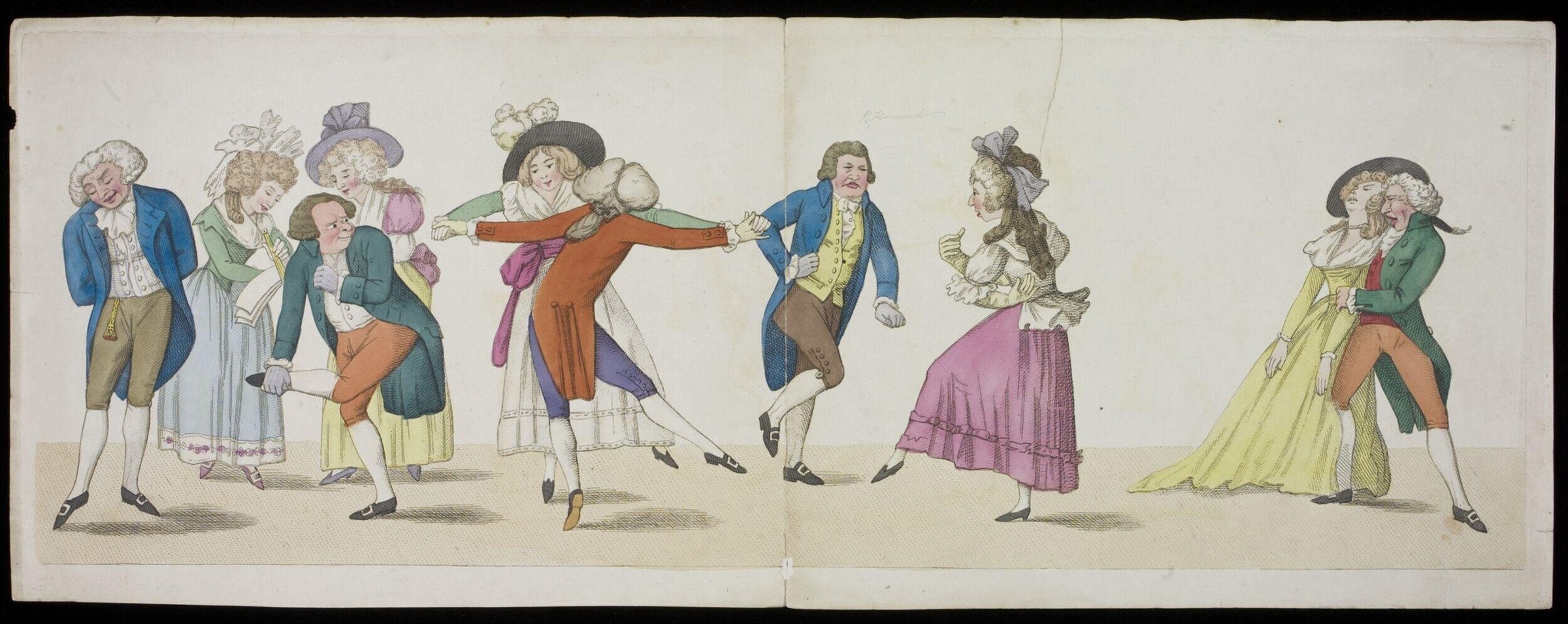
A hand-colored engraving depicting seven figures in late 18th-century dress arranged in a horizontal line across the composition. The scene reads as a sequential narrative of social interaction and dance. At left, three figures in formal attire (blue coats, breeches, tricorn hats) attend to two women in high-waisted chemises and elaborate bonnets. Center-right, a figure in an orange-red coat with arms spread wide executes a leap or révérence, his body bent backward in an exaggerated posture of gallantry or display. To his right, a man in blue observes or responds. At far right, a woman in a yellow gown with green trim stands beside a man in dark coat and breeches. All figures wear shoes with heeled feet visible. The women's clothing—high waistlines, muslin skirts with decorative hems, elaborate bonnets and ribbons—places the work firmly in the Regency or very late Georgian period. The print shows fine detail in faces and features, with careful hand-coloring in pastels and ochres. The setting is blank or neutral, emphasizing the figures themselves.
The dancing
The central figure's posture—back arched, arms extended wide in a near-horizontal spread, weight on one heel—suggests a moment of theatrical display rather than functional movement. The other figures adopt stiff, upright carriage with straight spines and aligned shoulders, consistent with formal dance deportment of the period. No couple is in closed position; instead, figures stand independently or in loose proximity, typical of Regency-era social mixing. Several figures gaze toward the central performer, establishing focus and narrative hierarchy. The bodies are arranged to display costume and bearing rather than to demonstrate complex footwork or holds.
The dance depicted
This is almost certainly a Regency quadrille or cotillion scene, possibly a single moment within a larger figure or a composite of typical moments from such a dance. The formal dress, the arrangement of individuals and pairs, and the exaggerated gestures of courtship and display are consistent with early 19th-century ballroom etiquette. The central figure's leap or révérence may represent a moment of individual flourish within a set formation—a commonplace element of cotillion figures where dancers took turns performing for one another. The absence of close partnering and the emphasis on individual display distinguish this from contemporary waltz or Viennese whirl imagery. The print likely documents fashionable social practice rather than a specific named choreography.
How it was made
This is a hand-colored engraving or possibly a colored stipple engraving, identified by the fine line work, the delicate cross-hatching in shadow areas, and the characteristic pale, translucent hand-coloring applied over the printed base. The technique was common in Britain for fashion plates and social satire of the 1790s–1820s, allowing rapid production and wide circulation among the fashionable classes. The coloring is accomplished in discrete, even tones without blending, a hallmark of commercial coloring workshops. The print's small size and refined execution suggest it was created for a periodical, satirical series, or album of fashionable amusements rather than as a standalone fine art object.
About this work
This is an eyewitness record of Regency ballroom practice, captured in the language of early 19th-century satirical engraving. The work documents not the technical execution of a specific dance but the social choreography of mixed-gender display and courtship—the costumes, the postures, the moments of individual performance within a group setting. The engraver's attention to dress and deportment suggests the print was made for consumption by people who themselves inhabited these spaces, as either instruction, humor, or flattery. The work sits squarely within the tradition of British social satire and fashion documentation, using dance as a lens through which to observe manners and desire.
How to look at it
Attend first to the central figure's posture: the backward arch and spread arms constitute a moment of deliberate display within the formal framework of social dance. Note the extreme formality of dress and the careful arrangement of the group—this is not spontaneous movement but choreographed social ritual. The engraver has frozen a moment mid-gesture, capturing the silhouette and line of the body as it would have been seen from across a ballroom. The blank background and linear arrangement of figures emphasize the compositional clarity and social hierarchy rather than atmospheric depth.
The period
The Regency era (1811–1820, but the cultural period extends through the 1820s) saw the rise of the quadrille and cotillion as the dominant forms of fashionable social dance, displacing the minuet and earlier baroque forms. These dances were participatory and improvisational in their figures, demanding social agility as much as physical skill. At the same time, early 19th-century British visual culture was dominated by satirical engraving—the tradition of Rowlandson, Gillray, and the Cruikshanks—which used social scenes, including dance assemblies, as vehicles for commentary on fashion, manners, and propriety. The print's apparent documentary tone (despite its satirical tradition) reflects the period's fascination with recording contemporary behavior as a form of social observation.
Where it lives
The work is held in a print collection and identified only by medium (print) and source. No artist, publisher, title, or date is recorded. Its style and content suggest British or possibly continental European origin in the period 1800–1830.
Dance in this work
Questions about this work
Is this a real dance or a made-up satirical invention?
It appears to document real Regency-era social practice—quadrille and cotillion dancing as it actually occurred in ballrooms. The emphasis on individual display and formal grouping matches contemporary accounts and surviving choreographies. However, the exaggerated central posture may also be satirical commentary on affectation and vanity in fashionable circles, which was common in prints of this era. The ambiguity is typical of Regency satirical art.
Why are the people not holding hands or in partners?
Quadrilles and cotillions were structured dances with defined figures, but dancers did not remain in continuous closed partnership throughout. Individual couples performed within formations, breaking apart to execute solo variations or to promenade. This print likely shows a moment between such figures, or a moment of individual display within a larger group structure.
What do the clothes tell us?
The women's high-waisted muslin gowns, puffed sleeves, and elaborate bonnets, combined with the men's fitted breeches, coat tails, and heeled shoes, date this precisely to the Regency period (roughly 1800–1820). The expense and refinement of the fabrics and trimmings indicate the dancers are wealthy and fashionable, not servants or common folk. Clothing this precise is valuable evidence when the print itself carries no date or attribution.
More dance artwork





