49 works in this view — arrow keys or swipe to move between them.
Dance in Art
The Flower Princess
J. W. Debenham
- Collection:
- Photograph
- Source:
- Victoria and Albert Museum
- Rights:
- Rights vary by item — check the source record before reusing this image. Source record ↗
- Recorded as:
- V&A — check rights per item
As a theatrical photograph from 1935, this work documents the visual and narrative conventions of theatrical dance during the interwar period, when ballet and dance-theatre were increasingly professional and photographically recorded. The image shows how theatrical dance was conceived and marketed to audiences of the era—through composed, pictorial tableaux emphasising costume, narrative, and visual spectacle rather than movement itself.
What you are looking at
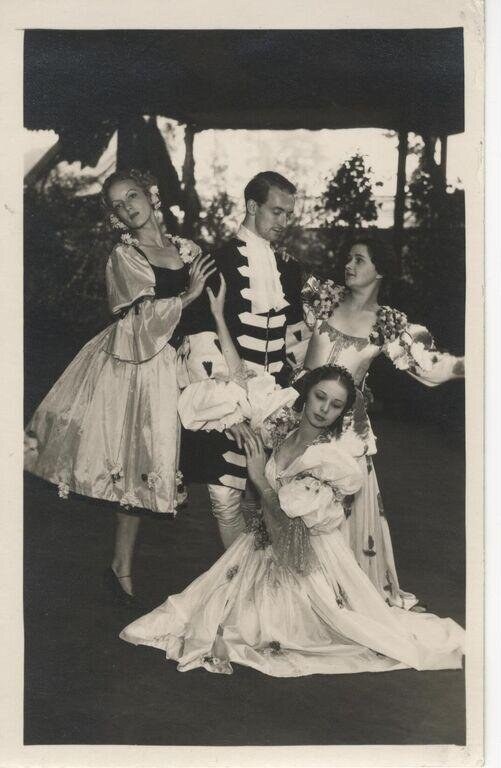
A formal theatrical tableau of five figures arranged on a porch or pavilion stage, against bright backlighting that silhouettes the architectural frame. At centre stands a man in military dress uniform with horizontal stripes across the chest and a white shirt. To his left stands a woman in a pale draped gown with puffed sleeves, her body angled away and her arm raised expressively. To his right, a woman in similar pale costume with floral garland holds a graceful pose. In the foreground, a younger figure in a white gown with elaborate train kneels or sits in profile, crowned with flowers. All figures wear period costume consistent with late 19th-century theatrical dress. The composition is tightly framed, with strong contrasts between the bright background and the darkened figures, creating the effect of a moment frozen mid-performance under stage lights.
The dancing
The five bodies are arranged in a classical theatrical composition rather than an active dance formation. The central male figure stands upright and frontal, anchoring the group. The women around him adopt varied poses—one with arm extended overhead in an attitude of emotional expression, another in a demure contrapposto, the kneeling figure with head inclined. The grouping suggests narrative interaction rather than coordinated movement; the poses are held, pictorial, and designed for visual effect from the audience vantage point rather than for the mechanics of ballroom or social dancing.
The dance depicted
This is not a depiction of social or competitive ballroom dance, but rather a theatrical scene—most likely from a romantic ballet or opera of the 1930s. The title 'The Flower Princess' and the costuming suggest either a narrative ballet (possibly in the Romantic tradition) or a theatrical dance scene within a musical or operatic production. The grouping, poses, and especially the elaborate floral garlands and period military dress point to a staged narrative moment rather than a defined dance technique. Without inscriptions or context identifying the specific production, the precise choreographic tradition cannot be determined from the image alone.
How it was made
This is a black-and-white photographic print, likely a theatrical publicity or production photograph taken during or in documentation of a live performance. The photographer is credited as J. W. Debenham. The high contrast and careful framing—with the pavilion structure creating a natural frame-within-frame—suggest professional theatrical photography, designed for promotion or archival recording. The silhouetting technique and backlighting are deliberate compositional choices that emphasise the stage lighting design and create dramatic separation of the figures from the background.
About this work
This is a photographic record of a 1935 theatrical production featuring a formal ensemble scene with costumed figures in period dress. The image documents a moment of staged dance or mime within what is likely a ballet, opera, or theatrical musical production, capturing the visual composition and costume design of the scene rather than the technical execution of a specific dance form. The work belongs in a gallery of dance in art as evidence of early 20th-century theatrical dance aesthetics, stagecraft, and the use of the photograph as a tool for documenting and promoting theatrical performance.
How to look at it
Notice the carefully balanced composition: the central male figure as anchor, the surrounding figures arranged in a pyramidal or symmetrical grouping typical of formal theatrical photography. The backlighting and silhouetting draw attention to silhouettes and outline rather than facial expression or footwork—a deliberate choice that emphasises the overall visual tableau. The moment captured is not one of dynamic movement but of posed narrative interaction, the 'photograph-able' moment of a theatrical scene designed to communicate story and spectacle.
The artist
J. W. Debenham was a theatrical photographer active in the 1930s, documenting stage productions through professional studio and on-stage photography. Debenham's work represents the established practice of theatrical photography as both documentation and promotional tool during the period when dance was becoming a more widely photographed and reviewed art form.
The period
In 1935, theatrical dance in Britain and beyond was dominated by Russian Imperial Ballet tradition and the Romantic ballet revival. The photograph reflects the conventions of formal theatrical photography and the visual aesthetics of 1930s stage design—elaborate costuming, symbolic properties (floral garlands), and carefully composed ensemble groupings. Photography was becoming the primary means by which theatrical dance reached audiences beyond the theatre, making theatrical photographs important documents of choreographic and design practice.
Where it lives
This photograph is held in the V&A (Victoria and Albert Museum) collections, a major repository of British theatrical and design history. The work is catalogued as a theatrical photograph, a category of object used for production documentation and publicity during the era of live theatrical performance.
Dance in this work
Questions about this work
Is this a photograph of an actual ballet performance?
Yes, this is a photograph taken during or documenting a theatrical production in 1935. However, it is composed as a theatrical publicity or archival photograph, with posed figures and professional lighting, rather than a candid capture of movement. It records a narrative scene rather than a specific moment of dance technique.
What ballet or theatrical production is this from?
The catalogue record identifies the scene as 'The Flower Princess' but does not specify the full title or context of the production. Without additional documentation, it is not possible to identify the complete work from the photograph alone.
What style of dance is being performed?
The image does not show active choreography or specific dance technique, but rather a posed theatrical tableau. Based on the costume, narrative context, and period, this is most likely a scene from a romantic ballet or theatrical dance production, but the specific technique cannot be determined from the photograph.
More dance artwork





