49 works in this view — arrow keys or swipe to move between them.
Dance in Art
Theatre costume
Wilhelm
- Collection:
- Theatre costume
- Source:
- Victoria and Albert Museum
- Rights:
- Rights vary by item — check the source record before reusing this image. Source record ↗
- Recorded as:
- V&A — check rights per item
This costume is a rare surviving example of a complete theatrical ensemble from the 1912 era, providing concrete evidence of how early 20th-century performers who danced on stage were dressed, how costume was constructed to enable and enhance movement, and what visual values shaped theatrical dance dress before the modernist reforms of later decades. For dancers and historians, it demonstrates the material reality of theatrical costume—the weight, volume, and construction of garments worn during performance.
What you are looking at
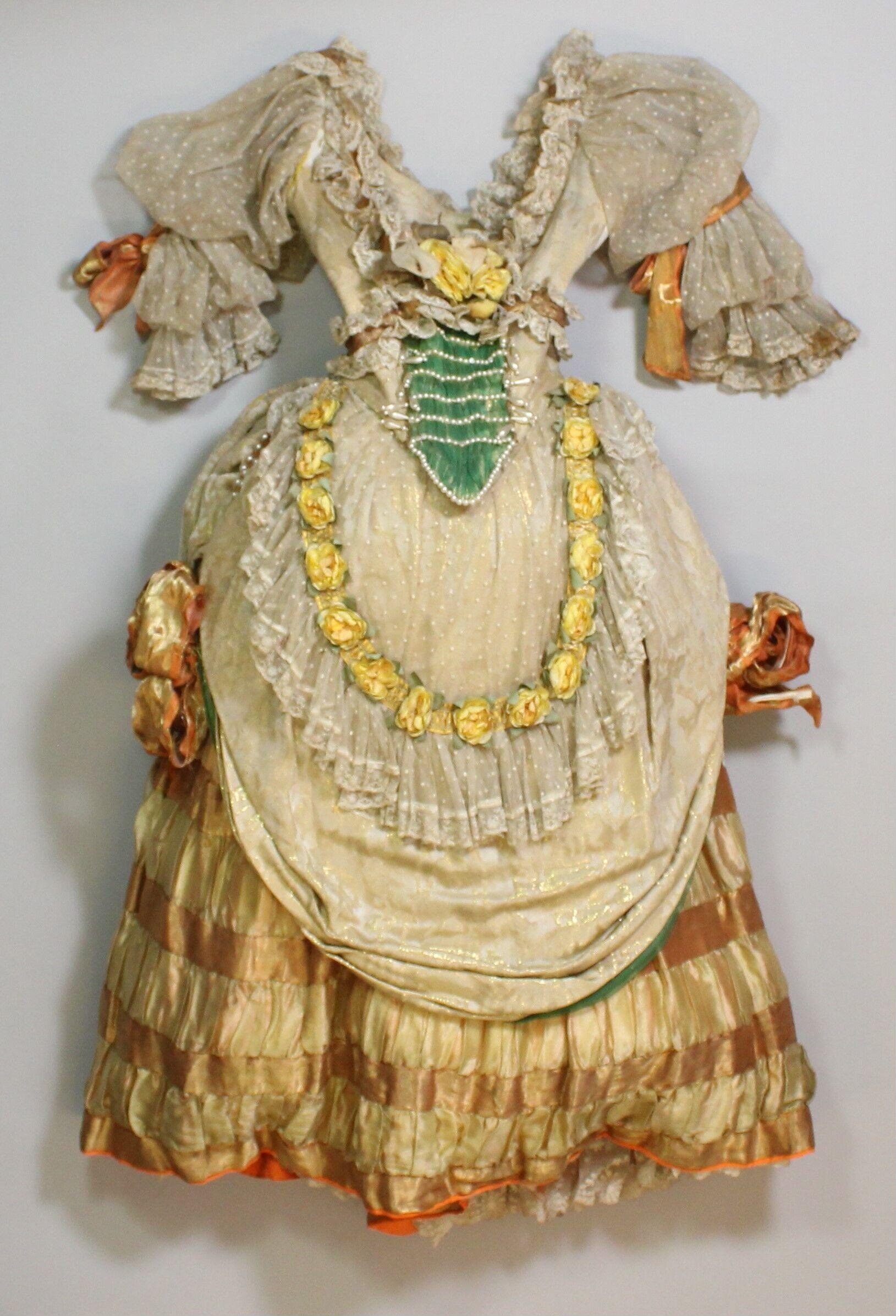
A theatrical costume displayed as a dress form against a plain background. The ensemble consists of a cream-coloured muslin or cotton ground dress with a deep green silk stomacher or plastron at the centre front, decorated with white pearl beading in a scalloped pattern. A deep yellow silk sash or garland drapes diagonally across the bodice and skirt, studded with gold sequins or metallic ornaments at regular intervals. The sleeves are dramatically oversized, puffed and gathered, constructed from fine cream muslin with lace edging and ribbon bows in burnt orange or rust tones at the shoulders and cuffs. The skirt falls in multiple horizontal tiers of cream, gold, and rust-coloured silk and cotton, creating a volume and silhouette typical of early 20th-century stage costume. Ruffled lace trim edges multiple layers throughout. The dress appears to be a period theatre piece, possibly for a fairy-tale, comic opera, or musical theatre role, designed to move and create visual drama through the accumulated weight and texture of multiple layers.
The dancing
No live figure is present—this is a costume displayed on a dress form or mannequin. The garment is arranged to show full silhouette and construction detail: the arms are extended outward to display the oversized sleeves, and the tiered skirt is positioned to fall naturally and reveal the layered construction. The costume emphasizes breadth at the shoulders and hips, with cinching at the waist, which would frame the body of a performer in profile or three-quarter view during stage movement.
The dance depicted
This is almost certainly a theatrical costume rather than a dance-specific one, though it is constructed for movement and dramatic effect in a theatrical context. The construction—particularly the multi-layered skirt, the oversized sleeves, and the horizontal tiers—suggests a performer who would move across a stage, possibly with waltzing, turning, or processional movement. The style is consistent with early 20th-century comic opera, operetta, or musical theatre rather than ballet or ballroom. Without additional context (programme, playbill, or attribution to a specific production), the exact role cannot be identified, but the costume reflects a feminine, fanciful character—possibly a fairy, a country maiden, or a comic heroine—rather than a principal ballerina.
How it was made
This is a three-dimensional textile object: a complete theatrical costume consisting of multiple layers of muslin, silk, cotton, lace, and ribbon, hand-sewn and finished with decorative elements including sequins, beads, and silk ribbon bows. The dress form display method preserves the full spatial structure and silhouette. The construction technique—layering, gathering, and the use of contrasting materials—was essential to early 20th-century stage costume, where garments needed to project visually to the back of a theatre auditorium and withstand repeated performance and movement.
About this work
A complete theatrical costume dating to 1912, attributed to the designer or maker Wilhelm. The costume is a three-dimensional example of early Edwardian theatrical dress: a cream muslin ground dress with a green silk stomacher, cream lace sleeves with orange-rust ribbon accents, and a dramatically tiered skirt in graduating tones of cream, gold, and rust. The construction emphasizes theatrical visibility and movement—the oversized sleeves, layered skirt, and decorative beading and sequins all respond to the needs of stage performance rather than ballroom or concert dance. The costume reflects the aesthetic of comic opera, operetta, or musical theatre of the 1910s, a period when theatrical dance and entertainment were integrated with dramatic narrative and visual spectacle. It belongs in a gallery of dance in art as evidence of how performers were dressed to dance on the theatrical stage of the early 20th century.
How to look at it
Attend to the construction logic: notice how the oversized sleeves are gathered at the shoulders but fall freely, allowing arm and shoulder movement; observe how the tiered skirt is designed to catch light differently at each level as the performer moves and turns. The green stomacher and yellow sequin garland establish the axis of the body and draw the viewer's eye to the torso and its movement. The colour coordination—creams, golds, rusts, and greens—was chosen to read as a unified character from a distance, despite the complexity of the construction. The lace cuffs and ribbon bows signal femininity and youth, typical of theatrical coding in this period.
The artist
The costume is attributed to Wilhelm, a theatrical costume designer or dressmaker active in the early 20th century. The name alone appears in the record; without additional sources, the full identity, workshop location, and extent of Wilhelm's practice cannot be established. The quality of the construction and the use of expensive materials (silk, lace, metallic trim) suggest a costume house serving professional theatrical productions rather than amateur or amateur theatrical societies.
The period
In 1912, theatrical costume in Western Europe and North America was at a transition point. The ornate, heavily decorated aesthetic of Victorian and Edwardian stage dress—with its emphasis on silk, lace, and handwork—remained dominant, especially in operetta and comic opera. However, the avant-garde theatrical movements of the 1910s (notably the Ballets Russes, founded 1909) were beginning to challenge conventional costume design with flatter silhouettes, bolder colours, and simplified construction. This costume belongs firmly to the pre-modernist theatrical tradition: it prioritizes visual richness, feminine volume, and decorative ornament. Dancer performers of the period, particularly in musical theatre and operetta, wore costumes of this type, which facilitated waltzing, turning, and processional movement while projecting a clearly coded character or role to the audience.
Where it lives
The costume is held in a theatre costume collection (designated 'Theatre costume' in the holding record and catalogued with source 'va', likely the Victoria and Albert Museum). It is a complete three-dimensional artefact rather than a design drawing or pattern, and it has survived intact with all components and decorations.
Dance in this work
Questions about this work
Could this costume have been worn for dancing?
Yes, certainly. The construction—the freedom of the sleeves, the volume and tier of the skirt, the way the weight is distributed—is designed for a performer who moves across a stage, including waltzing, turning, and processional movement. This is theatrical costume for a performer in a narrative or comic opera role, not concert dance like ballet, but still requiring freedom of movement.
What do the green and yellow decorative elements mean?
The bright green stomacher and yellow sequin garland served both aesthetic and practical functions: they created a strong visual silhouette visible from the back of a theatre, they established the centre axis of the body for the audience's eye, and they likely signalled a specific character type—a young, fanciful, or comic heroine. The specific colour coding helped the audience read the costume's meaning.
Who was Wilhelm?
The record does not provide a full name, location, or dates for Wilhelm beyond attribution to the costume. He or she was working as a theatrical costume designer or dressmaker in or before 1912, evidently at a level producing costumes for professional productions. Further identification would require additional archival sources.
Why are there so many layers and decorative elements?
In early 20th-century theatrical practice, costumes needed to project a clear character and visual impression across a large auditorium lit by gas or early electric light. Layers, ruffles, and decorative elements (beads, sequins, ribbon) caught light, created movement as the performer moved, and made the costume visually 'read' as a coherent character from the back rows. This was not excess; it was communication.
More dance artwork





