49 works in this view — arrow keys or swipe to move between them.
Dance in Art
Theatre costume
Wilhelm
- Collection:
- Theatre costume
- Source:
- Victoria and Albert Museum
- Rights:
- Rights vary by item — check the source record before reusing this image. Source record ↗
- Recorded as:
- V&A — check rights per item
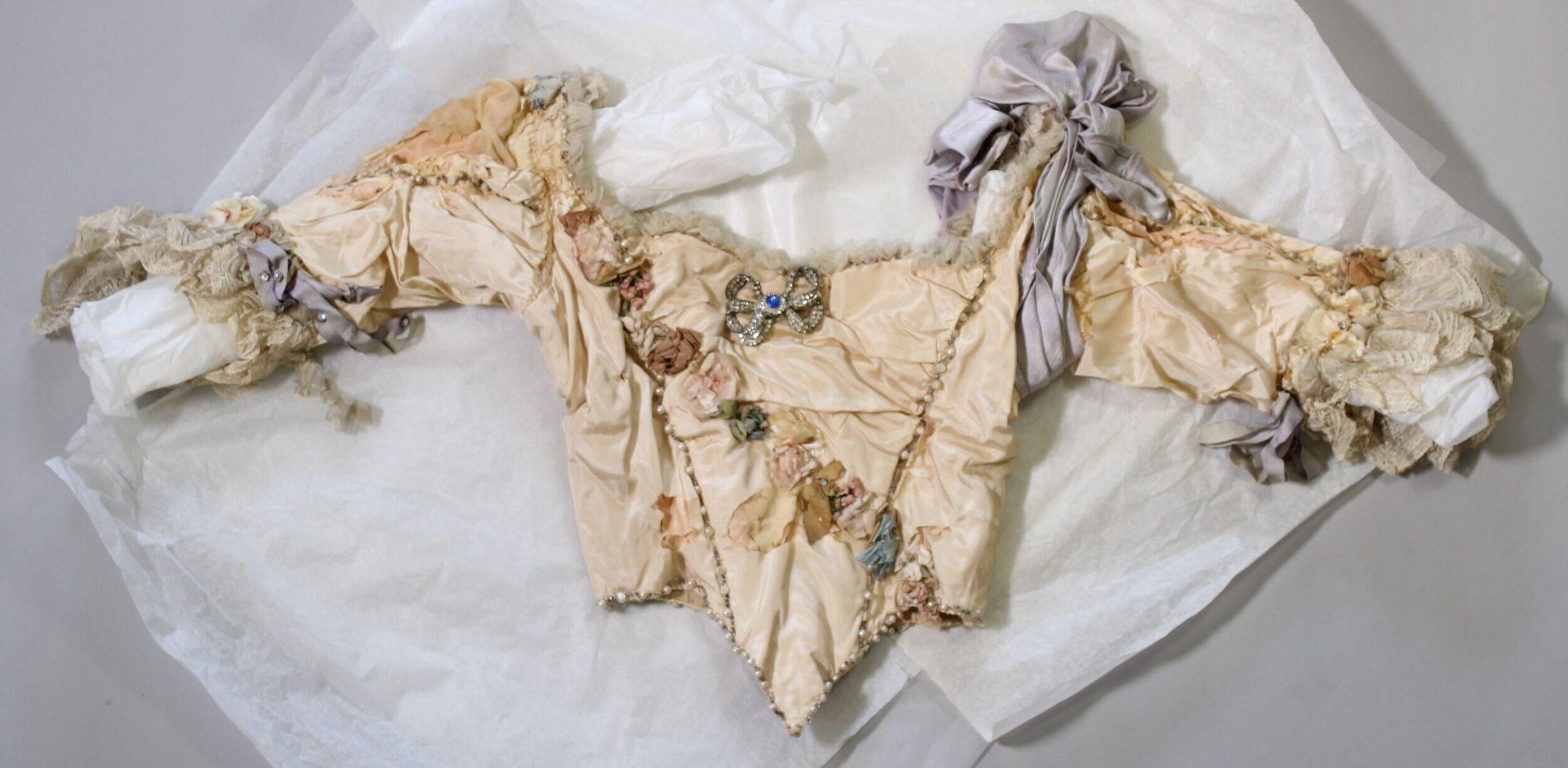
Costumes are rare survivals from pre-recorded performance, and this piece offers concrete evidence of how early 20th-century theatrical dancers were dressed, what fabrics and techniques were available, and how character and fantasy were signaled through ornament and cut. For a historian of dance or theatre, the object poses productive questions: Who wore it? In what production? What dance vocabulary did this costume enable or constrain?
What you are looking at
A fragmentary theatrical costume laid flat on white tissue paper, presented as a museum specimen. The garment is constructed from cream silk or similar lustrous fabric, heavily decorated with applied ornament: embroidered or appliquéd floral motifs in rust, green, and gold thread scattered across the bodice and skirt. The costume features an off-shoulder or short-sleeved cut typical of early 20th-century stage wear. Two purple silk ribbon bows are positioned at the shoulders, and the neckline is trimmed with what appears to be beadwork or crystal embellishment forming a geometric brooch or clasp at the center front. The skirt portion is cut with pronounced points or scallops at the hem. The entire object shows age: the silk has yellowed and become fragile, with creasing and small tears visible throughout. The way it is displayed—flattened, supported by tissue, photographed from above—emphasizes its status as a preserved artifact rather than a garment worn in performance.
The dancing
No figure is present; this is a costume object alone. The garment's structure suggests a female dancer of petite to moderate build. The abbreviated sleeve and low neckline indicate freedom of arm movement. The construction allows for torso articulation, while the pointed hem suggests a skirt designed to create visual interest during movement—whether through flutter, spiral, or the extension of leg line.
The dance depicted
The costume's style and decoration are consistent with early 20th-century European theatrical dance, particularly the lighter pantomime, vaudeville, or operetta traditions that flourished in music halls and theatre productions of the 1910s. The ornamental embroidery and ribbon detail suggest a character role rather than classical ballet, yet the cut and fabric quality indicate a professional production of some standing. The purple ribbons and jeweled brooch point toward a fantastical or exotic character—possibly a fairy, nymph, or orientalist figure popular in theatrical revue. Without additional documentation, the specific dance form cannot be determined, but the garment itself speaks to a performer trained in the eclectic movement vocabularies of early theatrical dance.
How it was made
This is a textile object: a constructed silk costume with hand-sewn applied decoration. The embroidery and appliqué suggest skilled needlework, either executed in a theatrical atelier or by a professional dressmaker. The fragile condition and careful preservation suggest this piece has been in a collection for decades, treated as a cultural artifact. The photograph documents the costume flat, in conservation context, which reveals construction details—seams, closures, proportions—that would be invisible on a moving body or displayed on a dress form.
About this work
This is a fragment of theatrical performance history: a silk costume from a 1912 European stage production, preserved as a museum specimen. The garment's refined materials and skilled decoration attest to professional theatre; its style and ornament place it squarely in the ornamental, character-driven dance and pantomime traditions of the Belle Époque and early 20th century. The costume survives now as an object to be studied for what it reveals about performer, production design, and the material culture of dance before modernism fundamentally altered theatrical practice.
How to look at it
Examine the construction: the seams, the way the embroidery is applied, the choice of closure and trim. Notice the proportions—how narrow the bodice, how the sleeve is cut. These details speak to the movement the costume was engineered to support. The fragility of the silk and the brittleness of the embroidery thread tell you this is an old object; the care taken in its preservation tells you it was valued as a record of someone's labor and someone's performance.
The artist
The catalogue attributes the costume to "Wilhelm," but without additional documentation this cannot be verified as a maker's name, a costume house, or an artist's signature. It may refer to a dressmaker, a theatrical company, or a performance artist. The name is insufficient to establish a reliable biography or practice context.
The period
In 1912, European theatrical dance was in ferment. Classical ballet remained dominant in court and grand opera contexts, but music halls, cabarets, and touring revue companies created a parallel ecosystem of movement, spectacle, and design. The same year saw the Paris premiere of Nijinsky's Afternoon of a Faun and the height of Ballets Russes influence; yet the broader theatrical market was fed by comedies, pantomimes, fairy tales, and exotic fantasias that made fewer claims on the body's virtuosity and more on its capacity for transformation through costume and character. This garment belongs to that second, less-documented tradition.
Where it lives
The costume is held in a theatrical or performing arts collection (indicated by the source designation "va"). Its catalogue record offers minimal detail beyond title, artist, and date, suggesting it may have entered the collection without accompanying documentation of performance, performer, or production context.
Dance in this work
Questions about this work
Who was Wilhelm?
The available record does not identify Wilhelm beyond the name. It may be a dressmaker, a theatrical costume house, a performer, or a company name. Further research in theatre archives, production records, or dressmaking guilds of the period might clarify the attribution, but it cannot be established from the object alone.
What kind of dance was performed in this costume?
The style and materials suggest a character role in theatrical pantomime, operetta, or music-hall revue rather than classical ballet. The embroidery and ornament point toward a fantastical figure. Without a production title or performance program, the specific dance form or vocabulary cannot be determined.
Why is the costume displayed flat?
Textile conservation practice often calls for flat storage and display to minimize stress on fragile fabrics. Displaying the costume on a dress form or hanging it would place weight on the silk and risk further deterioration. The flat photograph also allows viewers to study the construction and decoration in detail.
How do we know it's from 1912?
The catalogue record assigns the date 1912, but the source and basis for this dating are not provided in the available documentation. The style of the silk, the embroidery technique, the cut, and the aesthetic of the ornament are all consistent with the 1910s, but this cannot be confirmed without additional research.
More dance artwork





