49 works in this view — arrow keys or swipe to move between them.
Dance in Art
Theatre costume
Wilhelm
- Collection:
- Theatre costume
- Source:
- Victoria and Albert Museum
- Rights:
- Rights vary by item — check the source record before reusing this image. Source record ↗
- Recorded as:
- V&A — check rights per item
Theatre costumes are rarely preserved intact, making this an exceptionally valuable document of how a performer's body was shaped and adorned for stage movement in the 1910s. The costume reveals the aesthetic priorities of early 20th-century European theatre—the balance between visual richness and functional movement, and the gendered expectations embedded in how female dancers and performers were dressed. For historians of theatre and dance, surviving costumes provide evidence that cannot be reconstructed from programmes, photographs, or written description alone.
What you are looking at
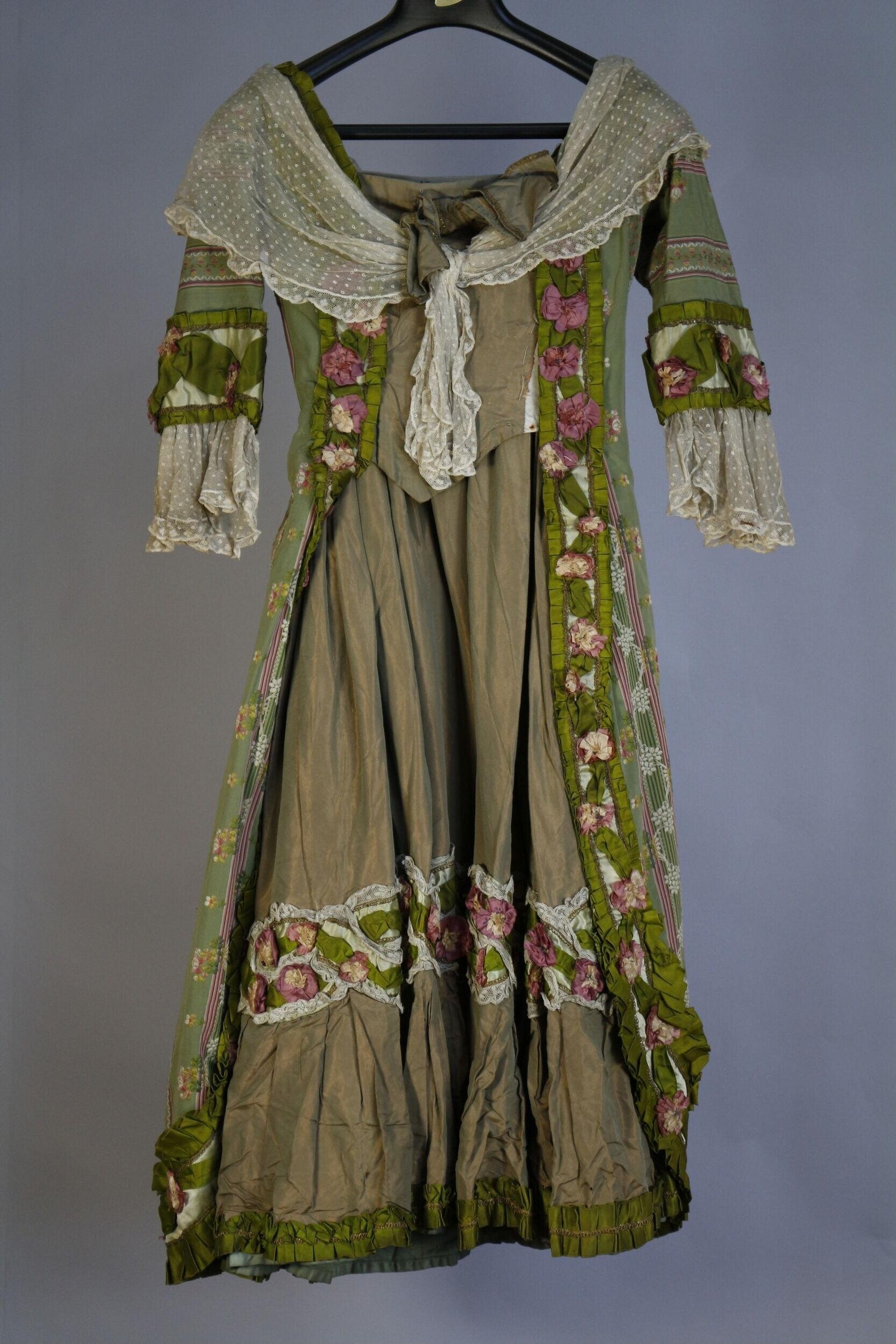
A theatre costume displayed on a hanger against a neutral background, shown flat to present its full construction. The dress is an elaborate two-piece ensemble in soft sage green and cream linen or linen-blend fabrics, dating to the early 20th century. The main body is a long, flowing gown in neutral cream or pale tan, with the skirt constructed in multiple gathered tiers that create volume and movement. Flanking the skirt on both sides are wide decorative panels in sage green, embroidered or appliquéd with pink and rose floral motifs arranged in vertical columns. These panels extend from waist to hem and are trimmed with ruffled edges in matching green. The bodice is similarly constructed with green fabric panels featuring the same floral embroidery, while the upper chest and sleeves are cream. The dress features a dramatic collar element—a large, gathered cape or fichu in cream cotton with tiny white dots, tied at the neck with cream ribbon. The three-quarter-length sleeves are constructed from layered cream fabric with lace trim at the cuffs, creating a period-appropriate silhouette. The overall effect is one of Edwardian or early 1910s opulence, with emphasis on the interplay between plain and ornamental fabrics.
The dancing
No figures are present; the costume is displayed on a dress form or hanger to show its construction. The garment's cut and proportions suggest it was designed for a female dancer or performer. The gathered, tiered skirt construction and the width of the decorative side panels would allow considerable freedom of movement in the lower body, while the fitted bodice and structured upper portions would support an upright, formal posture. The cape collar element suggests the costume was designed for a character who needed visual impact and elegance from a distance—typical of theatrical presentation of the period.
The dance depicted
This is a theatre costume rather than a dance document, but its construction and style indicate it was worn in European musical theatre or ballet of the early 1910s, most likely in a comedic operetta, pantomime, or light theatrical work. The elaborate floral embroidery and the two-tone colour scheme suggest a pastoral or rustic character—possibly a village maiden or a character from a fairy tale or romantic comedy. The costume's generosity of fabric in the skirt and the prominence of the decorative side panels would have allowed for controlled, graceful movement typical of theatrical dance of this period, including waltzes and figure dances common in operetta. The garment does not appear designed for the extreme athleticism of classical ballet, but rather for a performer who needed to move expressively while maintaining visual grandeur.
How it was made
This is a surviving three-dimensional textile object—a complete theatre costume garment rather than a representation of one. It is constructed from hand-sewn pieces of linen or linen blend, with applied embroidery or appliqué work in silk or wool on the sage green panels. The construction technique—gathered tiers, hand-stitched seams, and individually attached lace trims—is consistent with high-quality theatre costumery of the Edwardian era, made for a production with adequate budget and resources. The costume survives as a museum object, which suggests it was retained after the production either because it was significant or because the theatre or performer's collection was preserved. Such costumes are rare survivors and provide direct evidence of how performers' bodies were dressed and how movement was enabled or constrained by the garment.
About this work
This is a complete female theatre costume from approximately 1912, likely made for a European opera house or light theatre production. The dress combines practical construction with striking visual effect: the sage green floral panels frame a neutral skirt that would move fluidly on stage, while the gathered cape collar and ornamental embroidery announce the wearer's status and character to the audience. It belongs in a gallery of dance in art because costumes are the physical evidence of how dance was performed—they reveal the aesthetics of movement, the constraints and possibilities dancers faced, and the visual language of theatrical spectacle in the early 20th century. This particular object shows us a moment when European theatre was richly decorative, when female performers were expected to be both elegant and capable of expressive movement, and when a single costume might serve both comedic and romantic scenes.
How to look at it
Look first at the side panels: they are the dominant visual element and would have framed the performer's body on stage, catching light and creating an impression of richness and movement even during stillness. The tiered skirt beneath is economical in a different way—multiple layers in a neutral tone would create visual texture and allow the skirt to move in a controlled, elegant flow when the performer walked or danced. The cape collar is the third element to study: large and gathered, it would move around the shoulders and create an impression of amplitude and importance at the moment of entrance or in moments of strong emotion. The costume was designed to telegraph character and status before the performer spoke or moved—a common convention of early 20th-century theatre in which visual reading of the stage picture was as important as the action.
The artist
The costume is attributed to 'Wilhelm,' likely a theatrical costumier or atelier active in the early 1910s. The name appears to be a shop name or maker's mark rather than a personal surname. Wilhelm may have been the head of a costume workshop serving an opera house or theatre company, a common arrangement in European cities at the time. Without further documentation, the individual or workshop identity cannot be confirmed, but the quality and sophistication of the garment suggest training in haute couture techniques adapted to theatre production.
The period
In the 1910s, European theatre—particularly opera, operetta, and ballet—was at a high point of lavish spectacle. This was the era of the Ballets Russes, founded in 1909, which revolutionised stage design, but it was also a moment of continued investment in ornate, richly decorated theatre at more conservative opera houses. Women's fashion of the period favoured high waistlines, gathered skirts, and decorative embroidery, all of which appear in this costume. The early 1910s saw the persistence of Belle Époque aesthetics even as modernist movements were beginning to challenge them. Theatre costumes of this era typically emphasised the performer's silhouette while allowing controlled movement; this dress exemplifies that balance. The care taken with materials and embroidery suggests this was a costume for a substantial role in a well-funded production, not a background character.
Where it lives
The costume is held as a theatre costume in a collection (specific institution not recorded in available metadata, listed only as source 'va'). The attribution to 'Wilhelm' appears on the object itself, suggesting it was a maker's mark sewn into or attached to the garment. Theatre costumes from this period are held in many museum collections, but individual provenance—when and how the costume entered the collection, from which theatre or performer—is often incomplete or lost.
Dance in this work
Questions about this work
What does this costume tell us about early 1910s theatre?
It shows us that high-quality theatre costumes combined fashion sophistication with practical construction for movement. The elaborate embroidery and two-tone design indicate a production with significant resources. The fit and proportions suggest the performer needed to move expressively, probably in a comic or romantic role requiring controlled grace rather than athletic display.
What kind of role would have worn this costume?
The pastoral florals and decorative style suggest a village maiden, a comic peasant character, or possibly a character from a fairy tale or romantic comedy. The quality and care suggest it was not a background role. The lack of extreme ornamentation implies a character who needed to appear approachable and human, not supernatural or allegorical.
How do we know it's from 1912?
The attribution is based on the catalogue record only; the image itself does not show a date. The style is consistent with 1910s women's fashion and theatre costume construction—the high waistline, gathered skirt, and colour palette are typical of the period. Dendrochronology or fibre analysis might refine the date, but without further examination of the object, the date remains an attribution in the catalogue.
Could this costume still be worn?
Yes, structurally. It is intact and the seams appear sound. However, as a historical artefact, museum practice would restrict wearing it to conservation-controlled exhibition or research purposes. The linen and silk have aged and would be vulnerable to stress. A performance costume from this era would need significant reinforcement to be danced in today.
More dance artwork





