49 works in this view — arrow keys or swipe to move between them.
Dance in Art
Theatre costume
Wilhelm
- Collection:
- Theatre costume
- Source:
- Victoria and Albert Museum
- Rights:
- Rights vary by item — check the source record before reusing this image. Source record ↗
- Recorded as:
- V&A — check rights per item
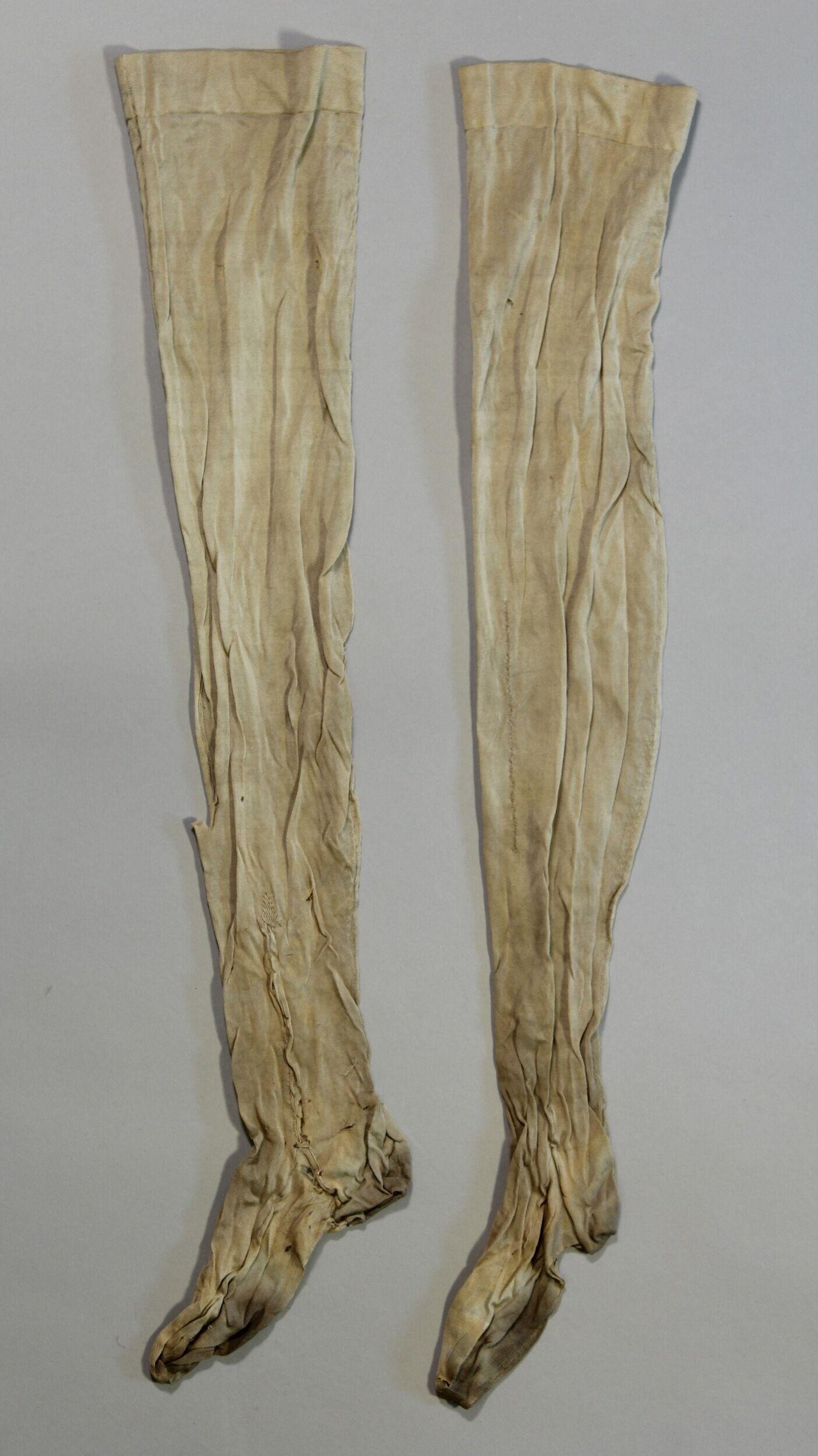
These stockings are evidence of the material reality of early 20th-century stage dance — how bodies were dressed, supported, and shaped beneath the visible costume. For dancers and costume historians, they reveal actual garment construction, fiber content, and wear patterns that no written record captures, and they document the care taken to create a complete theatrical leg even in parts of the costume the audience could not see.
What you are looking at
Two leg warmers or stockings are displayed flat against a neutral background, photographed in bright raking light that casts shadows and reveals the textile's creasing and structure. Each piece is tubular and extends from hip to ankle, made of a pale linen or linen-blend fabric with visible weave texture. The fabric shows significant wear and age — deep creases, discoloration, staining at the foot end, and fragile-looking material suggest these are genuine historical garments. They are laid out as if on display in a museum or archive, arranged as a pair with slight asymmetry to show their three-dimensional form.
The dancing
These are not costumes for a specific dance but rather foundational legwear. Their tubular construction suggests they were meant to be pulled on and fitted snugly to the lower leg and foot, providing warmth and line to the dancer's leg. The seaming visible down the center of each piece indicates tailoring to fit the calf and ankle. There is no evidence of decoration, and the plain construction speaks to utility rather than display.
The dance depicted
These leg coverings are most likely part of early 20th-century theatrical costume, consistent with ballet or other stage dance of 1912. Such stockings or leg warmers were essential to theatrical dress of the period, worn under skirts or as part of the complete costume. The pale color and plain construction suggest they may have been worn under a classical ballet costume, where they would be invisible beneath the tutu or skirt but essential to complete the line of the leg and provide comfort and warmth during performance and rehearsal.
How it was made
These are textile artifacts — historical garments rather than artworks in the traditional sense. They appear to be hand-sewn or machine-sewn linen or linen-cotton blend, made by the tailoring and construction methods standard to theatrical costume production of the early 20th century. Their survival and preservation suggests they have been held in a museum or costume collection, where they have been flattened and stored to prevent further deterioration. The photograph documents them in their current state of preservation.
About this work
This pair of leg coverings represents the working costume of early 20th-century theatrical dance, specifically from 1912. They are not the spectacular element of a performer's dress — the tutu, the jeweled bodice, the headdress — but rather the foundational garment that allowed the dancer's leg to be shaped, warmed, and presented correctly to an audience. Such objects survive rarely because they were worn out through repeated use and were easily discarded. Their inclusion in a dance archive acknowledges that the history of dance is not only about what audiences saw on stage, but about the materials, engineering, and labor that made performance possible.
How to look at it
Examine the seaming and construction: the center seam running the length of each leg reveals how the tailor shaped the fabric to fit the curve of the calf and ankle. Look at the discoloration and wear, especially around the foot — this shows where the dancer's foot moved and perspired during performance and rehearsal. The fragility of the fabric and the depth of the creases suggest how many times these were worn, washed, and dried. These details tell the physical story of dance practice that photographs and reviews cannot capture.
The artist
The catalogue credits these to "Wilhelm," likely a costume maker or theatrical tailor rather than a designer in the modern sense. Early 20th-century theatrical costume was often produced by specialist tailors and costume shops rather than by individual artists, and attribution frequently went to the shop or the head tailor. Without further documentation, the individual credited as Wilhelm cannot be placed with confidence.
The period
In 1912, theatrical ballet and classical dance were experiencing a period of intense innovation in costume design, notably through the avant-garde work of the Ballets Russes (founded 1909) and more established houses across Europe. Yet beneath the spectacular reforms in silhouette and decoration, the fundamentals of costume construction remained rooted in 19th-century practice. Leg coverings like these were standard issue for any theatrical dancer, worn in classical ballet, music hall, pantomime, and other stage performance. The materials, construction, and plainness of these pieces suggest they were made for professional use rather than as special pieces for a celebrated dancer or premiere.
Where it lives
These pieces are held in a theatrical costume collection, catalogued as part of a museum or archive's material record of stage performance. The source attribution "va" may indicate a specific collection or institutional holding. They were likely acquired as a working pair from a theatrical wardrobe, possibly from a single production or a performer's personal stock.
Dance in this work
Questions about this work
What would a dancer wear these under?
These stockings or leg warmers would have been worn under a classical ballet costume, typically beneath the tutu or skirt. They were invisible to the audience but essential to the dancer — they warmed the leg muscles, provided a smooth base under the outer costume, and helped create the desired line from hip to foot. Dancers might also wear them during rehearsal under practice clothes.
Why are they so wrinkled and stained?
These creases and stains are evidence of active use. Dancers would put them on and take them off repeatedly during rehearsal and performance, and they would be washed many times. The discoloration at the feet likely comes from perspiration and the friction of the dancer's foot moving inside the stocking during years of use. This wear pattern is actually valuable evidence of how the garment functioned.
Could these belong to a famous dancer?
The catalogue record provides no information about the original wearer, and the plain construction and materials suggest these were standard working stockings rather than custom-made pieces for a celebrated performer. Many such garments were made and worn; their survival is often accidental rather than the result of conscious preservation of a famous dancer's wardrobe.
More dance artwork





