49 works in this view — arrow keys or swipe to move between them.
Dance in Art
Theatre costume
Wilhelm
- Collection:
- Theatre costume
- Source:
- Victoria and Albert Museum
- Rights:
- Rights vary by item — check the source record before reusing this image. Source record ↗
- Recorded as:
- V&A — check rights per item
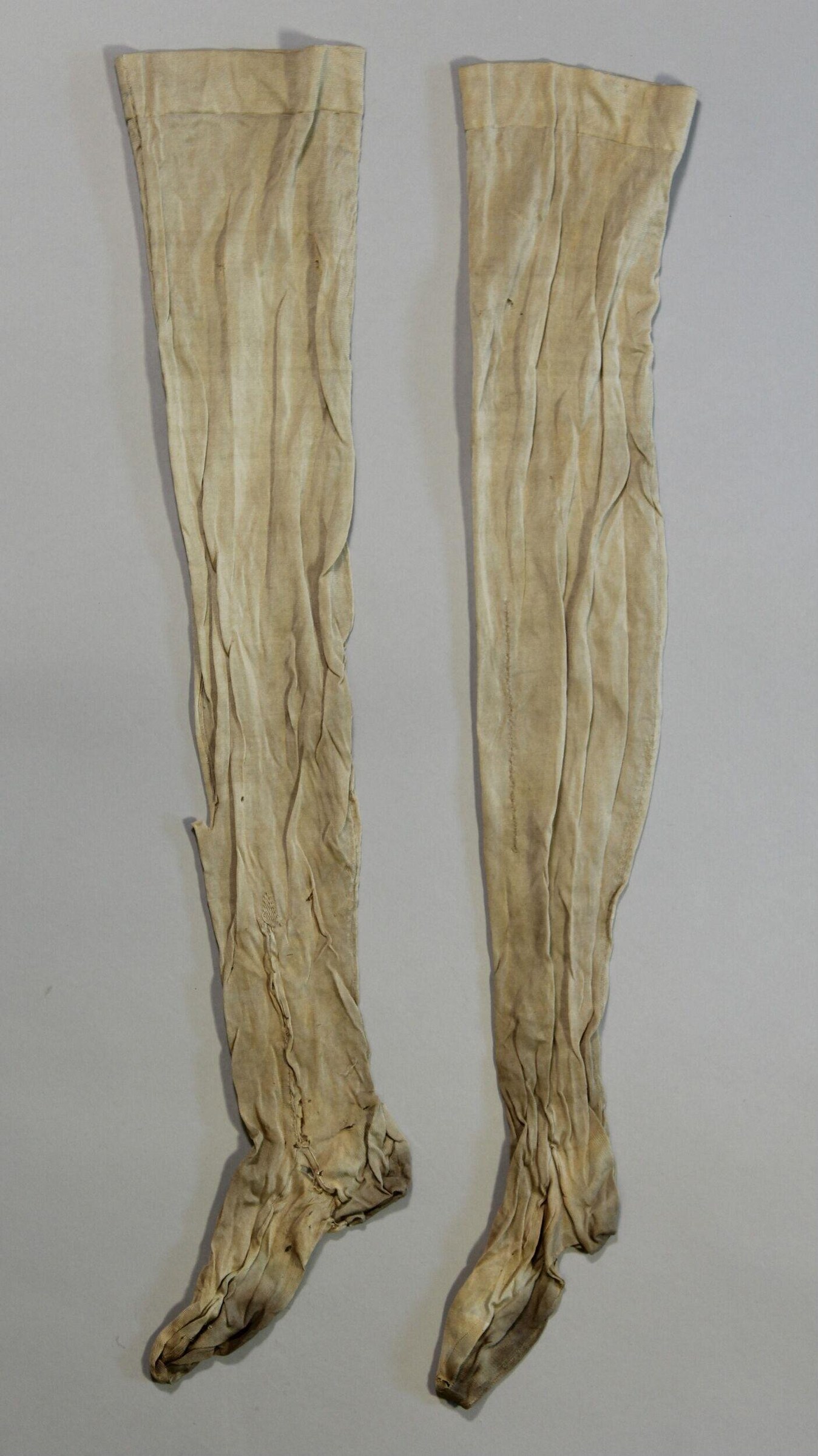
These stockings are among the few surviving material examples of early-twentieth-century ballet costume. They show how the technical requirements of performance—the need for a clean, unbroken leg line from hip to foot, the fit required under pointe shoes—shaped costume construction at the moment when ballet was consolidating its classical form. For historians of dance costume and for dancers understanding their own tradition, these garments are primary evidence.
What you are looking at
Two long, narrow fabric tubes, constructed from cream or pale linen, are displayed vertically against a neutral background. Each tube extends approximately waist-to-ankle length and shows significant creasing and gathering of fabric. The tubes are open at the top and closed at the foot, where the fabric bunches densely. The material appears naturally aged or deliberately styled to show prominent vertical wrinkles and folds running the full length. The construction suggests these are fitted leg coverings—stockings, tights, or hose—designed to cling closely to the leg rather than hang loosely. The heavy creasing at the lower leg and foot, particularly visible where the fabric gathers and compresses at the ankle, indicates compression or elastic binding at the bottom. The left tube shows slightly more pronounced creasing overall than the right.
The dancing
These are not depictions of human figures but rather costume pieces themselves—legwear designed to be worn on the body. The fabric demonstrates how such garments would sit and drape on the leg, with the pronounced gathering at the foot suggesting the piece was either photographed while compressed or styled to show its intended worn appearance. The vertical alignment of wrinkles follows the body's natural lines when standing, indicating the garment was constructed to fit close to the leg in an extended vertical position.
The dance depicted
If these are theatrical costume pieces from 1912, they were most likely worn in formal ballet or pantomime productions of that era. Ballet dancers of the period wore flesh-coloured silk hose as standard costume elements—essential to the clean line of the leg. The tight gathering at the foot is consistent with ballet tights of the early twentieth century, which often bunched at the ankle under pointe shoes. The pale cream colour matches historical ballet practice. However, the image alone does not confirm their specific use in performance, and the maker Wilhelm may have produced them for use in other theatrical forms—legitimate theatre drama, revue, or dance-theatre hybrids popular in Germany at that period.
How it was made
The object is a pair of textile garments—stockings or tights—constructed from linen or linen-cotton blend. The documentation is photographic: a straightforward product photograph showing two pieces laid out flat and pinned or suspended vertically against a wall, likely taken for archival or collection purposes. The photograph captures the garment's structure, fabric weight, and characteristic bunching without dressing a model, a practical approach for archive records. The monochrome or sepia tonality and modest lighting are consistent with early-twentieth-century documentation photography rather than artistic portraiture. This is a record image of a functional costume component, not a performance photograph.
About this work
These are theatre costume stockings or tights, documented photographically as a pair. Dating to 1912, they represent the standard legwear of formal ballet and theatrical performance in the Edwardian era. The garments are historically significant as examples of the precise construction and material choices that shaped the visual line of the dancer's body on stage. The maker Wilhelm, likely a German-speaking costumier, produced these for professional theatrical use. The photograph preserves evidence of how such essential costume components were made and understood in early modern dance and theatre—objects rarely survived or documented, but vital to the historical appearance of performance.
How to look at it
Observe the vertical distribution of wrinkles: they follow the line of the standing leg, indicating the piece was worn stretched vertically. Focus on the foot end, where the fabric density increases dramatically—this bunching shows where the stocking would have been compressed or bound, either by the foot itself or by the pointe shoe's vamp. The consistency of the creasing across both pieces suggests they were a matched pair and were stored or displayed in similar conditions. The pallor of the linen or cotton indicates the colour choice was deliberate: pale legwear was essential to the visual vocabulary of classical ballet, where the extended leg line was paramount.
The artist
Wilhelm is credited as maker, likely a professional costumier or costume house operating in the German-speaking theatre world circa 1912. No further information is available in the catalogue record. Theatre costume makers of this period were skilled artisans—rarely celebrated as artists, their names often lost—but essential to the visual form of performance. The attribution to Wilhelm (a single name, possibly a surname, possibly a shop name) suggests either a celebrated local maker or an archive practice of crediting the costumier rather than the institution.
The period
In 1912, ballet was in transition. The Ballets Russes had premiered in Paris in 1909, destabilizing classical conventions; yet institutional ballet in Central Europe continued training dancers in the strict technique of the Russian Imperial schools. Legwear was undergoing material innovation—the introduction of cheaper synthetic fibres was beginning, but quality theatrical stockings were still silk or natural fibres, hand-finished. German theatre was also exploring Ausdruckstanz (expressive dance) and modern movement forms, so Wilhelm's stockings may have served both classical ballet and experimental theatrical dance. The gathering technique visible here—compression and bunching at the foot—was the standard solution to keep stockings in place under pointe shoes before modern elasticated construction became standard.
Where it lives
These stockings are held as part of a theatre costume collection with German provenance. They entered the archive as documented costume components, likely separated from the full costume to which they belonged. The source is recorded as 'va', suggesting a Vienna archive or a Viennese institutional collection.
Dance in this work
Questions about this work
Are these ballet pointe shoes or stockings?
These are stockings or tights, not shoes. The bunching at the foot would have occurred where the stocking fitted under a pointe shoe, but the garment itself is legwear. In early twentieth-century ballet, such stockings were worn as a standard component of the costume, essential to create an unbroken line from hip to foot.
Why is the fabric so wrinkled?
The wrinkles follow the leg's natural vertical lines and show how the garment clung to the body when worn. The heavy bunching at the ankle is particularly significant: it indicates the stocking either compressed under the foot or was deliberately bunched for storage and archival preservation. This creasing pattern is typical of early stockings that lacked modern elastic construction.
Could these have been used in modern dance rather than ballet?
Possibly. In 1912, the boundaries between theatrical dance forms were still fluid, particularly in German-speaking Europe. However, the colour, length, and construction are consistent with classical ballet costume. Without additional documentation, the specific choreographic context cannot be established.
What is Wilhelm?
Wilhelm is credited as the maker—a costumier or costume workshop operating in the German theatre world. The name alone does not establish whether this was an individual artisan, a workshop, or a family business. Theatre costume makers of this era rarely received documented biographical records.
More dance artwork





