49 works in this view — arrow keys or swipe to move between them.
Dance in Art
Theatre costume
Wilhelm
- Collection:
- Theatre costume
- Source:
- Victoria and Albert Museum
- Rights:
- Rights vary by item — check the source record before reusing this image. Source record ↗
- Recorded as:
- V&A — check rights per item
Theatre costumes are primary sources for understanding how dance and movement were performed and perceived in their own time. These shoes reveal the physical constraints and aesthetic values of early twentieth-century performance: the expectation that a woman's body should be visibly refined and delicate even in motion, the centrality of fashionable dress to theatrical credibility, and the continuity between ballroom dancing and staged representation. For historians of dance in musical theatre or social dance, the shoe tells us what footwear made possible and what it demanded of the dancer's body.
What you are looking at
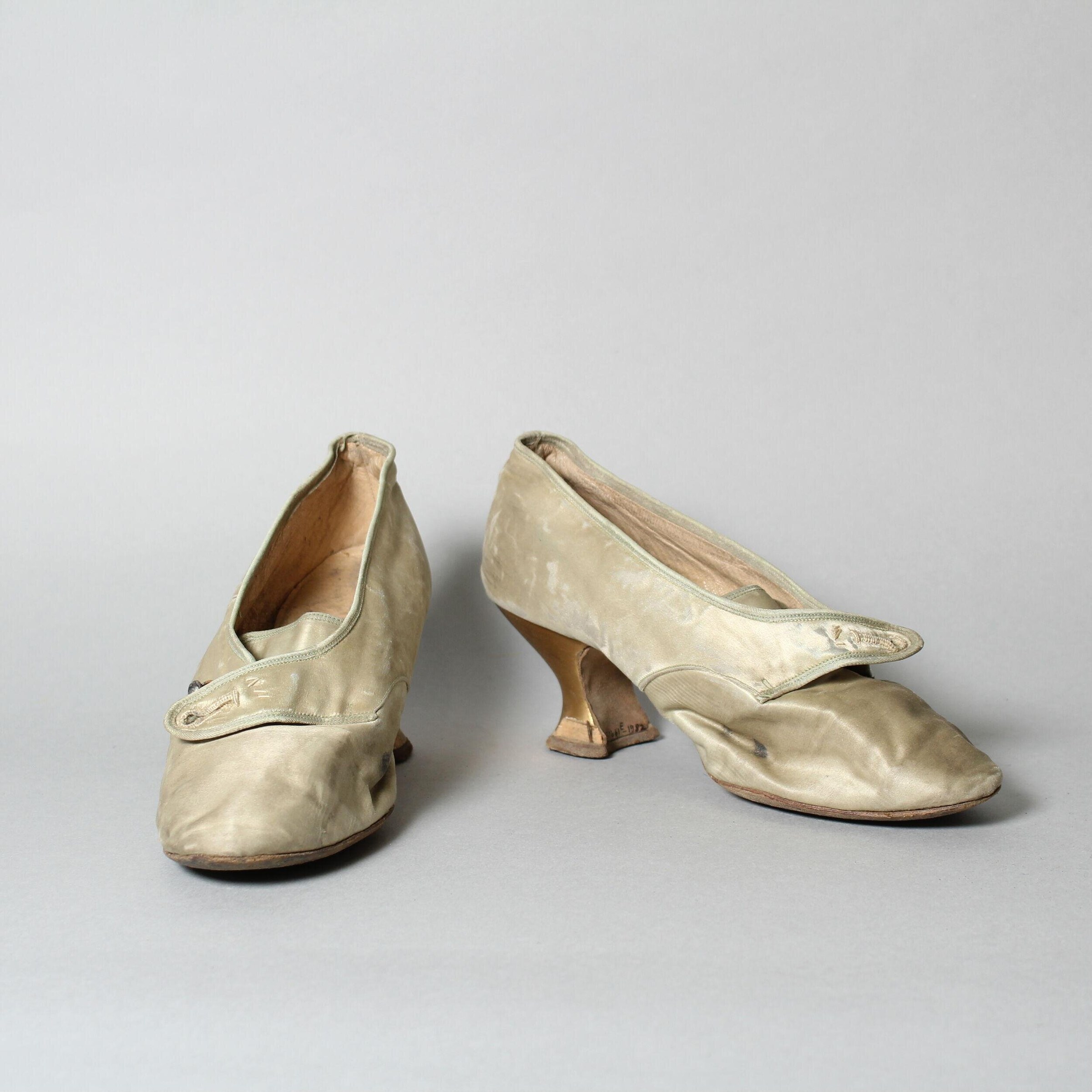
A pair of pale cream or ivory silk shoes, photographed against a neutral background with dramatic raking light that casts sharp shadows. Each shoe is a heeled court pump with a distinctly high, slender heel (approximately 2–3 inches) and a rounded toe. The uppers are cut low and wrap around the foot with a subtle curved vamp. The left shoe is shown from the rear three-quarter view, revealing the open back and the interior lining in warm tan leather; the right shoe is angled to show the heel and profile. Both shoes show signs of age: subtle creasing in the silk, gentle wear on the heel caps, and a patina consistent with early twentieth-century manufacture and use. No maker's mark or label is visible in the photograph.
The dancing
These are not dance shoes in the modern sense—there is no pointe work, no specialized sole, no reinforcement for jumping or turning. These are fashionable street or formal wear for a woman, cut and heeled in the style of the 1910s. The heel is pitched forward and relatively delicate, typical of the period. The shoes are small and narrow, suggesting they were fitted to a slender foot. They are designed for walking and standing in formal or social contexts, not for the kind of vigorous movement that characterizes theatrical dance of the era.
The dance depicted
If these shoes were worn by a dancer, it would have been in a theatrical context that privileged naturalism or contemporary social dance over technical virtuosity—drawing-room comedy, social scenes in operetta, or the fashionable ballroom dances of the 1910s such as the tango or foxtrot. The shoes themselves offer no evidence of a specific dance practice. They are consistent with the shoes a woman would have worn to *perform* a dance that mimics social dancing (as in musical theatre) or to dance in a ballroom, but not with the specialized footwear of ballet, tap, or other theatrical forms that demand structural support.
How it was made
This is a photograph, likely a professional museum or archive photograph made in the late twentieth or early twenty-first century for documentation and display. The careful staging, neutral background, controlled raking light, and sharp focus are characteristic of museum object photography. The photograph serves to preserve and present the physical artifact without alteration, allowing scholars and curators to examine construction, materials, and condition. The image is a record of a three-dimensional object in space.
About this work
This is a pair of women's heeled court shoes from approximately 1912, attributed to the maker Wilhelm. They are a theatrical costume—a prop or an actor's personal footwear used in performance. The shoes exemplify the fashionable silhouette of the early 1910s: narrow, high-heeled, and refined. They are neither specialized dance shoes nor street wear, but rather the kind of elegant footwear a performer might wear in a dramatic work depicting contemporary social life. The shoes sit at the intersection of costume history, fashion history, and theatre history, documenting both what people wore and how that appearance was staged and understood on the early twentieth-century stage.
How to look at it
Observe the fineness of the construction: the delicate heel, the minimal upper, the refined curve of the toe. Note the wear patterns and the interior lining, which show this was a real working shoe, not a museum reproduction. The cream silk would have caught light on stage, drawing attention to the foot and leg. The height and pitch of the heel would have altered the dancer's posture and gait in a specific way—shortening the stride, raising the heel, creating the silhouette of the fashionable woman of 1912. This is a shoe that shaped and displayed the body.
The artist
Wilhelm is documented only as a maker of theatrical costumes, likely working in a European theatrical center in the early twentieth century. No biographical information is available in the current record.
The period
The 1910s were a period of rapid change in women's fashion and social dancing. The corset was beginning to loosen, skirts were shortening, and new dances from Latin America and the United States—the tango, the foxtrot, the one-step—were creating a revolution in ballroom practice and in popular entertainment. Musical theatre was at a high point of popularity and sophistication, with operetta and comedy giving way to new forms. Theatre was becoming more naturalistic, which meant that costumes had to reflect contemporary fashion with accuracy and immediacy. A shoe like this one would have been essential to the visual authenticity of any scene depicting modern social life or ballroom dancing on the stage.
Where it lives
The shoe is held in a theatrical costume collection and is catalogued as a theatre costume, attributed to the maker Wilhelm. The holding institution is not named in the current record.
Dance in this work
Questions about this work
Were these shoes used for ballet or other theatrical dance forms?
No. These are fashionable women's court shoes, not specialized dance shoes. There is no pointe work, no reinforced sole, and no structural adaptation for the demands of ballet, tap, or other theatrical forms. If they were used in performance at all, it would have been in a scene depicting contemporary social life or ballroom dancing, not in a formal dance work.
What does the heel height tell us about the performer or the period?
The slender, forward-pitched heel of approximately 2–3 inches is typical of fashionable women's shoes from the 1910s. This height was considered elegant and modern, and it would have altered the wearer's posture and gait in a way that was read as refined and contemporary. On stage, the heel would have been part of the visual language of character and class.
Could a dancer actually dance in these shoes?
A trained dancer could move in them, but they are not designed for the technical demands of theatrical dance. They would work for social dancing, for a theatrical scene set in a ballroom or drawing room, or for the kind of naturalistic movement that musical theatre of the 1910s required. For sustained or vigorous dance practice, they would be limiting and potentially uncomfortable.
More dance artwork





