49 works in this view — arrow keys or swipe to move between them.
Dance in Art
Theatre costume
Wilhelm
- Collection:
- Theatre costume
- Source:
- Victoria and Albert Museum
- Rights:
- Rights vary by item — check the source record before reusing this image. Source record ↗
- Recorded as:
- V&A — check rights per item
Surviving theatre costumes are rare; this garment is a primary source for understanding how dancers' bodies were framed and decorated in early 20th-century European theatre, and how design choices—print, colour, volume, construction—shaped the visual and kinetic experience of performance. The costume reveals assumptions about femininity, movement, and spectacle in the years just before the First World War transformed European culture and before the Ballets Russes codified a new modernist aesthetic for theatrical dance.
What you are looking at
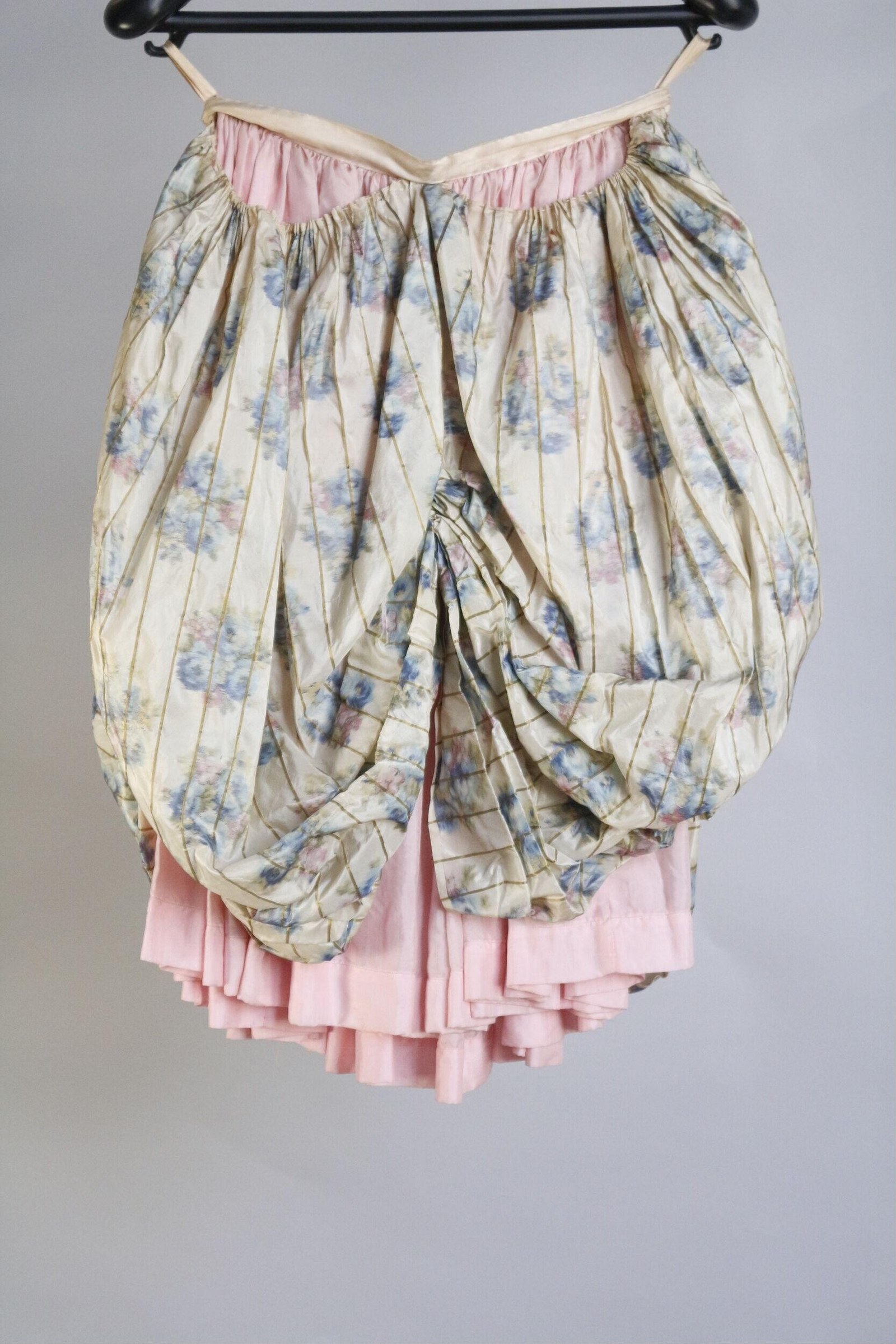
A theatre costume consisting of two layered skirts photographed on a dress form against a neutral grey background. The outer skirt is constructed from cream-coloured linen or cotton printed with a delicate pattern of blue flowers and pale green foliage arranged in vertical stripes. The fabric is gathered extensively at the waistband and falls in deep, structured folds that create a pronounced bubble or pouf silhouette, particularly toward the hem where the material is bunched and drawn up dramatically. Beneath this outer layer, a pink linen underskirt is visible, its plain fabric forming a crisp, geometric counterpoint to the floral print above. The waistband is finished with cream-coloured ribbon or binding. The costume belongs to the early 20th century, when such layered, voluminous skirts were fashionable both in everyday dress and on the stage.
The dancing
This is a garment rather than a figure in motion, so traditional dance analysis of body position does not apply. However, the silhouette itself communicates movement potential: the extreme gather and the deep folds suggest a skirt designed to move and swirl, to catch light and air as the wearer turns or walks. The proportions—a very high waistline and an expansive skirt that extends from hip to mid-calf—are consistent with early 20th-century theatre costume for a female dancer or actress. The construction prioritises visual volume and decorative effect over the structured line of classical ballet costume.
The dance depicted
The costume is consistent with European theatrical dance of the 1910s, particularly the sort of light comedic or character roles that did not require pointe work. The floral-printed outer skirt and the layering technique are characteristic of costume design for musical theatre, operetta, or light ballet of the Edwardian and early 1910s era. Without additional context—a theatre programme, an actor's name, or a production title—it is not possible to identify the specific role or work. However, the garment belongs to the period when Diaghilev's Ballets Russes and other avant-garde companies were beginning to experiment with brighter, more naturalistic colour palettes and printed fabrics, in departure from the austere tutus of classical ballet.
How it was made
This is a three-dimensional textile object, a constructed garment, photographed against a plain background in what appears to be a studio setting, likely early 20th century. The photograph is the medium of documentation; the costume itself is made from woven linen or cotton, printed by hand or by block-print technique (the irregularity in the floral pattern suggests hand printing), and hand-sewn with linen thread. The waistband binding and the gathering stitches are visible and deliberate. The photograph has been taken to display the garment fully: the dress form is frontal, the skirt is smoothed to show the folds clearly, and the lighting is even to render the colours and construction details legible.
About this work
This is a theatre costume from 1912, attributed to a maker or designer named Wilhelm, now held in a dance and performance collection. It documents the dress conventions of European musical theatre and light ballet in the early 20th century, a period when stage costume was becoming more colourful, printed, and naturalistic. The layered construction and generous volume speak to the movement demands of dance and theatrical gesture of the era; the outer skirt would swirl and lift with the wearer's motion, creating visual interest on stage. The work is valuable precisely because it survives: most stage costumes of this period have been discarded or lost, and this garment offers direct evidence of how dancers and actors were dressed, how textiles were chosen and combined, and what the visual language of early 1910s theatre was.
How to look at it
Attend first to the construction: the vertical stripes of the printed flowers create a visual rhythm that would be broken and reformed as the skirt moved, so the print is designed for motion, not for static viewing. Notice the density of the gathering at the waist and the way the fabric is bunched at the hem—this is not a skirt meant to hang straight, but to create volume and texture. The colour relationship between the floral print and the pink lining is sophisticated: the pink shows through the folds and gathers, creating a tonal harmony. Finally, observe the proportions: the very high waistline, rising nearly to the armpit, reflects both 1910s fashion and a theatrical desire to elongate the line and create an idealized feminine silhouette on stage.
The artist
The catalogue credits the costume to 'Wilhelm,' a designation that may refer to a costume maker, a theatre designer, or the costume department of a specific theatre. Without additional documentation, the identity and practice of Wilhelm cannot be established. The name suggests a German or Central European maker, which aligns with the period when German theatre design was influential and when the Vienna and Berlin stages were centres of theatrical innovation.
The period
In 1912, European theatre was in transition between the aesthetics of the 19th century and the radical experiments of the modern avant-garde. Classical ballet was still dominated by the Russian Imperial style and the legacy of Marius Petipa, but regional opera houses and music halls throughout Europe staged lighter, more eclectic entertainments—operettas, pantomimes, and comic ballets—in which costume was bold and decorative rather than austere. The Ballets Russes, founded in 1909, had begun to challenge convention with works by Fokine and designers such as Léon Bakst, who used intense colours and printed fabrics. This costume sits in that moment of opening possibility: the floral print and the bold layering suggest a designer aware of new visual languages, even if the silhouette remains rooted in Edwardian fashion.
Where it lives
The costume is held in a theatre costume collection, catalogued as a work by Wilhelm from 1912. It was acquired or documented by the VA (Victoria and Albert Museum), London, whose Theatre and Performance collections include thousands of stage costumes, set designs, and production photographs. The work is catalogued under the generic title 'Theatre costume' rather than a specific production or role.
Dance in this work
Questions about this work
What dance style or theatrical form was this costume made for?
The costume is consistent with early 20th-century European musical theatre, operetta, or light ballet, rather than classical ballet proper. The layered skirt, floral print, and bright pink lining suggest a character or comedic role. Without a programme or production title, the exact work cannot be identified, but the silhouette and construction date it firmly to the 1910s.
Why is the skirt constructed in layers?
Layering served both practical and aesthetic purposes: the outer printed layer provided visual interest and could be trimmed or altered independently, while the pink underskirt created body and shape, caught light in the folds, and created a colour accent as the outer skirt moved. It was also economical, as the underskirt could be reused with different outer layers.
How do we know this is from 1912?
The catalogue record attributes it to 1912, and the style is consistent with that dating: the silhouette, the high waistline, the use of printed cotton or linen, and the construction techniques all align with theatrical costume of the early 1910s. The attribution to Wilhelm as maker is documented in the institutional record.
What would a dancer or actor have worn under this costume?
That is not recorded. However, the high waistline and the generous skirt suggest a corset or corset-like support beneath to create the silhouette, and tights or stockings (likely flesh-coloured to lengthen the line visually). Soft shoes—ballet slippers or character shoes—would have been worn, depending on the role.
More dance artwork





