49 works in this view — arrow keys or swipe to move between them.
Dance in Art
Celebration
Ross, Vera Edith
- Collection:
- Oil painting
- Source:
- Victoria and Albert Museum
- Rights:
- Rights vary by item — check the source record before reusing this image. Source record ↗
- Recorded as:
- V&A — check rights per item
For dance historians, this work offers insight into how 1920s artists visualized and romanticized 18th-century social dance and aristocratic leisure. It shows the continued cultural power of Rococo imagery at a moment when modernism was ascendant, and how artists used historical dance settings as vehicles for exploring light, color, and composition. The painting documents a specific moment in taste: the coexistence of avant-garde and historicist aesthetics in interwar art.
What you are looking at
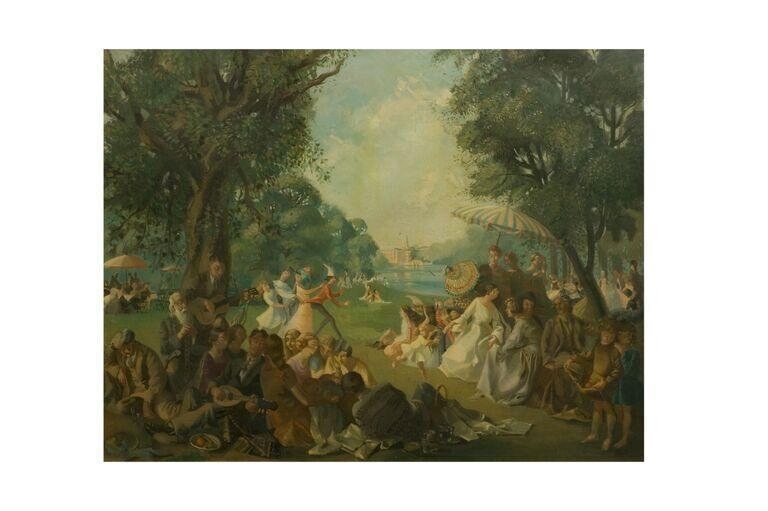
A festive outdoor gathering dominates this composition, with dozens of figures scattered across a sunlit meadow framed by tall trees. The scene unfolds beneath an arcaded structure or pavilion on the right, its geometry suggesting an aristocratic estate or formal garden. The lighting is golden and diffuse, creating an Arcadian atmosphere typical of 18th-century pastoral fantasy. In the middle distance, groups of elegantly dressed figures interact in loose clusters—some seated on the grass, others standing or moving through the space. The figures wear pale, flowing garments, many with the silhouettes of fashionable dress from the early 1700s. A band of musicians or attendants is visible in the shadowed area on the left. The composition is crowded but rhythmic, with the eye drawn from the darker foreground through lighter central passages to the luminous background, where architecture and landscape merge. The mood is one of genteel leisure and celebration—a privileged gathering of the kind that became a staple of Rococo art.
The dancing
The bodies throughout are loosely arranged rather than formally positioned. Limbs are extended with the relaxed grace associated with Rococo aesthetics; several figures recline or sit, while others stand in conversational poses. The nearest figures on the right show women in rounded skirts with raised arms and bent knees—gestures consistent with a light, rhythmic movement. The spacing between groups is generous; there is no sense of tight formations or strict hold patterns. The proportions suggest an artist more concerned with the overall decorative effect than with anatomical precision or the technical detail of a specific dance style.
The dance depicted
This is most likely a depiction of fête galante or pastoral celebration in the manner popular in 18th-century Rococo painting, though the catalogue dates it to 1925. The assembly resembles the idealized garden entertainments of Watteau and his followers, in which aristocratic figures engage in courtship, music, and leisurely movement rather than formal dance. The gestures and groupings suggest social dance—possibly a minuet or country dance—rather than theatrical performance, though no single dance style is precisely recognizable. The painting captures a moment of social movement and celebration rather than a technical choreographic moment.
How it was made
This is an oil painting, as stated in the catalogue. The technique is consistent with early 20th-century representational painting: the brushwork is fluid, the perspective atmospheric, and the color palette warm and muted. The artist has used glazing and soft transitions to create the diffuse light characteristic of the period aesthetic. The scale and finish suggest a work intended for exhibition and sale to an educated middle-class audience familiar with art-historical references to Rococo composition and subject matter.
About this work
Vera Edith Ross's Celebration is a Rococo-revival painting depicting an idealized garden party or festive gathering. Executed in 1925, it demonstrates the persistence of 18th-century pastoral themes in early 20th-century art, particularly among artists drawn to romantic, aristocratic subjects. The work shows figures engaged in social movement and celebration in a luminous outdoor setting, with dress and pose evoking the world of ancien-régime leisure. While not a precise record of any specific dance, it is valuable as evidence of how early 20th-century artists understood and aestheticized historical dance and social movement. The painting sits at the intersection of art-historical pastiche and documentary interest—a response to Rococo precedent filtered through modernist sensibilities.
How to look at it
Attend to the distribution of light and the rhythm of the figures across the composition. The artist has created a sense of festive movement not through dramatic gestures but through the placement of pale-clothed bodies in an illuminated landscape. Notice how the eye is guided through pools of light and shadow, and how the architectural frame on the right provides a counterpoint to the informality of the foreground. The moment chosen is not one of peak dramatic action but of gentle, ongoing social interaction—a celebration as a state of being rather than a climax. Observe how the figures' postures and arm positions echo Rococo conventions without reproducing them with documentary precision; the painting is a meditation on a historical aesthetic rather than an attempt to reconstruct it exactly.
The artist
Vera Edith Ross was an early 20th-century painter working in Britain. Little is recorded of her training or exhibition history in standard references, and the catalogue offers no additional biographical detail. Her choice of subject—the Rococo-revival fête galante—places her within a broader tradition of interwar artists engaged with historical pastiche and decorative art, though her individual practice remains underexplored.
The period
In 1925, modernism and historical revivalism coexisted in uneasy tension. While Cubism, Futurism, and abstract art dominated avant-garde discourse, many artists continued to work in representational modes informed by art-historical study. The Rococo had become a touchstone for discussions of decoration, artifice, and the relationship between nature and culture. Simultaneously, there was renewed interest in 18th-century social history, including courtship rituals and the aesthetics of aristocratic leisure. In dance, the 1920s saw the height of the Ballets Russes, Denishawn modern dance, and continued professional ballet, while social dance underwent rapid transformation with jazz and ballroom innovation. Ross's choice to paint an imagined 18th-century celebration represents a deliberately backward-looking aesthetic, possibly in reaction to the speed and disruption of contemporary culture.
Where it lives
The work is held in a collection marked 'va' in the catalogue record, the meaning and location of which are not specified in the available metadata. It is recorded as an oil painting with no further details on exhibition, publication, or provenance.
Dance in this work
Questions about this work
Is this painting based on a specific historical event or artwork?
No documentary evidence supports a specific source. The painting is in the tradition of fête galante—a genre invented by Watteau and imitated for over a century—and follows conventions of that tradition rather than recording an actual gathering. Rococo revival was popular in early 20th-century art, and Ross is responding to that historical aesthetic.
What dance is being performed?
No single dance style is precisely identifiable. The loose groupings, relaxed postures, and light arm movements suggest social dance in a parkland setting, consistent with 18th-century country dances or minuets, but the artist has not rendered the technical detail or formal structure of a specific choreography. The focus is on celebration and festive movement rather than technical dance.
Why would an artist in 1925 paint an 18th-century scene?
The 1920s saw intense interest in art history and period aesthetics, partly as a response to the disruptions of modernism and the First World War. Historical subjects offered a retreat into elegance and order. Rococo in particular was being revisited by decorative artists and designers. Ross's painting participates in this broader cultural nostalgia and aestheticism.
What does the painting tell us about 18th-century dance?
Very little with precision. It captures the *idea* of 18th-century leisure and social movement as understood and idealized by a 20th-century artist, but it is not a reliable record of dance technique, costume, or structure. It is valuable as evidence of historical taste and aesthetic memory rather than as documentary evidence of past dance practice.
More dance artwork





