49 works in this view — arrow keys or swipe to move between them.
Dance in Art
Dance O' the Wind
Hall, Shirley M.
- Collection:
- photograph
- Source:
- Victoria and Albert Museum
- Rights:
- Rights vary by item — check the source record before reusing this image. Source record ↗
- Recorded as:
- V&A — check rights per item
Dance photographers of this period played a crucial role in disseminating new movement vocabularies and aesthetic ideals; this image shows how photographers used fabric, lighting, and the frozen moment to elevate a single pose into a complete artistic statement. The work is also a record of how mid-century American dancers used their bodies and costumes to convey themes of freedom, nature, and transcendence.
What you are looking at
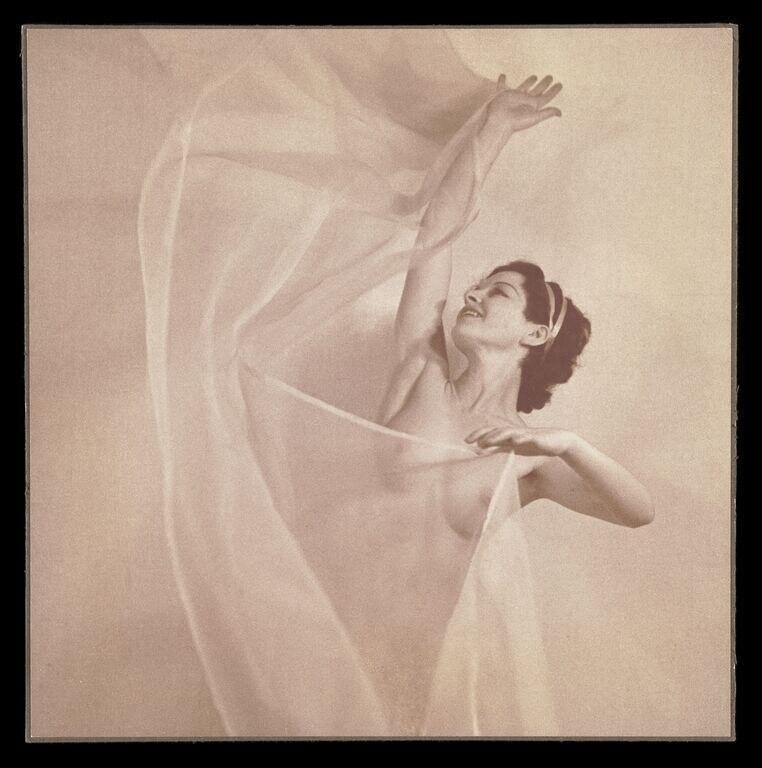
A solitary female figure stands in three-quarter view, her body arched gracefully backward with her left arm extended upward in an expansive gesture. She wears a simple, pale draped garment that falls to her knees, leaving her shoulders bare. Her dark hair is styled close to her head, typical of the 1940s. The composition is dominated by billowing, translucent fabric—a diaphanous shawl or veil—that swirls around her upper body and extends dramatically upward and behind, creating the visual impression of wind or weightless flight. The lighting is soft and ethereal, with subtle gradations creating volume in both the fabric and the figure's musculature. The background is a warm, neutral tone that allows the pale fabric and figure to read clearly. The overall effect is one of liberation and buoyancy, as if the dancer has been caught mid-ascent or mid-spin.
The dancing
The dancer's body displays a striking backward arch from the lower spine, with the torso open to the viewer. Her extended left arm reaches upward and slightly back, fingers relaxed and splayed. The right arm is held closer to the body at approximately shoulder height. Her weight appears to be supported on her legs, which are only partially visible beneath the draped garment. The pose suggests a moment of suspension or the climax of a turning movement. The exposure of the shoulders and the simplicity of the costume emphasize the articulation of the upper body.
The dance depicted
The work depicts a style of theatrical dance common in mid-twentieth-century American modern and interpretive dance. The bare feet, simple draped costume, and the emphasis on flowing, expressive arm gestures point toward the Modern Dance or theatrical contemporary dance movement of the 1930s–1940s. The title "Dance O' the Wind" and the swirling fabric invoke a nature-inspired, lyrical aesthetic. The elongated lines, arched back, and extended reaches are consistent with the vocabulary of theatrical-contemporary or theatrical-ballet seen through an interpretive or expressive lens. Without more specific costume markers or a visible prop, the precise style cannot be narrowly identified, but the movement vocabulary and presentation suggest American modern dance or interpretive dance of this era.
How it was made
This is a photograph, rendered in sepia or warm monochromatic toning typical of mid-twentieth-century studio portraiture. The soft focus and atmospheric lighting suggest the work was taken in a professional studio environment, likely using tungsten lighting or similar controlled sources. The technique allows for a romantic, ethereal quality well suited to dance photography. The medium implies this was likely a promotional or portfolio image, circulated among dance companies, critics, or audiences interested in contemporary dance. The sepia tone and the quality of reproduction suggest this may be a print made from an original negative.
About this work
This photograph captures an American interpretive dancer in a moment of lyrical, wind-inspired movement. The work exemplifies the early-to-mid twentieth-century studio photography tradition of documenting modern and contemporary dance, where the photographer collaborates with the dancer to create a single, idealized moment rather than documenting a stage performance. The billowing fabric and the dancer's extended, arched form convey both the technical facility and the emotional expressiveness valued in theatrical dance of the period. The image belongs in a gallery of dance in art because it documents not only the dancer's body but also a specific aesthetic moment in American dance history—the intersection of photography, modern dance, and commercial or artistic portraiture.
How to look at it
Attend to the suspended quality of the pose: the dancer's arched back and extended arm suggest neither a beginning nor an end, but rather the peak or climax of a movement phrase. Notice how the fabric frames and amplifies the body's line, extending the visual reach of the gesture. The photographer has chosen to freeze the movement at the moment when the body's extension is greatest, creating what amounts to a visual metaphor for weightlessness and freedom. The soft lighting and the neutral background allow the body and fabric to become the sole focus, a compositional choice typical of 1940s dance photography.
The artist
Shirley M. Hall was a photographer working in the mid-twentieth century, documented here as the creator of this dance photograph. Little additional biographical information is currently available in the record, but her work falls within the tradition of American studio dance photography that served both artistic and commercial purposes, creating publicity and portfolio images for dancers and dance companies.
The period
The 1940s saw the consolidation of American Modern Dance as a recognized theatrical form, with figures like Martha Graham, Doris Humphrey, and Charles Weidman establishing schools and companies that taught and performed new movement vocabularies. Simultaneously, dance photography emerged as a significant art form in its own right, with photographers using studio techniques to capture and promote modern dance. The sepia tone and studio aesthetic of this image place it squarely within that tradition. The war years (the photograph is dated 1941) saw American culture turning inward and emphasizing home-grown artistic forms; modern dance benefited from this cultural moment.
Where it lives
The photograph is held in the Virginia collection (indicated by source code 'va' in the record). It is catalogued as a photograph and dated 1941. No information is currently recorded regarding the original negative, print status, or circulation history.
Dance in this work
Questions about this work
What is the fabric swirling around the dancer?
It appears to be a sheer, lightweight shawl or veil, possibly silk or gauze. In studio dance photography of this era, such props were used to amplify and visualize the dancer's movement, making the trajectory of the gesture visible and ethereal. The fabric catches light and air, creating the visual impression of wind or weightlessness.
Is this a stage photograph or a studio portrait?
This is a studio portrait, not a documentation of a stage performance. The controlled lighting, neutral background, and the careful pose indicate that the photograph was created in collaboration between photographer and dancer in a studio setting. Such images were used for publicity, portfolio building, and artistic promotion.
What kind of dance is this?
Based on the costume, the movement vocabulary, and the aesthetic, this is most likely American Modern Dance or theatrical interpretive dance from the 1940s. The bare feet, simple draped costume, and emphasis on expressive arm gestures are characteristic of this tradition.
Why is the image toned in sepia?
Sepia toning was a standard practice in mid-twentieth-century photography, both for preservation and aesthetic purposes. The warm tone creates an archival, nostalgic quality and was believed to enhance the longevity of the print. It was also considered aesthetically flattering for portraiture, particularly in dance and theatrical contexts.
More dance artwork





