49 works in this view — arrow keys or swipe to move between them.
Dance in Art
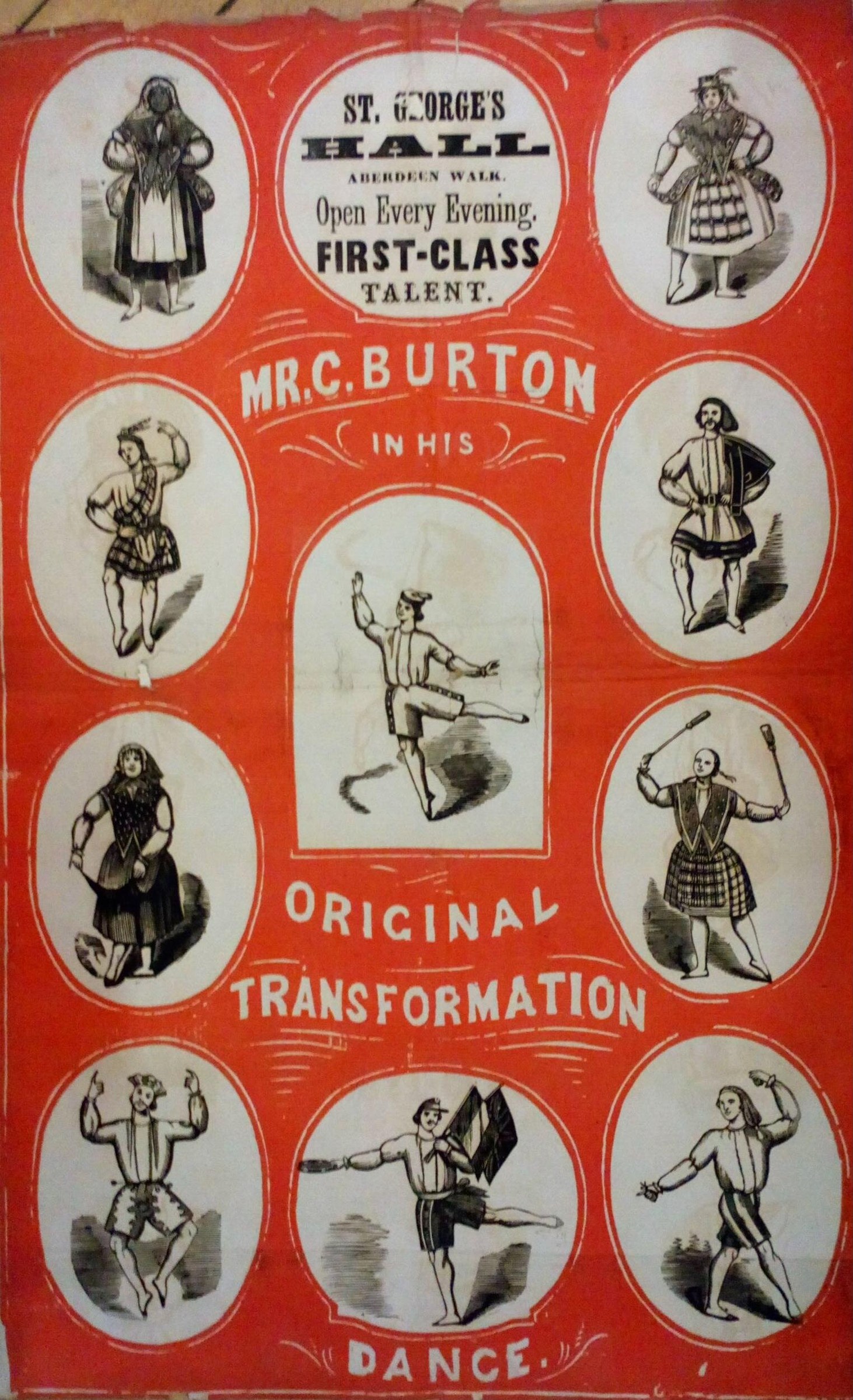
Mr. C. Burton in His Original Transformation Dance
Unknown
- Collection:
- Poster
- Source:
- Victoria and Albert Museum
- Rights:
- Rights vary by item — check the source record before reusing this image. Source record ↗
- Recorded as:
- V&A — check rights per item
Transformation dances were a major popular entertainment in the Victorian music hall, yet they have largely disappeared from dance history because they do not fit the categories of ballet, ballroom, or folk dance. This poster is direct evidence of how one performer marketed extreme flexibility and rapid character changes as a dance spectacle. It shows what Victorian audiences paid to see and what performers trained their bodies to accomplish.
What you are looking at
A vibrant red poster advertising an evening performance at St. George's Hall in Aberdeen Walk, featuring Mr. C. Burton executing a series of transformation movements. The composition arranges twelve oval vignettes around a central scene: ten smaller ovals frame individual figures in various costumes and poses around the border, while a larger oval at the center shows a male dancer in a dramatic split or leap. The surrounding figures progress through different theatrical personas—women in long dresses with bonnets, men in kilts, figures in classical or acrobatic poses—suggesting rapid costume changes or metamorphoses. The poster's typography announces "First-Class Talent" and emphasizes the "Original Transformation Dance." All figures are rendered as detailed engravings against the crimson ground, creating a dynamic sense of motion and variety.
The dancing
The central male figure executes an extreme split leap with arms outstretched, demonstrating significant flexibility and dramatic extension. The surrounding figures show varied poses: some standing in formal dress, others in stylized acrobatic or contorted positions. Multiple figures display raised arms, extended legs, and theatrical stances. The postures suggest the dancer moved rapidly between distinct shapes and characters rather than maintaining a single line of movement. The composition emphasizes the body's capacity for extreme range rather than balletic line or hold.
The dance depicted
This is a transformation dance, a Victorian music-hall specialty in which a single performer rapidly changed costume and character before an audience. C. Burton was a professional performer in this genre, which combined elements of acrobatics, pantomime, and dance. The vignettes depict the sequence of characters or 'transformations' he performed in a single act—peasant women, soldiers in kilts, classical figures, and acrobats. The style belongs to theatrical variety and music-hall entertainment rather than classical dance forms, emphasizing spectacle, flexibility, and the surprise of rapid metamorphosis.
How it was made
This is a chromolithographed poster, evidenced by the bold flat color (red ground with black and white engraved figures) and the printing technique visible in the registration and surface. The use of oval vignettes was a standard compositional device for advertising theatrical acts, allowing the advertiser to show multiple moments or transformations within a single image. Chromolithography made such color posters affordable for mass distribution in music halls and on London streets, reaching a working-class and middle-class audience. The combination of engraved detail work with chromolithic color printing was typical of 1850s–1860s theatrical advertising.
About this work
This poster documents a performance style that dominated Victorian music halls: the transformation dance, in which a single male performer executed rapid changes of costume, character, and pose to astonish and entertain audiences. The genre was a hybrid of dance, acrobatics, and pantomime, demanding extreme flexibility and dramatic timing rather than technical precision in balletic movement. C. Burton was one of several professional transformation dancers who toured British theatres in the 1850s–1870s, and this poster preserves both the visual spectacle of the act and the commercial apparatus by which it was advertised. The work matters because it documents a now-obscure but once-popular performance mode that blended dance with athleticism and theatrical illusion in ways that contemporary ballet history often overlooks.
How to look at it
Examine the central figure's extreme flexibility and the variety of poses arrayed around it: the poster is not depicting a single unified movement but a sequence of distinct, surprising transformations. Notice how the surrounding ovals progress through different characters and costumes, suggesting the act unfolded as a series of rapid reveals. The theatrical emphasis is on surprise and contrast rather than grace or continuity—each oval invites the viewer to imagine the moment of unveiling and metamorphosis. The degree of acrobatic extension shown (the central split-leap, the contorted poses) reveals what Victorian performers trained their bodies to do.
The artist
The artist is unknown, as is standard for theatrical posters of this period. The work was likely designed by a staff designer or lithographer employed by the printer, whose name may not appear on the stone. The style is typical of mid-Victorian music-hall advertising, where clarity, bold color, and multiple vignettes were used to convey the variety and spectacle of the entertainment on offer.
The period
The transformation dance flourished in British and European music halls during the 1850s–1870s, a period when variety entertainment was the dominant popular theatre form. This era preceded the Music Hall Act of 1899 and predates the dominance of musical comedy. Dance in this context was primarily a feature of music hall, circus, and pantomime rather than the ballroom or the ballet theatre. The poster's aesthetic—chromolithography, the oval vignette format, and the emphasis on novelty and transformation—reflects the commercial and visual culture of Victorian popular entertainment.
Where it lives
Listed in the holding as a poster from an unspecified Virginia collection, dated 1858. The object type is theatrical advertising material, part of the ephemeral print culture of Victorian music halls.
Dance in this work
Questions about this work
What is a transformation dance?
A transformation dance was a music-hall specialty in which a single performer rapidly changed costume and character before the audience, often incorporating acrobatic feats and pantomime. The appeal lay in the speed and surprise of the changes, and in the performer's physical extremes. C. Burton and other transformation dancers were stars of Victorian variety theatres.
Was this a real performance, and did C. Burton really perform these acts?
Yes. Transformation dancers were documented professional performers in British and European music halls from the 1840s onward. This poster is advertising evidence that C. Burton performed at St. George's Hall in Aberdeen Walk in 1858. The acts were real, though the vignettes on the poster stylize and compress the sequence for visual impact.
Why don't we hear about transformation dances in dance history?
Transformation dances were a music-hall form, and music-hall dance was historically marginalized by ballet scholarship and theatre history. The genre required athletic flexibility and rapid comic timing rather than the balletic technique that became the standard measure of 'serious' dance. As a result, transformation dancers and their aesthetics were largely erased from the historical record.
How does this poster work as advertising?
The poster uses multiple vignettes to convey variety and spectacle without requiring viewers to read extensive text. The bold red ground and the oval frames make it eye-catching and memorable. The promise is 'First-Class Talent' and continuous astonishment—'Open Every Evening.' This visual strategy was typical of mid-Victorian theatrical marketing.
More dance artwork





