49 works in this view — arrow keys or swipe to move between them.
Dance in Art
Monsieur Jourdain's Dancing Lesson: Molière, <i>Le Bourgeois Gentilhomme</i>, Act II, Scene 1
Frith, William Powell
- Collection:
- Oil painting
- Source:
- Victoria and Albert Museum
- Rights:
- Rights vary by item — check the source record before reusing this image. Source record ↗
- Recorded as:
- V&A — check rights per item
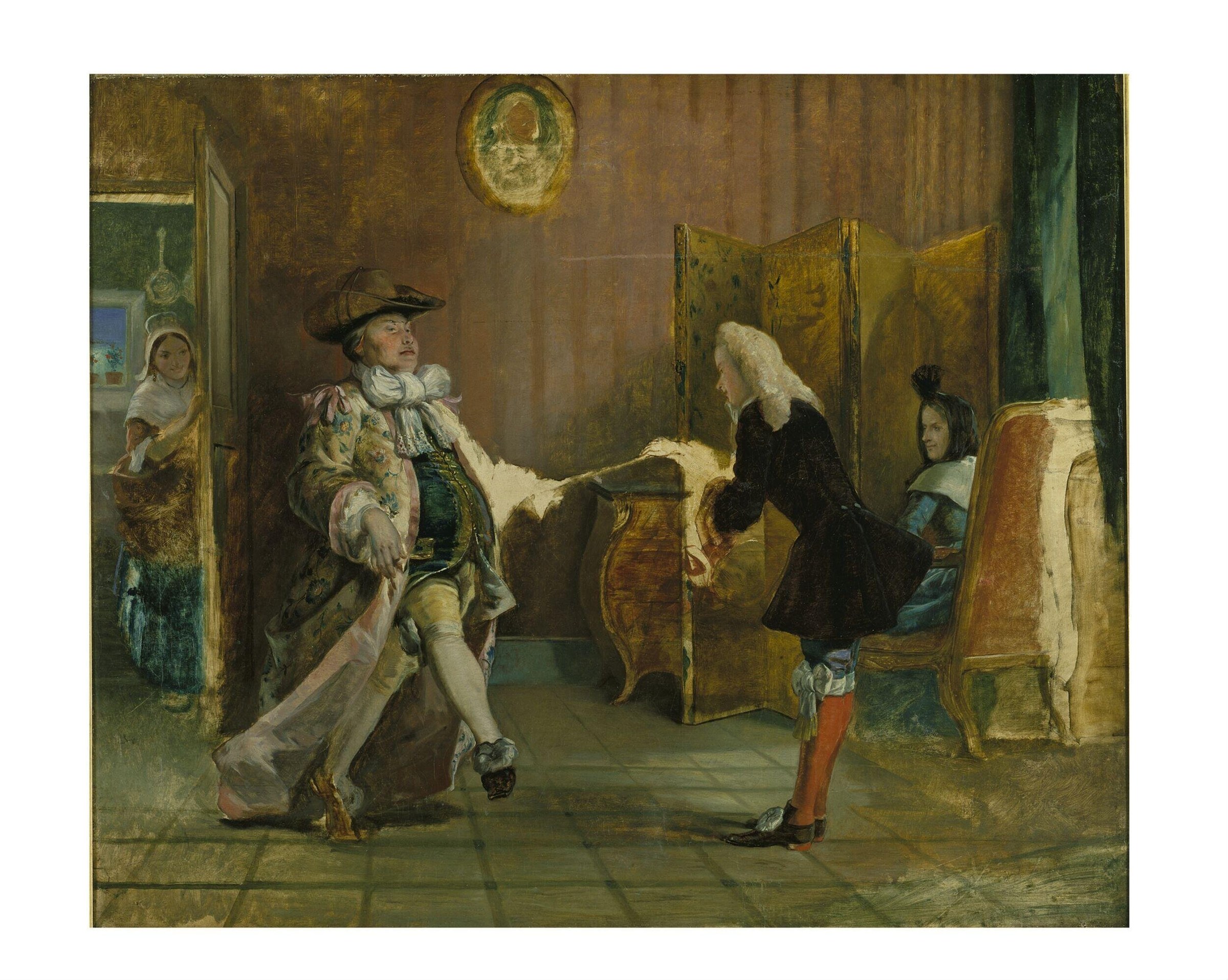
The painting preserves the physical vocabulary of 17th-century court dance instruction and deportment as understood by a 19th-century audience—not as authentic recreation but as a readable theatrical convention. It demonstrates how dance was learned, taught, and valued as a marker of social status in the ancien régime, and how that system remained culturally intelligible and mockable two centuries later.
What you are looking at
A elegantly dressed man in a feathered tricorn hat and embroidered coat takes a dancing lesson from an older woman wearing widow's cap and black dress in a shabby, austere interior. The man stands in an exaggerated posture, one arm extended with a flourish, his body twisted in an affected manner that suggests both vanity and comic incompetence. The woman gestures with one hand as if instructing him, while two younger figures watch from the right—a boy in red breeches and a girl at a small table. A folding screen of worn gilt paper and a portrait medallion on the ochre wall establish the interior as modest, neither grand nor comfortable. The light falls unevenly across the figures, emphasizing the contrast between the man's elaborate dress and the room's decay. This is a moment of ridicule caught mid-movement: the would-be gentleman is being taught, but his posture and the onlookers' stance suggest he is being mocked.
The dancing
The dancing master stands with his weight on one leg, the other extended behind or to the side in an affected pose, his upper body twisted and one arm raised with exaggerated grace. His frame is entirely open and artificial, displaying the mannerisms of courtly dance rather than any naturalistic movement. The older woman instructor gestures with an open hand, her posture upright and authoritative despite her plainness. The two children observe intently from behind a screen and chair, their positioning creating a secondary audience that emphasizes the pedagogical nature of the scene.
The dance depicted
This depicts a dance lesson of the French court tradition, specifically a minuet or other courtly baroque dance, as evidenced by the affected posture, the use of formal instruction with gesture, and the elaborate costume of the pupil. The scene illustrates the teaching of deportment and movement as practiced in 17th and 18th-century aristocratic circles—a fundamental element of the socialization of nobility. The comic intent of the composition (the pupil's exaggerated vanity, his clumsiness implied by his strained posture, the instructress's plain appearance) suggests this is a theatrical or literary moment rather than a serious lesson, likely from Molière's *Le Bourgeois Gentilhomme*, in which a merchant aspires to courtly manners and hires a dancing master.
How it was made
The work is executed in oil on canvas, employing a warm, muted palette of browns and ochres that unifies the interior and suggests age and decay. The paint handling is careful and detailed in the costumes and faces but looser in the background, creating atmospheric depth. The controlled composition, with figures positioned at different depths and the careful use of light to direct attention, is characteristic of narrative or theatrical painting of the 19th century. This technique of detailed oil painting allowed Frith to create a readable narrative scene suitable for exhibition and engraving reproduction.
About this work
Frith's painting illustrates a famous scene from Molière's 1670 comedy *Le Bourgeois Gentilhomme* in which Monsieur Jourdain, a wealthy merchant with social pretensions, receives a dancing lesson from a professional master. The work belongs to the 19th-century tradition of literary and theatrical painting, in which artists provided visual interpretations of canonical literary moments. The composition captures not the execution of a dance but the teaching of it—the master's authoritative gesture, the pupil's absurd straining for elegance, and the onlookers' detached observation all work together to render Molière's satire of social climbing and false refinement visible. In the context of dance in art, the painting documents the pedagogical methods and aesthetic ideals of baroque court dance while also exposing them to ridicule through comic exaggeration.
How to look at it
Attend to the precision of the man's posture and the particular angle of his limbs—Frith has captured a specific moment in a lesson, not a completed step or graceful pose, emphasizing the strain and artificiality of courtly deportment. Notice how the woman's calm authority, the children's composed observation, and the threadbare room all work together to undercut the man's pretensions; the comedy lies partly in how the painting refuses to grant him the elegance he is laboring to achieve. The formal vocabulary of baroque dance—the turned-out legs, the raised arm, the twisted torso—is rendered visible but also ridiculous through context and composition.
The artist
William Powell Frith (1819–1909) was one of the most successful and prolific English painters of the Victorian era, celebrated for his large-scale narrative paintings depicting scenes from literature, history, and contemporary life. He was elected Royal Academician in 1853 and specialized in detailed, anecdotal compositions with multiple figures and careful attention to costume and historical setting. His work often carried a moralistic or satirical edge and was extremely popular with the exhibition-going public and with art dealers, as his paintings were frequently engraved for mass circulation.
The period
The 1840s saw a vigorous revival of interest in 17th-century French comedy and literature among English artists and writers. Molière's works, in particular, were celebrated as masterpieces of character observation and wit, and literary painting—the visual representation of canonical scenes from literature—was at the height of its prestige in Victorian art academies. At the same time, ballet was undergoing a Romantic transformation, moving away from the ballroom dances and courtly traditions that had dominated earlier centuries; Frith's painting documents an older, courtly system of dance as historical artifact rather than living practice. The choice to depict a moment of instruction rather than performance reflects a broader Victorian interest in the mechanisms of education and social formation.
Where it lives
The work is recorded as an oil painting in an unnamed collection, with attribution to William Powell Frith and a date of 1840. The catalogue record does not provide current location or accession information.
Dance in this work
Questions about this work
Is this Frith's only painting of this scene?
The catalogue record provided documents this single work. Frith painted scenes from literature throughout his career, and may have revisited theatrical subjects, but we cannot confirm from the information available here.
What is Monsieur Jourdain's dancing lesson in Molière's play?
In *Le Bourgeois Gentilhomme* (The Would-Be Gentleman), Jourdain hires a dancing master, along with a music master and fencing master, to acquire the refinements he believes he lacks. The lesson scene is one of the play's principal opportunities for satire: Jourdain's earnest effort to become genteel, combined with his obvious unsuitability for it, exposes the artificiality of courtly manners and the vanity of social aspiration.
What kind of dance was being taught in the 17th century?
The dance of Molière's era and the French court was based on baroque conventions: turned-out legs, raised arms, a formal frame, and small precise steps. Minuet and courante were among the most valued dances of the period. These dances were taught systematically and were considered essential to the education of a gentleman or noblewoman.
Why did Frith paint this scene in 1840?
Literary painting was at its height in Victorian England, and Molière was widely admired and frequently illustrated by artists. The scene of instruction also appealed to 19th-century interest in pedagogical and social themes. The comedy of the scene—a man straining ludicrously to acquire refinement—would have been immediately comprehensible and entertaining to exhibition viewers.
More dance artwork





