49 works in this view — arrow keys or swipe to move between them.
Dance in Art
Orpheus Singing and Dreaming
Dimou, Fotini
- Collection:
- Dance costume
- Source:
- Victoria and Albert Museum
- Rights:
- Rights vary by item — check the source record before reusing this image. Source record ↗
- Recorded as:
- V&A — check rights per item
This work documents a Greek choreographer's engagement with classical mythology during the 1990s, a period when many European contemporary dance makers were returning to ancient narratives. More significantly, it demonstrates how dance historians and artists can recover performance through the material evidence of costume—the creases and folds become a text of movement and embodiment that survives long after the performance itself.
What you are looking at
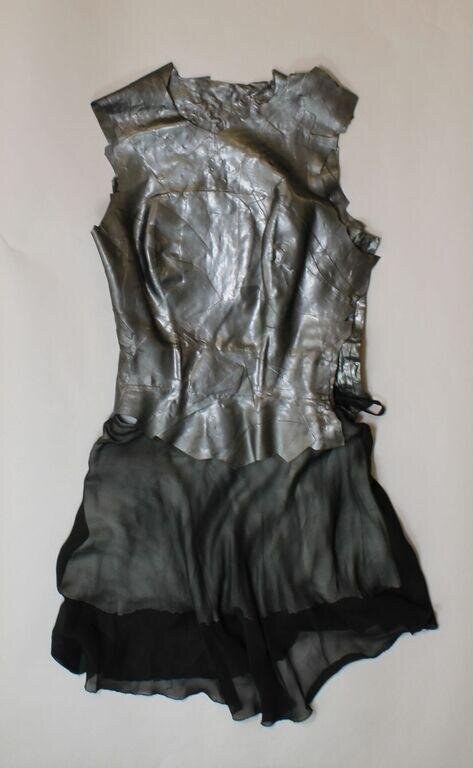
A crumpled, translucent costume lies flat against a neutral background, photographed from above. The garment consists of two distinct sections: an upper portion of silvery, iridescent fabric heavily creased and folded, suggesting movement or distress, and a lower section of dark charcoal or black material with softer, more organic folds. The upper metallic section dominates the composition, its surface catching light unevenly to reveal deep shadows within the creases. The fabric appears gossamer-thin and delicate, almost tissue-like in places. No body is present; the costume exists only as material evidence of wear and use.
The dancing
There is no dancer present in this image. The costume is photographed as a flat, sculptural object, its folds and creases suggesting a body that has worn and moved within it. The upper garment's aggressive wrinkling implies vigorous physical activity—spinning, falling, or passionate gesture. The contrast between the reflective upper section and the matte lower section suggests movement through different planes, with the metallic material catching light as the wearer moved.
The dance depicted
The costume's construction—a sleeveless upper shell with what appear to be shoulder seams and arm holes—suggests a theatrical dance costume for a principal or solo role. The gossamer quality and metallic sheen of the upper section evoke Romantic-era ballet aesthetics, particularly tragic or mythological roles. Given the title *Orpheus Singing and Dreaming* and the costume's sculptural decay, this appears to document the costume of a male dancer performing Orpheus, the mythological figure whose lyre-playing and voice enchanted all who heard him. The darkness of the lower garment and the ethereal quality of the upper suggest a costume designed to convey otherworldliness and pathos.
How it was made
This is a photograph of a three-dimensional textile object rather than a traditional performance documentation. The overhead, high-contrast lighting emphasizes texture and form, transforming the costume into abstract sculptural material. The photograph itself appears to be archival in intent—the neutral background and technical framing treat the garment as a historical artifact to be preserved and examined. The medium allows the viewer to read the physical evidence of performance in the fabric's wear: creasing that records the dancer's movements and bodily presence.
About this work
This is a photographic document of a theatrical dance costume from Fotini Dimou's 1996 work *Orpheus Singing and Dreaming*. Rather than capturing performance in action, it records the costume as a three-dimensional object and material archive, preserving the evidence of a dancer's body and movement written into the fabric itself. The work sits at the intersection of costume history, conceptual art, and dance documentation, treating the garment as both functional stage object and poetic artifact. For viewers interested in contemporary approaches to dance and the body, it represents how performance itself can be made visible through the material traces it leaves behind.
How to look at it
Look first at the creasing pattern in the metallic upper section: those folds and wrinkles are not random but rather the physical record of a body that moved within the costume. Trace the deepest shadows to imagine where the dancer's shoulders, arms, and torso pressed and twisted. Notice the sharp contrast between the chaotic upper section and the more settled, organic folds of the lower garment—this suggests different intensities of movement or different functions (perhaps the lower is more supportive, the upper more free). The photograph's flat, overhead perspective transforms the costume into a kind of two-dimensional index or signature of performance.
The artist
Fotini Dimou is a Greek choreographer and visual artist whose practice often bridges performance and visual documentation. The 1996 date places her within the 1990s contemporary dance context, when European experimental choreography frequently engaged with mythology, abstraction, and unconventional forms of notation and preservation. Her choice to preserve and photograph the costume as an autonomous object suggests an interest in how materials and traces record the ephemeral act of dance.
The period
In 1996, contemporary dance was increasingly self-reflexive about documentation and the problem of recording ephemeral performance. Video had become standard in dance, yet many choreographers remained interested in photography, costume, and other material traces as alternative archives. Simultaneously, conceptual art practices of the 1990s frequently engaged with everyday objects and materials as carriers of meaning and history. This costume photograph sits within that broader moment of interest in how objects hold memory and presence.
Where it lives
This work is held as a dance costume in a collection designated 'va' in the catalogue system, indicating it is preserved as material evidence of a theatrical production. The photograph itself is the archival form in which we encounter it; the original costume, if still extant, exists separately.
Dance in this work
Questions about this work
Is this a photograph of a real costume worn in performance?
Yes. This costume was worn by a dancer in Fotini Dimou's 1996 work *Orpheus Singing and Dreaming*. The creasing and wear visible in the fabric are evidence of that performance. The photograph captures the costume after use, treating it as an artifact.
Why is the costume photographed flat and not on a dress form or mannequin?
Laying the costume flat emphasizes its own form and the traces of movement within its fabric. This approach is common in costume archiving and also in contemporary art practice, where it treats the garment as a sculptural or indexical object rather than simply documenting its appearance when worn.
What does the title 'Orpheus Singing and Dreaming' tell us about the choreography?
Orpheus is a mythological figure associated with music, loss, and transcendence—themes that would naturally translate into contemporary dance language. The costume's ethereal, translucent upper section and its state of apparent distress or dissolution suggest a work exploring the emotional and spiritual dimensions of the myth rather than its narrative surface.
More dance artwork





